
Leonardo DiCaprio is a representative of Generation X, but one who—perhaps because of his roles and a career that began very early—has been embraced with affection by millennials and Generation Z. Naturally, in the way that has become most common: through memes.
For more than a decade, anyone who spends time on social media or keeps in touch with friends has certainly come across a sticker, a GIF, or a meme of the actor. He did not occupy this space by trying to be funny, nor by offering himself to the game of self-parody, but because his face, his reactions, and his silences came to function as collective codes. At some point in the last decade, Leo stopped being merely an acclaimed actor and became a bank of emotional images: surprise, irony, disbelief, restrained celebration, polite embarrassment. All of that fits into a single frame of him.
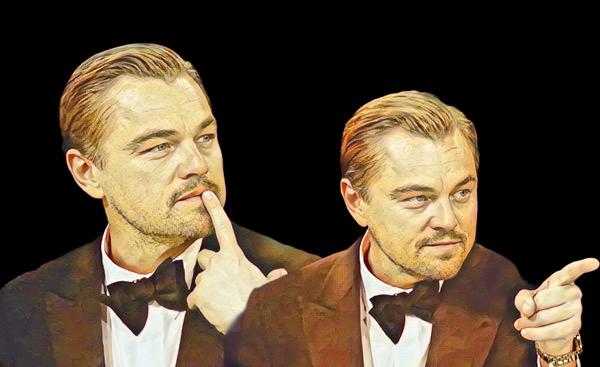
Perhaps the turning point was The Wolf of Wall Street, followed by The Great Gatsby: the toast with the glass, the lopsided smile, the look of someone who knows exactly what he is doing and, at the same time, seems to enjoy his own caricature. From then on, digital culture began to treat him as a visual shortcut for certain states of mind: “this calls for a toast,” “I told you so,” “look at me pretending to be normal.” Then came the Oscar for The Revenant, and with it the meme that turned the victory into collective catharsis. It was not just an actor finally being rewarded; it was a symbolic character of the internet receiving the ending that the internet itself had written for him.
What is curious is that DiCaprio has never been exactly performative off-screen. He does not cultivate a meme persona, does not provoke his own myth, and does not rely on self-parody as a communication strategy. On the contrary, he has always seemed uncomfortable with the logic of permanent spectacle. His public gestures are restrained, his interviews rare, his humor dry. So much so that at the 2026 Golden Globes, host Nikki Glaser made another joke about the youth of his girlfriends and then apologized, arguing that he shares so little of himself that only what little is known remains—including the memes. And yet it is precisely this restraint that makes him so “legible” to the culture of the cut. A half-smile becomes irony. A raised eyebrow becomes judgment. A toast becomes a symbol.
Over time, Leo has shown awareness of this phenomenon. At events, on red carpets, at ceremonies, he has become visibly more careful with his reactions. His body leans inward, the gesture shrinks, his hand often rises to his face, covering his mouth as he speaks or laughs. It is not paranoia: it is the perception that any second taken out of context can become public language. He knows he lives under the logic of the frame. And, in his own way, he tries to escape it.
That is precisely why the so-called “K-pop thing” at the 2026 Golden Globes gained the force it did. Because, in that brief commercial break, this vigilance seems to have failed. A short, silent video shows DiCaprio gesturing, animated, apparently telling a story to someone outside the frame. He tries to cover his mouth, tries to speak softly, tries to reduce the field of legibility—and still the scene escapes. In minutes, it is on social media. In hours, it becomes an enigma. What did he say? To whom? Was he being ironic? Was he praising something? Was he simply commenting on a moment from the ceremony? No one knows for sure. And perhaps that is what is most fascinating.
The internet, which had already turned DiCaprio into a reaction, now turned him into a mystery. Came the bets, the amateur lip-reading, the theories about whom he was speaking to, the interpretations of tone—whether it was an inside joke, a generational comment, a slightly offhand observation about the K-pop universe that dominated part of the night. There were also the criticisms, as always: accusations of condescension, of “disconnection,” of supposed irony toward something that does not culturally belong to him. And, of course, the jokes, the memes about the actor who tries to escape memes and ends up producing yet another one.
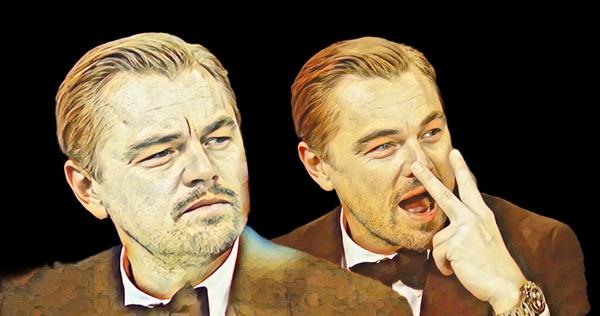
What I read—yes, you can “read” it—is that he was joking with someone nearby at the same table. Some bet on Chase Infiniti, who plays his daughter in One Battle After Another and is known to be a K-pop fan. It makes sense, because he seems to say something like: “I was watching you during the ‘K-pop thing’… is it him or is it K-pop? Oh, it’s you,” and then starts to laugh. He repeats the line, applauding and pointing toward another table—probably where the cast of K-pop Demon Hunters was sitting—until he is interrupted to sign an autograph.
But there is something deeper in this scene than the anecdote. The “K-pop thing” did not go viral merely because it was funny or curious. It went viral because it exposes DiCaprio’s central paradox in contemporary culture: he is, at once, one of the last great actors of classic Hollywood prestige and a figure completely absorbed by digital logic. His image no longer belongs only to him, nor only to the films he makes. It belongs to the collective repertoire of reactions, ironies, and internet codes.
And perhaps that is why his memes never sound like simple mockery. There is in them a layer of admiration, of cultural complicity. We laugh with him, not only at him. We recognize in his gestures something of ourselves: the contained irony, the corner-of-the-mouth comment, the look that says more than the entire sentence. When DiCaprio becomes a meme, it is not because he has become too small for his own greatness, but because his image has become too large to fit only in cinema.
In the end, the “K-pop thing” is not an image misstep. It is the confirmation of a process that was already underway. Even when he tries to protect himself, even when he covers his mouth, even when he speaks off-mic, Leonardo DiCaprio remains a public lfigure His silences are interpreted. His gestures are captioned. His expressions are shared. He is an actor who has become, involuntarily, a visual dictionary of the digital age.
And perhaps there is no greater—or more contemporary—irony than this: an artist obsessed with controlling his own image, famous for meticulously constructed performances, transformed into raw material for a culture of improvisation, cropping, and memes. In today’s world, even those who try not to go viral end up, at some point, saying something that the internet decides to keep. Even if no one ever discovers exactly what was said.
Descubra mais sobre
Assine para receber nossas notícias mais recentes por e-mail.
 miscelana.com