
Everyone thinks they want to be part of something that captivates the world, that brings recognition, fortune, and praise. To belong to a phenomenon and stand out within it, of course. Or so it seems. Because phenomena do not end when the screen fades to black. They continue as a shadow, as automatic comparison, as a filter through which everything that comes after will be read.
Game of Thrones was not just a successful series: it was a generational experience, a cultural event that reshaped how television was produced, consumed, and discussed. For its actors, that meant something both extraordinary and deeply ambivalent: unprecedented global visibility and, at the same time, a kind of symbolic imprisonment. There is no manual for “after a phenomenon.” And few have embodied that dilemma as clearly as Kit Harington, Sophie Turner, and Emilia Clarke.

The three of them grew up, matured, and became icons within Westeros. And all three have spent the years since trying — with visible effort, deliberate choices, and increasingly candid public statements — to prove that they are more than Jon Snow, Sansa Stark, and Daenerys Targaryen. Not always successfully. Not because of a lack of talent, but because the sheer scale of Game of Thrones transformed their characters into myths that are almost impossible to dismantle.
There is something profoundly unfair in the way audiences demand immediate reinvention from people whose lives were shaped for nearly a decade by a single role. At the same time, there is something structurally real about it: when a character becomes bigger than the person who plays them, everything that comes after exists in direct comparison, never on its own terms. It is in that space — between gratitude and exhaustion, between love and resentment, between public identity and the desire for autonomy — that the post-GOT trajectories of Kit, Sophie, and Emilia are being written.
Kit Harington: the hero who could not put down the armor
Kit Harington has always spoken about Jon Snow as if he were speaking about a part of his own body. A role that launched him to global stardom, but also one that consumed him. In interviews after the end of the series, he became progressively more open about the emotional cost of that journey. He said the finale was “extremely traumatic,” that he felt an emptiness he could hardly explain once filming ended, and that the intensity of the pressure — the responsibility of carrying a central character, of embodying a moral hero in such a widely scrutinized narrative — directly affected his mental health.
It was no coincidence that, just weeks after the final episode aired, news broke that he had voluntarily entered a rehabilitation clinic, dealing with stress, anxiety, and alcohol abuse. Instead of a polished statement, there was a respectful silence — and later, the acknowledgment that the end of Game of Thrones had not been merely a professional milestone, but a personal collapse. Harington himself has admitted that the series, while giving him everything, left him without a clear sense of who he was outside of it.
His subsequent projects seemed deliberately aimed at breaking away from the noble-hero archetype. In Gunpowder, he leaned into a morally ambiguous historical figure, almost an anti-Jon. On the London stage, in True West, he chose raw, physical, psychologically demanding theater, as if he needed to reconnect with acting in its most stripped-down form. On film, choices such as Pompeii, Brimstone, and even the Marvel blockbuster Eternals revealed an actor searching for new registers, yet still trapped in a kind of leading-man mold that audiences instinctively read as an extension of Jon Snow.

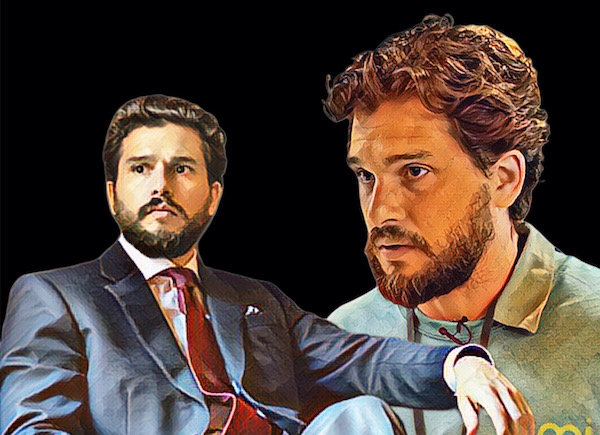

Notably, Harington has been one of the few to speak openly about the burden of carrying a “moral” character. He has said more than once that he felt responsible for how Jon was received, that he internalized criticism of the character’s ending, and that the conclusion of GOT left him emotionally drained. He even revealed that he and other cast members cried together when they read the script for the final episode — not only because of the story, but because they knew that that world, and that version of themselves, was ending.
His personal life also remained entwined with the series: he married Rose Leslie, who played Ygritte. For many fans, the union reinforced the sense that Westeros was never truly left behind. For him, perhaps it was a way to find continuity amid collapse. Still, his post-GOT years have been marked by something rare in celebrity narratives: public vulnerability. He did not sell a story of easy rebirth. He admitted that he still struggles to exist outside the shadow of the character. The hero survived the series, but the actor is still learning how to live without the armor.
Sophie Turner: growing up under the spotlight and negotiating identity
If Kit needed to shed a hero, Sophie Turner needed to discover who she was beyond a character that accompanied her from adolescence into adulthood. Sansa Stark’s arc was one of the most complex in the series: from naïve girl to cold strategist, from victim to survivor. For Sophie, that meant growing up in public, learning the craft while the world watched, and at the same time internalizing criticism that went far beyond the work itself.
She has spoken repeatedly about how the pressure of exposure, the obsession with her appearance, and the constant commentary on her body affected her mental health. She revealed struggles with depression, eating disorders, and a deeply conflicted relationship with her own image — intensified by the fact that, on Game of Thrones, every physical change was discussed as if it were part of a cultural product. The character matured; the audience judged the actress’s body.
After the series ended, Sophie seemed to consciously seek paths that distanced her from medieval fantasy and prestige drama. Her most visible role was the X-Men franchise, where she played Jean Grey. But the lukewarm reception of Dark Phoenix became a cruel symbol of the challenge she faced: her first major post-GOT project was framed as a misstep rather than as a legitimate transition. In interviews, she did not hide her frustration with how the film was treated, nor with the way criticism of the script and production often landed on her performance.
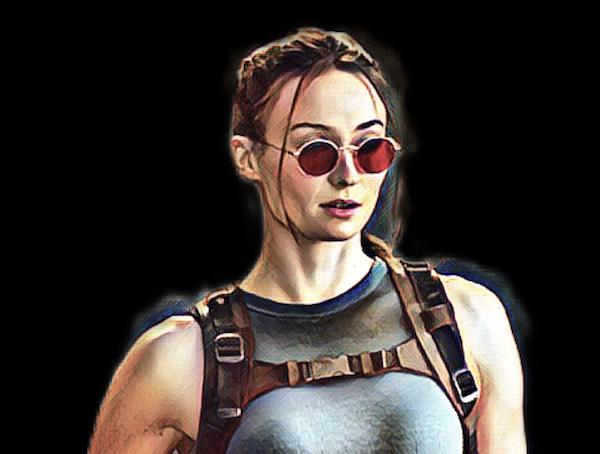

Sophie, however, has never seemed interested in replaying Sansa’s arc in another costume. Projects such as Survive, The Staircase, and more recent, intimate productions suggest a search for vulnerable, imperfect, human characters — almost an antidote to the cold strength Sansa ultimately came to represent. She herself has said that she had to relearn how to enjoy acting after years of associating the job with almost unbearable pressure.
Her personal life, brutally exposed in recent years, became another arena where the legacy of GOT seemed to follow her. Her marriage and subsequent separation from Joe Jonas were treated as a public spectacle, with polarized narratives, hasty judgments, and a constant framing of her image as “heroine” or “villain” — an unsettling echo of the moral readings applied to Sansa throughout the series. In recent interviews, Sophie has spoken about the importance of protecting her mental health, of rebuilding her identity outside of characters and headlines, and of refusing to prove anything to those who froze her in the teenage version they met in Westeros.
Perhaps among the three, she is the one who most explicitly recognizes that stepping out of Game of Thrones’ shadow is not merely a matter of roles, but of personal reconstruction. It is not just about career, but about who you are when the character that shaped your youth no longer exists.
Emilia Clarke: between myth and a fragile body
Emilia Clarke embodied, in Daenerys Targaryen, one of the most iconic figures of twenty-first-century pop culture. The “Mother of Dragons” was not simply a protagonist: she became a symbol of female power, liberation, political fantasy, idealism, and ultimately tragedy. For millions of viewers, Daenerys was not just a character, but a vessel for emotional and moral expectations. And for Clarke, that carried a physical and psychological cost that only later became public.
After the series ended, Emilia revealed that during the early seasons of GOT, she had suffered two potentially fatal brain aneurysms. Between surgeries, temporary loss of speech, fear of death, and returning to set, she built the public image of an indestructible heroine while, behind the scenes, she was fighting to survive. This revelation, years later, radically reframed her journey: she was not only an actress dealing with the pressure of a phenomenon, but someone literally filming epic scenes while her body was failing.
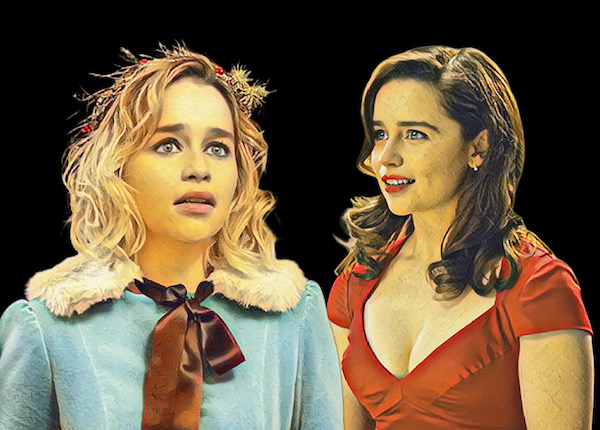
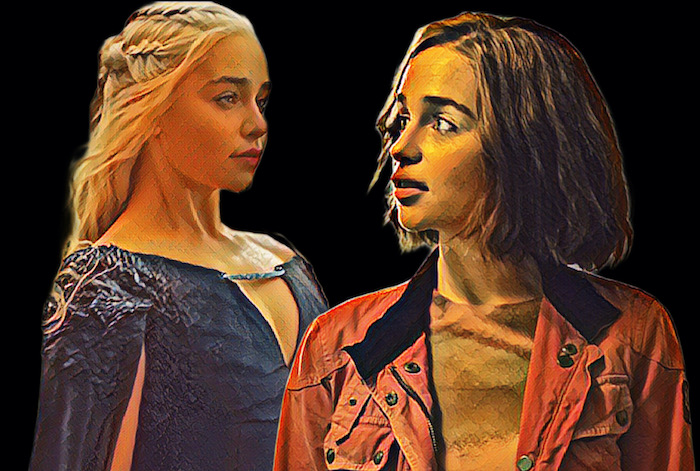
Emilia has always spoken of Daenerys with affection, but also with a kind of mourning. She said she was deeply shaken by the reaction to the character’s ending, that she understood fans’ frustration, but that it affected her personally. Not only because the story took a controversial turn, but because Daenerys had been, for nearly a decade, an emotional anchor amid health crises and uncertainty. When the series ended — and with a fate that divided audiences — Clarke lost not just a role, but a part of her own survival narrative.
Her subsequent projects show a conscious attempt to escape the “epic queen” archetype. In Me Before You, she had already explored a more romantic, contemporary path. Then came comedies like Last Christmas, the historical drama Above Suspicion, theater work, and, more recently, a foray into the Marvel universe with Secret Invasion. None of these, however, managed to eclipse Daenerys in the collective imagination. Emilia has continued to be introduced as “the Mother of Dragons,” regardless of the role she is promoting.
She herself has acknowledged in interviews that playing such an iconic character creates a kind of “ceiling of expectations” that is almost impossible to break. At the same time, she has perhaps been the most serene of the three in dealing with it publicly. She speaks of gratitude, of love for the series, but also of exhaustion. She has said she needed to relearn how to exist outside the character, to not feel diminished by no longer being at the center of a phenomenon of that magnitude.
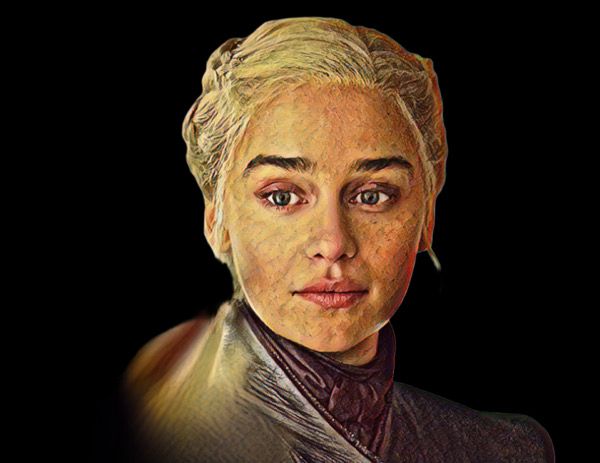
Her personal life, less exposed than Sophie’s, has been marked by another form of reinvention: the creation of a foundation to support people with brain injuries. Rather than turning trauma into a marketing narrative, Emilia transformed it into concrete action. For her, it seems, the post-GOT chapter is not only about career, but about meaning.
The shadow of a phenomenon
There is something cruel in the way the cultural marketplace treats phenomena. It demands that their protagonists be eternally associated with what made them famous and, at the same time, capable of surpassing it almost immediately. In the case of Game of Thrones, this contradiction is even sharper because the series was not merely a hit: it was a historical landmark. There is no “next role” that can compete, in symbolic scale, with Daenerys Targaryen, Jon Snow, or Sansa Stark.
Kit Harington, Sophie Turner, and Emilia Clarke have never hidden this ambivalence. They have spoken of pressure, exhaustion, and the difficulty of existing outside characters that became archetypes. They have spoken of the impact on mental health, of the sense of loss at the end of the series, and of frustration with the reception of later projects. And, perhaps most revealingly, they have spoken of the fear of being forever reduced to a single artistic identity.
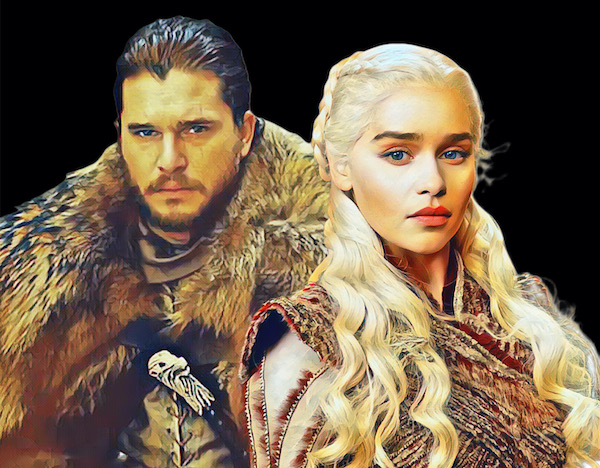
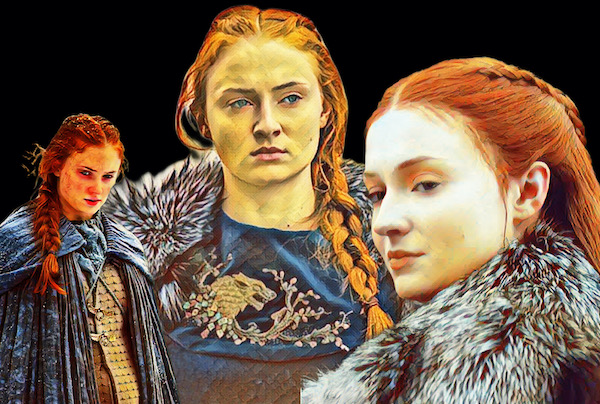
This is not about failure. None of them has “disappeared.” All continue to work, to choose projects, to explore new languages. What exists is something more subtle and harder: the awareness that certain phenomena leave no easy heirs and allow no smooth transitions. They turn their protagonists into symbols — and symbols do not reinvent themselves with the same freedom as actors.
Perhaps, at its core, the herculean effort of Kit, Sophie, and Emilia is not simply to escape the shadow of Game of Thrones but to learn how to live with it. To exist alongside a legacy that cannot be erased, only re-signified. Some reinvent themselves through rupture. Others through displacement. Others through acceptance.
In their case, what we see is a process still unfolding. There is no closed arc, no easy redemption, no clearly defined “second great era.” There are, instead, three artists marked by a work that gave them everything and demanded almost everything in return. And perhaps that is where the most human dimension of their journeys lies: after the throne, what remains is the work. And the slow, imperfect, courageous construction of an identity that no longer needs to rule a kingdom to exist.
Descubra mais sobre
Assine para receber nossas notícias mais recentes por e-mail.
 miscelana.com