
After years shelved, with production finished and originally aiming for a 2025 debut, delayed and kept in storage until finally premiering in January 2026, A Knight of the Seven Kingdoms has at last reached fans. And despite the apprehension that inevitably surrounds any return to Westeros, it does not disappoint. On the contrary, it proves there was a clear tonal victory waiting there, one that simply needed time, strategic distance, and the courage to exist outside the immediate shadow of Game of Thrones.
The series is based on three novellas written by George R. R. Martin, The Hedge Knight, The Sworn Sword, and The Mystery Knight, set roughly 89 years before the events of GOT. Longtime favorites among Martin’s readers, these stories follow the journey of a wandering knight, Ser Duncan the Tall, and his young squire Egg. They are smaller in scope, but immense in humanity, moral ambiguity, and irony, everything that made Martin “Martin” in the first place. Not by chance, if it had been up to fan votes alone, this adaptation would have arrived before House of the Dragon.
HBO, however, made a calculated and ultimately wise decision. After the Game of Thrones finale was so harshly rejected, the network chose to create distance, cool the debate, and allow the universe to breathe before inviting audiences back in. The Knight of the Seven Kingdoms benefits directly from that choice. It does not arrive as a course correction or an apology. It arrives as something else entirely, a conscious detour.
Even though it takes place “only” 89 years before GOT, the historical proximity matters. Egg, the boy traveling alongside Dunk, is Aegon Targaryen, the future King Aegon V, and the brother of Aemon Targaryen. Aemon does not appear, at least not in the first season, but his father and brothers are on screen, which helps explain why these stories stayed away from television for so long. Emotional, narrative, and symbolic distance were necessary for them to work. The wait was worth it.
The story of the books and of the series is simple in the best possible sense. Dunk is an ordinary man trying to become a knight in a world that romanticizes titles and brutalizes those without them. Egg is a curious, stubborn boy who is far more than he seems. Together, they pass through tournaments, villages, and small-scale conflicts that reveal something larger. Westeros is not made only of dragons and palace conspiracies, but of people trying to survive, to preserve some form of honor, and not to lose themselves entirely along the way. That is what fans have always loved about these tales, the gaze turned downward, toward the mud, the road, the margins.
The adaptation was followed closely for years and entrusted to Ira Parker, an experienced writer who until now had largely stayed away from the spotlight. The result shows near-reverential respect for the original material. The script trusts silences, relationships, and slow progression, something increasingly rare in franchises hungry for immediate impact.
And that is where the praise truly begins. The casting is precise, almost surgical. The adaptation is faithful without being rigid. The plot is “simple” in the noblest sense of the word, and deeply engaging. There are no dragons, no grand global conspiracies, no battles for the Iron Throne. And that absence is precisely the novelty within this universe.


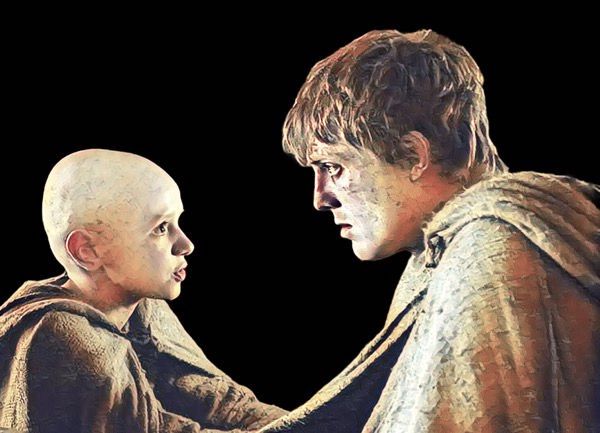
Shorter episodes help maintain the rhythm, and the lack of famous faces does too. Peter Claffey, as Dunk, carries the lead with an honest physicality and a rare vulnerability. Previously known for smaller roles and stage work, he finds here a part that demands presence more than overt charisma, and he delivers. Beside him, Dexter Sol Ansell, who plays Egg, is a revelation in his naturalism and sharp screen intelligence. Entering a franchise the size of GOT and holding the audience’s attention is no small feat. The chemistry between them works, and it works because it feels earned, not manufactured.
In the premiere episode, we follow Dunk as he tries to establish himself as a knight at a tournament that quickly exposes the cruel hierarchies of the world around him. Egg watches, learns, provokes. There is humor, tension, and a constant sense that violence could erupt at any moment, not as spectacle, but as consequence. The episode ends with a restrained yet effective hook, making it clear that this journey will not be grand, but it will be transformative.
One of the greatest challenges was musical. Losing a fixed composer is always daunting, especially when the theme created by Ramin Djawadi is practically a character within the franchise. Even so, the new score works beautifully. It respects the legacy without imitating it, creates its own identity, and understands that silence, too, is music.
And then we arrive at the only, and serious, problem. The worst moment of the entire episode is, ironically, the loudest and most unnecessary one. The direct reference to Game of Thrones, both through the mention of the capital and the explicit use of the central theme, culminates in a literal scatological gag, Dunk defecating on screen. It is aggressive, crude, and completely out of tone.

Ira Parker laughed about it, saying he “hopes fans forgive” the joke. Honestly, it does not feel like he wants forgiveness, and there is little to forgive. The crudeness is not just gratuitous; it disrespects what came before it in the episode, which is brilliant even with an unfortunate ending. If the intention was to flatter Martin with a coarse metaphor suggesting they are, forgive me, “shitting” on GOT and HOTD, or calling both series “crap”, doing so over Djawadi’s music is indefensible. That was the moment I wanted to stop watching.
I will keep watching The Knight of the Seven Kingdoms. Because what it builds up to that point is strong, delicate, and rare within a franchise accustomed to excess. But it is worth noting. George R. R. Martin loved D&D, and loved them until he didn’t. Ryan Condal is still under judgment. Ira Parker, your day will come, too.
The episode closes by returning its focus to the road, the duo, and the promise of new encounters and conflicts that do not need dragons to burn. If the series can trust that, and resist the temptation to comment on itself too loudly, A Knight of the Seven Kingdoms may well become the most honest adaptation Westeros has ever had.
Descubra mais sobre
Assine para receber nossas notícias mais recentes por e-mail.
 miscelana.com