
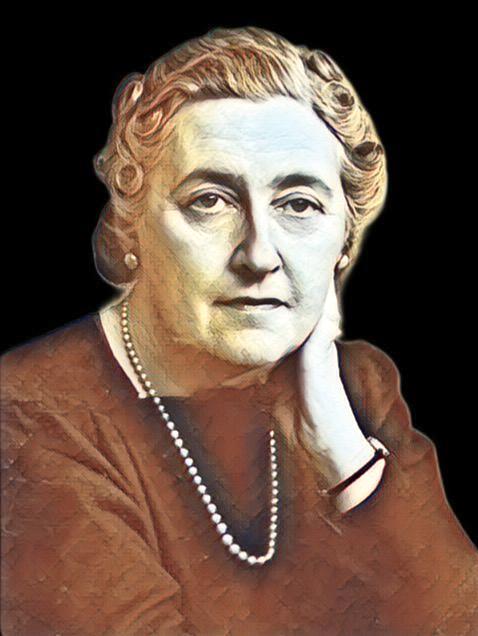
Half a century after Agatha Christie’s death, her novels continue to be read, adapted, and revisited not merely as entertainment, but as models of form: narrative structures that taught the world to think of crime as an enigma, the reader as investigator, and the ending as a moral revelation.
Christie did not create only iconic characters such as Hercule Poirot and Miss Marple; she organized a logic of suspense in which every detail matters, every gesture may be a clue, and every silence carries meaning. To choose her ten most important books, therefore, is not an exercise in nostalgia or popularity, but in historical understanding. It is to map the works that defined her style, expanded the boundaries of the genre, and explain why, more than a century after her debut, Agatha Christie remains not only the Queen of Crime, but the great architect of modern mystery.
1. The Murder of Roger Ackroyd (1926)
This is the book that changed the rules of the detective novel forever. Christie subverts the very structure of the genre with one of the most audacious narrative twists in literature. Set in the quiet village of King’s Abbot, where a wealthy man is found dead shortly after receiving a compromising letter, the story is taken on by a formally retired Hercule Poirot. What makes the novel a landmark is not only the ingenuity of the plot, but the radical disruption of the pact between author and reader: Christie challenges the genre’s tacit rules, plays with narrative trust, and delivers a solution that is at once impossible and inevitable. Its impact was so lasting that the book remains an object of literary study, in addition to having been adapted for television, notably in the series Poirot (ITV, 2000), starring David Suchet.
2. And Then There Were None (1939)
Christie’s best-selling book and one of the best-selling novels of all time. The purest form of the whodunit: ten people isolated, no detective, no escape. Ten guests arrive on a remote island, each burdened by a crime from the past. One by one, they begin to die, according to the relentless logic of a nursery rhyme. There is no external authority, only guilt, fear, and a countdown. Its power lies not only in the ingenuity of the plot, but in its moral atmosphere: everyone is, in some way, a defendant. Adapted countless times for cinema since 1945 and for television in acclaimed versions such as the BBC miniseries of 2015, the novel remains Christie’s most radical experiment in justice and punishment.
3. Murder on the Orient Express (1934)
Perhaps Poirot’s most famous case and one of the most debated solutions in the history of the genre. During a train journey across Europe, a passenger is found murdered. Trapped by snow, all the occupants become suspects. What turns the book into a classic is not merely the closed, almost theatrical setting, but a resolution that questions the very idea of truth and justice. Poirot does not simply identify the culprit; he confronts the reader with an ethical dilemma. The story has crossed decades in celebrated adaptations, from Sidney Lumet’s 1974 film to Kenneth Branagh’s 2017 version, as well as a 2010 television adaptation, consolidating the novel as a pillar of Christie’s mythology.
4. Death on the Nile (1937)
A perfect combination of romance, exoticism, and crime, and one of Christie’s most refined narrative architectures. During a cruise along the Nile, a young heiress is murdered. Jealousy, love triangles, and inheritance disputes form the puzzle Poirot must solve. The exotic setting serves as a counterpoint to a profoundly human drama, marked by resentment and possessive desire. Adapted for cinema in 1978 and again in 2022, and for television in Poirot (2004), the novel stands as a model of Christie’s mature craft.
5. The ABC Murders (1936)
Here Christie introduces the serial killer as a central concept in the classic detective novel. A criminal announces his crimes in letters to Poirot and kills following the alphabetical order of towns and victims. The game is no longer only about identifying the culprit, but about the spectacle of the chase itself. The novel anticipates modern concerns with notoriety, media manipulation, and the theatricalization of violence. It was adapted in Poirot (1992) and reimagined in a darker BBC version in 2018, starring John Malkovich.
6. The Body in the Library (1942)
Miss Marple’s first major case and the novel that firmly establishes her as a counterpart to Poirot. When the body of an unknown young woman is discovered in the library of a respectable household, Marple dismantles appearances to reveal a far more elaborate crime. She demonstrates that observing people can be as effective as deciphering material clues. The book was adapted by the BBC in the 1980s and later in ITV’s Marple series.

7. The Murder at the Vicarage (1930)
Miss Marple’s debut novel. The murder of the odious Colonel Protheroe in a seemingly peaceful community establishes the “English village” as a moral microcosm. More than solving a crime, Christie exposes how everyday relationships and long-standing resentments can generate tragedy. Initially perceived as merely a curious old lady, Marple asserts herself as one of the most original figures in detective fiction. The novel was adapted for television by both the BBC and ITV.
8. Witness for the Prosecution (1933 – short story; play in 1953)
One of the finest examples of Christie’s mastery of legal and emotional reversals. In a murder trial, a man depends on the testimony of his own wife, who appears to betray him in court. What follows is one of the most celebrated twists in the genre. Billy Wilder’s 1957 film adaptation turned the work into a classic of courtroom cinema, and the BBC revisited it in 2016.
9. The Mysterious Affair at Styles (1920)
Christie’s debut novel and the first appearance of Hercule Poirot. A wealthy woman dies from poisoning in a country house; Hastings assists Poirot in the investigation. The book establishes the author’s trademarks: seemingly trivial clues, characters who conceal more than they reveal, and a detective guided by psychological logic. It was adapted for television as the very first episode of Poirot in 1990.
10. Five Little Pigs (1942)
One of Christie’s most psychological novels. There is no new crime: Poirot investigates a murder that occurred sixteen years earlier. Five witnesses offer different versions of the same event. The inquiry becomes a study of memory, guilt, and perception, showing how truth fractures according to the eye of the beholder. Adapted for television in 2003, it is often cited as one of the author’s most sophisticated works.
Taken together, these ten titles form not merely a personal canon, but a map of Agatha Christie’s legacy in modern culture. They show how the detective novel moved beyond simple pastime to become a language capable of reflecting on morality, society, identity, and justice. Christie did not merely popularize the “whodunit.” She taught how to tell it, structure it, and reinvent it. That is why, more than a century after her debut, her name remains synonymous with mystery, not as a formula, but as literary architecture.
Descubra mais sobre
Assine para receber nossas notícias mais recentes por e-mail.
 miscelana.com