
As published by Blog of Amaury Jr./Splash UOL
There is something almost ironic about The Beauty. To tell a story about a world obsessed with correcting bodies, Ryan Murphy chooses as the narrative axis precisely the actor who spent years lending his face to his most disturbing creatures. Evan Peters, synonymous with excess, ambiguity, and discomfort in Murphy’s universe, now appears as Cooper Madsen, an FBI agent and the moral compass of a plot that transforms perfection into a social disease. It is not merely a change of role. It is a shift in meaning.
The relationship between Peters and Murphy has always been built on risk. In American Horror Story, the actor became the showrunner’s emotional laboratory: Tate Langdon, the toxic charm of romanticized violence; Kai Anderson, political delirium wrapped in charisma; James Patrick March, the macabre elegance of a predator; and, outside serial fiction, Jeffrey Dahmer in Monster, a performance as unsettling as it was decisive. In all of them, evil was never simple. It came filtered through seduction, pain, and vulnerability. Over more than a decade, Peters became the face of Murphy’s sophisticated antagonism. That is why, when The Beauty places him “on the side of good,” the choice is not casual. It is almost a commentary on the work itself.
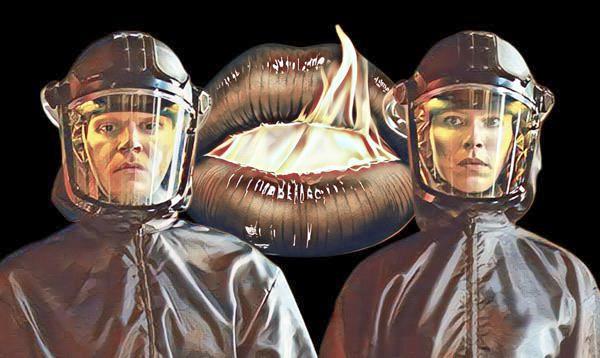
In the new series, Peters plays Cooper Madsen, an FBI agent sent to Paris to investigate the brutal deaths of international models. Alongside Jordan Bennett, portrayed by Rebecca Hall, he discovers that the center of the nightmare is a sexually transmitted virus that promises what our culture has learned to desire above all else: perfection. The difference is that, in The Beauty, the price is not symbolic; it is physical. Transformation is painful, has an expiration date, burns from the inside, and, at its limit, makes the victim literally explode. Murphy abandons the fable to embrace the body. Horror does not illustrate the argument; it is the argument.
It is within this territory, between spectacle, horror, and cultural critique, that Peters redefines his position in Murphy’s universe. After years of playing figures that embodied excess and the abyss, he now occupies the place of the gaze that tries to organize chaos. A character who does not present himself as a savior, but as someone who hesitates, investigates, and chooses. A hero without grandiloquence, and perhaps for that very reason more disturbing: in a world that sells absolute solutions, doubt becomes resistance.
In conversation with the press, Peters reflects on this shift, on the moral logic of The Beauty, and on what it means to play, for the first time in a long while, someone who crosses horror from the right side.
Below, the actor talks about Cooper Madsen, his partnership with Rebecca Hall, Ryan Murphy’s aesthetic, and the discomfort of living in a world obsessed with perfection.
Miscelana: After so many dark characters in Ryan Murphy’s universe, what was it like to take on the role of Cooper Madsen in The Beauty?
Evan Peters: It was a relief. When Ryan presented the idea of the series to me, he talked about big action sequences and a complicated romance with Jordan. But what struck me most was when he said he just wanted me to be normal. That was very challenging. After so many extreme characters, being someone more contained, more centered, felt almost like a new exercise for me.
Miscelana: Who is Cooper Madsen within the logic of the series?
Evan Peters: At first, his goal is simple: to find out why people are exploding, to understand what is happening. He wants to solve the case, to find answers. But over time, it stops being just a professional investigation and becomes something personal. The stakes increase, institutional structures are no longer enough, and he has to act on his own. That changes everything.
Miscelana: What attracted you most to the concept of The Beauty?
Evan Peters: There is something recurring in Ryan’s projects: the idea that what makes you you, what makes you unique, is precisely what should be celebrated. I think the series reinforces that very strongly in some episodes. It makes you question what it means to be different, what it means to be beautiful, and who gets to decide that
Miscelana: The series talks a lot about perfection and imperfection. How do you interpret this theme?
Evan Peters: I think the message is exactly that: what makes us unique is what makes us interesting. The obsessive search for perfection can erase precisely what defines us. The Beauty puts that into focus in a very direct, almost brutal way.
Miscelana: How do you see the dynamic between Cooper and Jordan?
Evan Peters:
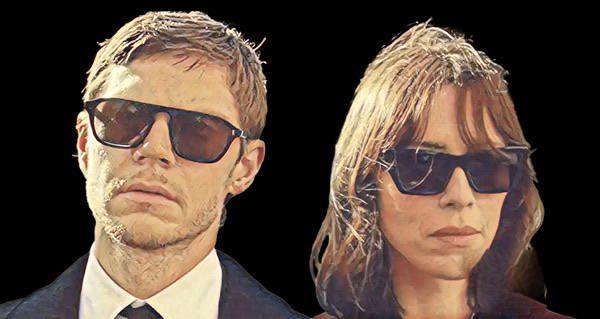
Cooper is more by-the-book, more organized. Jordan is very fun, more spontaneous, and more humorous. They balance each other out. There is an emotional tension there, something that goes beyond work. You end up rooting for one of them to say what they really feel. They function as complementary forces within the narrative.
Miscelana: What stood out most to you in the international filming of the series?
Evan Peters: Filming at the Trevi Fountain at three in the morning was a surreal experience. There was no one there. Seeing such an iconic place completely empty was something very special. It gave the series a truly international feeling, almost unreal.
Miscelana: At what point did you realize that the story of The Beauty is not as futuristic as it seems?
Evan Peters: When you look at the real world, you realize that many of the ideas in the series are already happening. Technology, medicine, and the beauty industry. All of that is advancing very quickly. The series exaggerates, of course, but it does not invent everything from nothing. It just pushes a little further something that already exists.
Miscelana: What do you think audiences take away from The Beauty?
Evan Peters: The series makes you question basic things: what is beauty, what is identity, what is worth preserving in yourself. It does not deliver ready-made answers. It provokes. And I think Ryan Murphy is one of the best at doing exactly that.
Descubra mais sobre
Assine para receber nossas notícias mais recentes por e-mail.
 miscelana.com