
As published in Bravo Magazine
I arrived from the United States after facing snowstorms, flight delays, and improbable connections, which kept me from being physically present at the opening of the 29th Tiradentes Film Festival and from witnessing firsthand the tribute paid to Karine Teles. Distance, paradoxically, made even clearer what was at stake that night: not only the beginning of a festival, but the celebration of a trajectory that deeply resonates with the current moment of Brazilian cinema.
In Tiradentes, under days of persistent rain and unstable weather, audiences, artists,s and filmmakers gathered to launch an edition shaped by encounters, memories, es and reflections on contemporary audiovisual culture. Once again, the festival reaffirmed its role as one of the main spaces for thought, risk, and invention in Brazilian cinema, a territory where films are not only screened, but debated, challenged,d and reinvented.
The program runs until January 31, with free admission and 137 films. Not even the rain, which affected some outdoor screenings, managed to interrupt the rhythm of the event. There is something profoundly symbolic in this effort to move forward despite the weather, an almost literal metaphor for the logic of persistence that defines Brazilian cinema.
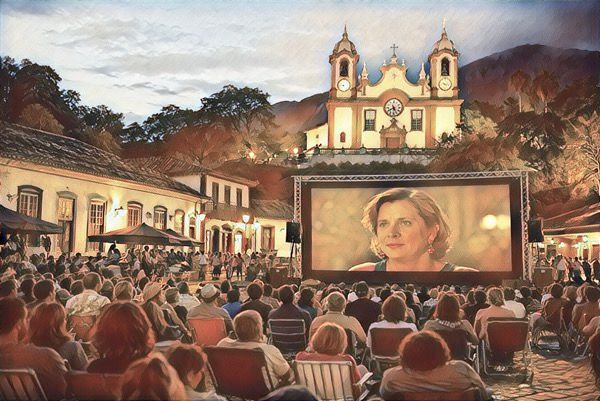
In this context, the tribute to Karine Teles takes on even more revealing contours. At a moment of international recognition for Brazilian artists and works, her trajectory, marked by lucidity, restlessness, and a refusal of glamour, functions as both a mirror and a counterpoint. Success is celebrated, but without forgetting the structural fragilities that still permeate filmmaking in the country.
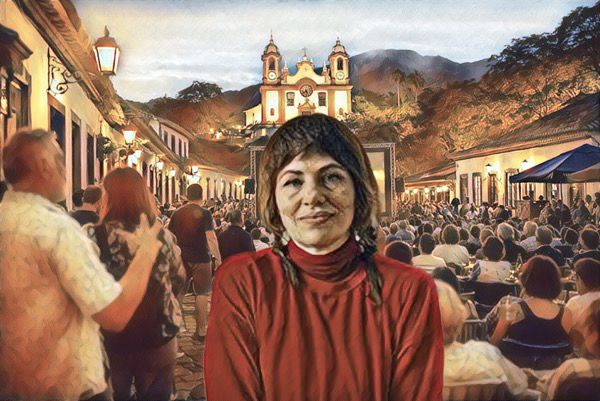
Karine delivered one of the most powerful speeches of the opening ceremony. When she took the stage, she recalled her first visit to the festival in 2007, when she was still a spectator dreaming of seeing her own work projected on that very screen. Nearly two decades later, the recognition came accompanied by a speech that rejected the celebratory tone usually expected on such occasions.
Instead of reinforcing the glamourized image of the profession, Karine chose to expose the instability that marks the trajectory of those who work with art and culture in Brazil. She spoke of unpredictable careers, the alternation between periods of intense work and long stretches without projects, and the constant changes in the political and institutional landscape. She also addressed the emotional toll of persisting in a field that demands continuous reinvention. “There is nothing glamorous, nothing romantic about it,” she said, describing the harshness of continuing to create.
This refusal of glamour is not merely rhetorical. It runs through Karine Teles’s entire trajectory, built between independent cinema, such as Riscado and Benzinho, television, in Pantanal and Vale Tudo, and some of the most emblematic works of recent Brazilian cinema, such as The Second Mother and Bacurau. Throughout this path, the actress has never placed herself in the comfortable position of consecration. On the contrary, she has consistently insisted that a career is not an ascending line, but a winding road, marked by curves, descents, and restarts.
When receiving the tribute, Karine spoke about moments when she considered giving up, about choices conditioned by material necessity, about projects she refused for artisticreasonss and about periods without work. She also spoke of fame as something secondary, almost irrelevant compared to what truly moves her: the process, the rehearsal, the thinking, the filming. “I don’t desire ascension, I desire permanence,” she said. The sentence, simple and radical, may be one of the most precise definitions of what it means to make cinema in Brazil today.
Lucidity amid optimism
The impact of her speech lay precisely in its lucidity. At a moment of relative optimism around Brazilian cinema, fueled by international awards, global visibility, and the resumption of public cultural policies, Karine reminded everyone that these achievements do not eliminate the structural fragilities of the sector. Persisting remains a daily challenge for artists, technicians, and filmmakers.
By thanking the festival for the recognition, the actress also highlighted Tiradentes as a space for encounters, debates, and the circulation of ideas. The festival is not merely a showcase of films, but a laboratory of thought about cinema itself. By connecting individual recognition with a collective defense of a more solid cultural field, Karine shifted the meaning of the tribute. It was not only about celebrating a career, but about reflecting on the conditions that make such a career possible or nearly impossible.
Her trajectory is that of an actress who has never allowed herself to be captured by the logic of stardom, yet has become central precisely because she inhabits the zones of tension within Brazilian cinema. In The Second Mother, she embodied a progressive elite unable to recognize its own privileges. In Bacurau, she gave a face to a colonizing logic. In Riscado, she transformed her own professional anguish into cinematic material. In all these works, Karine built characters that do not comfort; they disturb.
Permanence as a political gesture
Perhaps this is where Tiradentes and Karine Teles meet most powerfully: in the idea of permanence. In a country where cultural policies are intermittent, where artistic careers are marked by precariousness, and where the very idea of the future is often threatened, remaining is no longer merely an individual choice. It becomes a political gesture.
On opening night, amid rain, encounters andd celebrations, Karine’s speech functioned as a necessary counterpoint. A reminder that Brazilian cinema is not built only with awardsapplausees,e and headlines, but with insistence, invisible labor, and a constant dose of courage.
The Tiradentes Film Festival continues until the end of January, projecting films, debates, and dreams. Karine Teles continues along her winding road, refusing glamour and claiming something rarer: the right to go on. Ultimately, perhaps that is what the current moment of Brazilian cinema is asking us to celebrate. Not only the peak, but permanence.
Descubra mais sobre
Assine para receber nossas notícias mais recentes por e-mail.
 miscelana.com