
I have never fully understood the critical and popular success of Shrinking. The jokes about the analytic process are, at the very least, unsettling: a therapist who gives direct advice and gets involved in his patients’ personal lives is not exactly a funny subversion, but a caricature that flirts with irresponsibility. Now, the series seems to go one step further by turning the drama of a man being overtaken by Parkinson’s disease into raw material for humor. It is hard not to find this, at the very least, problematic.
Stepping outside my bitter and critical bubble, I understand the argument. Humor has always been a powerful tool for dealing with the tragic, the intimate, and the unbearable. Laughing at what hurts can be a way of surviving it. The problem is not laughter itself, but the point of view that sustains it, the ethical boundary it chooses to ignore, and the thin line between humanizing suffering and trivializing it.
In Shrinking, that line seems constantly blurred. The series wants to be sensitive, but resorts to easy shortcuts. It wants to be profound, but frequently relies on predictable emotional effects. It wants to be daring, but does so by simplifying what should be treated with complexity. In the end, what disturbs is not the existence of humor around pain, but the feeling that pain, here, serves less as a human experience and more as a narrative device.
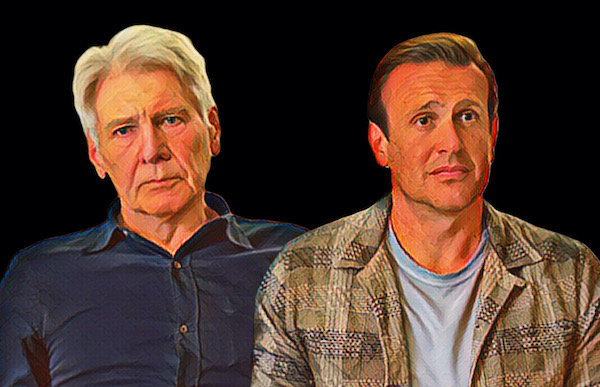
Perhaps that is why Shrinking works so well for audiences. It turns trauma into something digestible, suffering into something consumable, and therapy into a fantasy of quick answers. But precisely for that reason, it is difficult to celebrate its success without discomfort.
If there is something that prevents Shrinking from being dismissed as a minor comedy, that something is the cast. In this third season, Harrison Ford definitively assumes the center of gravity of the series.
Ford has always been associated with laconic, gruff, and morally fatigued characters. Alongside Tommy Lee Jones, he may be one of the few actors capable of growling on screen while still generating empathy. In Shrinking, he transforms Paul into something that goes beyond the archetype of the cynical old man. There is hardness, yes, but also melancholy, dignity, and a kind of contained vulnerability that Ford masters like few others. It is a great performance, even when the character seems like an extension of the persona that cinema has built around him over the decades.
The paradox is that Ford delivers the kind of work that legitimizes the series, while the writing insists on remaining in an undefined zone between drama and comedy. In its third season, Shrinking still cannot decide what it wants to be. For me, that is the greatest mystery: how can a series that has never fully found its aesthetic, ethical, and tonal identity survive with such stable critical and popular support?

Narratively, the current season tries to deepen its conflicts. Jimmy faces the emptiness of becoming an empty-nest father and the anguish of watching Alice make life choices he can no longer control. Paul, in turn, confronts new stages of Parkinson’s disease, an arc that culminates in the appearance of Michael J. Fox, himself publicly living with the condition. Fox’s presence carries a symbolic weight that Shrinking seems almost too conscious of exploiting, as if the actor’s historical significance were summoned to lend gravity to a series that rarely knows how to sustain its own drama.
And this is where the discomfort intensifies. The series touches on real, painful, and complex themes such as aging, physical degeneration, grief, children’s autonomy, and the limits of therapy, but insists on treating them with a lightness that is not liberating, only superficial. Neither Harrison Ford’s talent, nor Michael J. Fox’s emotional impact, nor the cast’s effort manages, for me, to produce the effect the series seems to pursue.
Nothing in Shrinking makes me laugh. And perhaps the problem is not my sense of humor, but the way the series confuses delicacy with concession, emotion with ease, and humanity with comforting formulas.
Descubra mais sobre
Assine para receber nossas notícias mais recentes por e-mail.
 miscelana.com