
Catherine O’Hara built her career playing women who never accepted the idea of fitting in—whether into genres, expectations, behavioral limits, or age boundaries. Her comedy was never about punchlines, but about identity. About the discomfort of existing in a world that demands restraint when everything about you is excess.
Even before revisiting her most iconic roles, it’s worth remembering how utterly relevant Catherine O’Hara remained until the end. In The Last of Us, her appearance was brief but devastating: a woman pierced by loss and memory, capable of condensing an entire lifetime of affection and desolation into just a few minutes. In The Studio, she stole the spotlight as part of a fierce satire of Hollywood’s inner workings, reaffirming something that has always defined her career: the ability to dismantle the very industry that consecrated her, exposing vanity, ego, and fragility with humor and surgical precision.
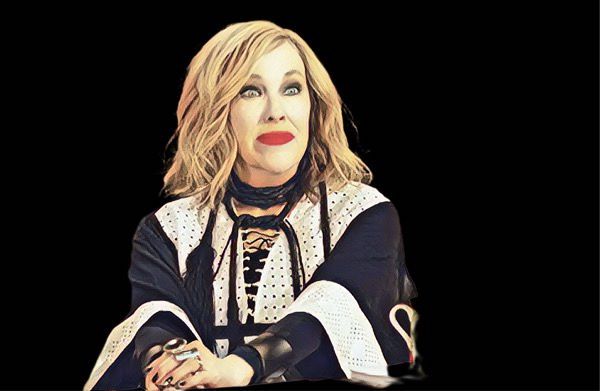
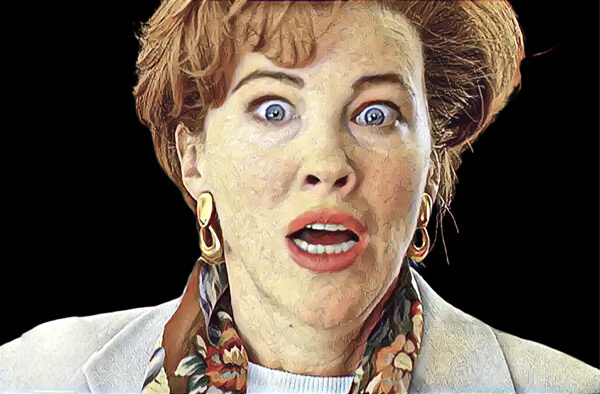
That mastery of discomfort was present from early on. In Martin Scorsese’s After Hours, O’Hara played Gail, the ice-cream truck driver who is as seductive as she is threatening—a figure that blends eroticism, danger, and absurdity. It was a small role, but a revealing one. There, already, was the actress capable of turning eccentric characters into unsettling experiences, pushing laughter into a zone of tension.
Perhaps that’s why her most famous characters are always larger than life, but never empty. On the contrary, the more extravagant they are, the more revealing they become.
1) Moira Rose — Schitt’s Creek
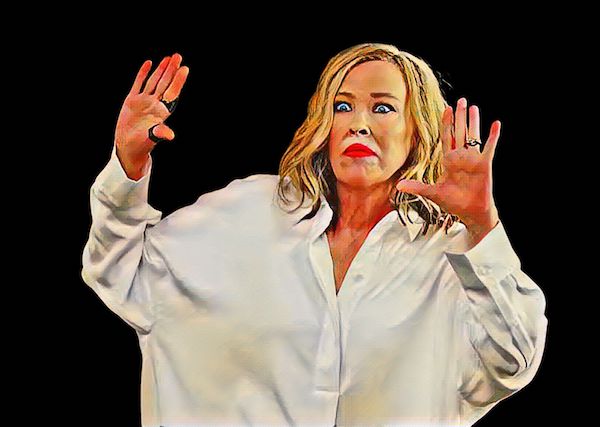
Moira Rose is the pinnacle of Catherine O’Hara’s brilliant trajectory. A wealthy, fallen, and relentlessly performative former actress who speaks as if she were perpetually on stage, Moira could easily have been a caricature. What O’Hara did instead was transform her into a painfully human portrait of the fear of disappearing. Moira doesn’t perform out of vanity alone, but out of survival. The invented accent, the excessive costumes, the nearly absurd wigs are armor against oblivion. Beneath the laughter lies panic. Beneath the arrogance, fragility. That is why Moira became an icon—and why she earned O’Hara her long-delayed, definitive Emmy.
2) Kate McCallister — Home Alone
Decades earlier, O’Hara had already entered the collective imagination as the mother who forgets her son at home and crosses the world to get back to him. But she turns Kate into something deeper. Her famous scream of “Kevin!” is not merely comic—it’s existential. It condenses guilt, terror, and absolute love into a single word. Few actresses have made motherhood feel so intense without lapsing into cheap sentimentality. Kate McCallister became one of the most recognizable mothers in cinema history because O’Hara understood that desperation can be funny—so long as it’s true.
3) Delia Deetz — Beetlejuice
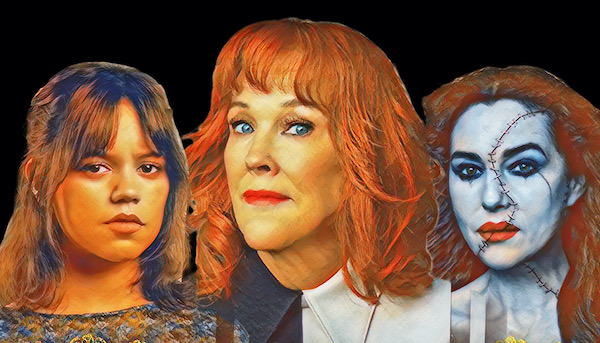
Standing out in a universe as singular as Tim Burton’s is no easy feat, and among the female characters that immediately come to mind is the complex Delia Deetz from Beetlejuice. She represents another fundamental aspect of O’Hara’s work: excess as aesthetic. Delia is a performance artist—self-centered, displaced, and fascinating. Rather than softening the grotesque, O’Hara embraces it. She understands that Tim Burton’s world doesn’t call for naturalism; it demands commitment to the absurd. Delia doesn’t try to be normal, and that’s precisely what makes her unforgettable. Here, O’Hara inaugurates a persona that would define much of her career: women who doesn’t apologize for taking up space. And let’s be honest—Harry Belafonte has never been more legendary than in that dinner scene, thanks to Catherine O’Hara.
4) Cookie Fleck — Best in Show
I was tempted to include Patty Leigh from The Studio on this list, but O’Hara’s sharpest critique of class, ego, and appearance reaches its cruelest point in Cookie Fleck from Best in Show. Cookie is venomous, controlling, obsessed with status, and absolutely hilarious. O’Hara turns every line into a small act of social violence, exposing the ridiculousness of the American elite without ever softening the discomfort. It’s one of the most brilliant performances in the history of improvisational comedy because she never seeks easy empathy. Cookie doesn’t want to be loved. She wants to win. And O’Hara understands exactly how to make that both funny and deeply unsettling.
5) Sally Owens — A Mighty Wind
Few people remember A Mighty Wind, where, as Sally Owens, O’Hara delivered one of the most revealing performances of her career. Here, excess gives way to melancholy. Sally is a folk singer marked by frustration, interrupted dreams, and a life that never quite lived up to its promise. O’Hara sings, acts, and moves the audience with a delicacy that dismantles any notion that she was merely an eccentric comedian. This role confirms something essential: her greatest strength was always her ability to alternate between humor and pain without warning the viewer.
Seen together, these characters make one thing clear: Catherine O’Hara was never interested in well-behaved, balanced, or easily classifiable women. She chose those who fail in public, who exaggerate, who speak too much, who dress too much, who feel too much. Women who unsettle because they refuse to disappear.
Her legacy lies not only in the laughter she inspired but in the way she taught us that comedy can be a territory of emotional complexity, social critique, and aesthetic resistance. Catherine O’Hara didn’t play characters to please. She played them to exist.
And perhaps that’s why she remains so vividly alive.
Descubra mais sobre
Assine para receber nossas notícias mais recentes por e-mail.
 miscelana.com