
As published on Bravo Magazine!
Like almost everything today, the debate surrounding literary adaptations tends to organize itself in binary terms. Either any reinterpretation is accepted as a sign of modernity, or any deviation from the original text is accused of betrayal. I have positioned myself clearly in this territory for years, and I do not mind assuming a more purist and conservative stance when it comes to literature translated to the screen. Not out of a fetish for literal fidelity, but because we have repeatedly seen how certain artistic choices can illuminate what is most powerful in a book, while others simply dilute it, simplify it, or strip it of its identity.


Since the announcement of “Wuthering Heights”, quotation marks deliberately included, directed by Emerald Fennell, this debate has returned to the center of the conversation. Fennell is a singular, award-winning, undeniably talented filmmaker. She was original with Promising Young Woman, for which she won the Oscar for Best Original Screenplay, and she confirmed her provocative visual signature with Saltburn. Even when working with recognizable references from literature and cinema, Fennell demonstrates aesthetic confidence, mastery of eroticism as language, and an authorial assurance that often results in divisive, but rarely uninteresting, works.
It is precisely for this reason that her entry into the realm of literary adaptations demands a more rigorous gaze. Based on my reading of Wuthering Heights, I do not agree with the idea that it is a great love story, much less the greatest of all time. But the central problem with Fennell’s version goes beyond thematic interpretation. The director adopts an old and recurring cinematic strategy: isolating a fragment of the novel while ignoring its most complex layers. By eliminating the second half of the story and a crucial character, transferring that dramatic function to another, she alters two central pillars of the narrative. The result is not an adaptation, but a rewriting. Personally, I do not believe that Emily Brontë’s classic, still strikingly modern today, required rewriting.
At the very least, there is honesty in this gesture. The quotation marks in the title function as a warning. Fennell does not hide the fact that she is telling the story from her own experience as a reader, shaped by the emotional impact the book had on her. Within the logic of art, this is legitimate. Subjectivity is an essential part of the creative process. The quotation marks serve the same purpose as a credit that reads “inspired by”, signaling that this is not a direct translation of the literary work.
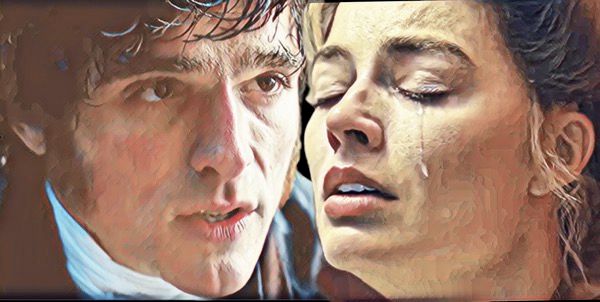
The problem begins when this authorial freedom collides with what makes Wuthering Heights singular. Emily Brontë did not write a novel about soulmates prevented from living a fulfilled love. She wrote about emotional inheritance, violence passed down through generations, narcissism, resentment as a structuring force, and the inability to break destructive cycles. It is a deliberately uncomfortable book, populated by characters who do not invite easy empathy and driven by a narrative that insists on consequences.
The plot follows the profoundly dysfunctional relationship between Heathcliff, an orphan taken in by the Earnshaw family, and Catherine, the daughter of the owner of the bleak estate in Yorkshire. When Catherine decides to marry Edgar Linton, not out of love but as a conscious strategy of social advancement, Heathcliff turns rejection into purpose. The novel does not seek redemption or reconciliation. What follows is a cold, meticulous project of revenge meant to corrode two entire family lineages. Obsession transcends life, death, and narrative space itself. Catherine’s ghost is both literal and metaphorical, but above all, it reveals that time did not sever the bond between their souls and that there were no regrets. It is sensational and daring, and there is no stronger recommendation than reading the original work.
There is nothing romantic here in the comforting sense of the word. Brontë’s nineteenth-century novel is a dark descent into the rawest aspects of the human soul. It explores relationships marked by abuse, emotional violence, and resentment, using the Gothic not to beautify drama, but to turn it into a curse. Suffering does not purify, teach, or redeem. It replicates itself.

Fennell’s reading follows another path. Although the film does not completely ignore the toxic nature of Cathy and Heathcliff’s relationship, that dimension is domesticated. By shifting the focus from structural violence to romantic obsession, the film risks romanticizing abusive dynamics that Emily Brontë constructed precisely to provoke discomfort.
This decision materializes in the staging of desire. The film relies on the physical magnetism of Margot Robbie and Jacob Elordi, on insistent close-ups, and on dialogue loaded with performative intensity. The drama ceases to be corrosive and becomes sensory. Pain is displayed rather than accumulated. Instead of discomfort, the film delivers immediate impact.
From this angle, the comparison with less demanding narratives aimed at younger audiences is not unfounded. Fennell’s “Wuthering Heights” is built on emotional excess, controlled eroticism, and an indulgent reading of toxic relationships, packaged as romantic intensity. It fits neatly into fantasies already filtered through the desire for rapid consumption and the aesthetics of immediate identification, key pillars of Generation Z’s affective imagination.
This dialogue with a younger audience is also present in the film’s cinematic language. Unlike the repressed, suffocating desire that permeates Brontë’s novel, the film opts for an exuberant yet curiously sanitized sensuality. It also ignores the time of maturation the story demands. Scenes are short and fragmented, and the passage of time, which allows us to understand the seed of Heathcliff’s hatred, is absent.
I enjoy the soundtrack featuring Charli XCX, which brings a contemporary air to Fennell’s vision, but it does not come close to what Baz Luhrmann achieved, for example, in Romeo + Juliet and The Great Gatsby, two major adaptations of classics that prove it is indeed possible to be both faithful and modern when engaging with original material.

The fact remains that the result here is a visually seductive film that is dramatically shallow. Costume and production design are impeccable, with outfits by the brilliant Jacqueline Durran, all deliberately anachronistic yet clearly translating Cathy’s social ascent. When Heathcliff returns as a kind of “evil Mr. Darcy”, Jacob Elordi is openly objectified, and frankly, no one can really blame her. Apologies.
Still, casting is what most severely compromises the film’s dramatic density. Cathy and Heathcliff’s childhood, fundamental to understanding the cruelty of their adult selves, is given little space. In the novel, this is where emotional violence is born. In the film, the transition feels rushed, almost ornamental.
Margot Robbie is a great actress, but her maturity creates a dissonance with the essence of a character who does not surpass her early twenties in the book. Cathy is defined by youthful impulsiveness and the difficulty of crossing into adulthood. Robbie’s assured presence introduces a strangeness that distances the viewer, simply because it feels wrong to see her in that position. Jacob Elordi, meanwhile, faces the unfortunate challenge of stepping into a role already inhabited by many legendary performances. His Heathcliff is too restrained. What is missing is brutality, loss of control, ferocity, the very traits that prevent Heathcliff from becoming a romantic hero. And we have not even begun to address the racial and social dimensions of the character in the novel, which would be timely and compelling to make canonical today.
What makes me particularly irritable when classics are “revisited” anachronistically is the following question: if they need to be changed so fundamentally, why retell them at all? There are many examples of how cinema can remain faithful to a literary work without being literal, reverent without being rigid, and authorial without being arbitrary. Sense and Sensibility, directed by Ang Lee with a screenplay by Emma Thompson, understands Jane Austen from within. The Talented Mr. Ripley preserves Patricia Highsmith’s moral ambiguity. Luhrmann’s updated Shakespeare adaptations do the same. None of these films softens what is uncomfortable in their source material.
That is why I find myself conflicted about not loving Fennell’s “Wuthering Heights”. Not because it is authorial, which is always welcome, but because it displaces the nerve center of the work. By transforming a complex mechanism into a straight line, the film loses what allows the novel to endure over time. In the name of identification, sensuality, and immediate intensity, it abandons the refusal of comfort that defines Emily Brontë.
To be conservative in this debate today is an act of critical resistance. Not against new readings, but against the idea that every classic must be corrected to function in the present. Some books endure precisely because they do not adapt. Because they remain abrasive. Because they demand more from the reader and, consequently, from the cinema that seeks to translate them.
And when that does not happen, truth be told, quotation marks are not enough. Perhaps it would have been more honest to choose another name.
Descubra mais sobre
Assine para receber nossas notícias mais recentes por e-mail.
 miscelana.com