
If the first season of A Knight of the Seven Kingdoms presented Westeros as a stage of honor, bravery, and public tragedy, the second is expected to move the narrative into a far more intimate, quiet, and uncomfortable territory. Based on the novella The Sworn Sword, the new chapter is slated to premiere in 2027 on HBO and HBO Max, once again with only six episodes and a deliberately contained scope. The story unfolds amid a devastating drought, far from the court and the great houses, which naturally requires a profound reshaping of the on-screen cast.
Some presences, however, remain unchanged.
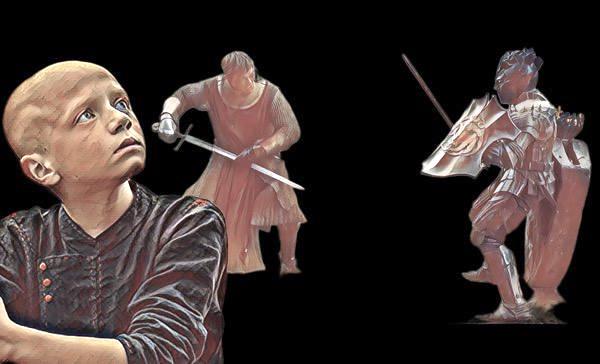
Peter Claffey returns as Ser Duncan the Tall, now less improvised and more aware of the weight of his choices. Two years have passed since Ashford, and Dunk is no longer merely a hedge knight trying to prove his worth, but a man responsible for the safety of a disguised prince and for defining what it truly means to be honorable in a world that rarely rewards honor.
Dexter Sol Ansell also returns as Aegon Targaryen, the young Egg, whose intelligence and sensitivity continue to serve as the story’s moral counterbalance. Their relationship should appear stronger and more affectionate, yet also shaped by a power imbalance both prefer to ignore. Egg already shows the reformist perspective that will one day define him as Aegon V, but he remains bound to his disguise and dependent on Dunk to survive beyond the safety of the court.
Beyond this central duo, almost everything changes.
Fans discuss that the most significant addition (not yet officially confirmed) is Lucy Boynton as Lady Rohanne Webber, known as the Red Widow. Lady of Coldmoat, Rohanne governs her lands with a firmness that challenges Westeros’s gender expectations and shows no intention of yielding to external threats. In the literary material, she is one of the most complex and magnetic figures in the entire Dunk and Egg cycle, combining strategic intelligence, personal trauma, and an emotional intensity that never becomes weakness. Her relationship with Dunk is not a conventional romance but a field of political and psychological tension, marked by mutual respect and the awareness that certain connections are impossible within the rules of their world.
Other confirmed actors have not yet had their roles officially disclosed, but the context of the story allows for plausible inferences.
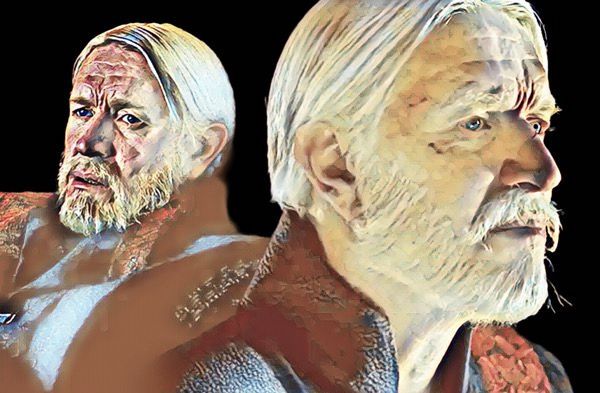
Paul Chahidi, Steven Hartley, Mimi Joffroy, Kwaku Mills, and Craig Parkinson are likely to form the core of Houses Osgrey and Webber, along with knights, advisors, and soldiers orbiting the central conflict. In The Sworn Sword, the dispute arises between the impoverished Ser Eustace Osgrey, a former Blackfyre supporter, and the powerful Rohanne Webber, making it probable that members of this cast will portray those key figures and their respective retinues.
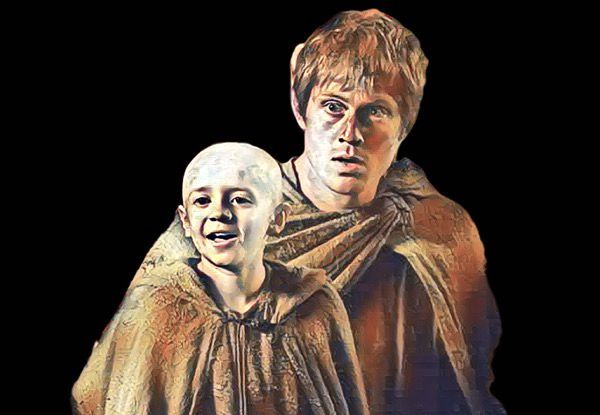
If Craig Parkinson were cast as Osgrey, for instance, it would suit a character defined by age, pride, and the scars of political defeat. Kwaku Mills, meanwhile, could plausibly embody a younger and more provocative knight such as Longinch from the books, whose calculated demeanor contrasts sharply with Dunk’s almost disarming sincerity. None of this has been officially confirmed, but the narrative logic points in that direction.
A notable aspect is the near-total absence of the Targaryens seen in Season 1. Princes such as Aerion Brightflame or Maekar Targaryen are unlikely to return, not because they lack historical importance, but because the story deliberately unfolds far from the centers of power. Westeros remains under the rule of Daeron II and still lives in the shadow of the Blackfyre Rebellion, yet this high politics is felt only as a distant echo in the lives of ordinary people.
This choice reinforces the saga’s itinerant nature. Dunk and Egg are not protagonists of ongoing court intrigue but travelers moving through different social microcosms of the continent. Each stop reveals a new set of characters shaped by local circumstances, by memories of past wars, and by immediate needs such as land, water, and survival.
The production itself reflects this shift. Because the story takes place during a severe drought, filming is unlikely to remain in Northern Ireland, requiring more arid and sun-drenched locations. This will contribute to a distinct visual tone, less verdant and more austere, matching the narrative’s mood. Showrunner Ira Parker has indicated that Season 2 may be even smaller in scale than the first, not due to lack of ambition but in fidelity to the source material.
Chronologically, the series remains set around 209 AC, decades after the Dance of the Dragons and roughly eighty years before Game of Thrones. The dragons are gone, the Targaryen dynasty has lost much of its symbolic power, and the Blackfyre threat endures as an open scar. This political context permeates the story even when it does not appear directly on screen.
The likely result is a season dominated by new, morally ambiguous, deeply human characters, where the greatest danger comes not from monsters or epic battles but from the inability to reconcile honor, duty, and survival. If the first season showed how a knight might be born, the second should reveal what happens when he must live with the consequences of his choices.
And it may be precisely in this space without glory, without spectators, and without princely saviors that Dunk becomes most extraordinary, not as a legendary hero, but as a man who insists on being good even when the world has long since abandoned that possibility.
Descubra mais sobre
Assine para receber nossas notícias mais recentes por e-mail.
 miscelana.com