
In Westeros, tragedy rarely springs from pure cruelty. It springs from character. George R. R. Martin built a world where integrity saves no one, compassion goes unrewarded, and honor, when taken seriously, becomes a form of moral suicide. Unlike classical fantasy, where the good suffer but ultimately prevail, here the good suffer because they are good, and often die precisely for that reason.
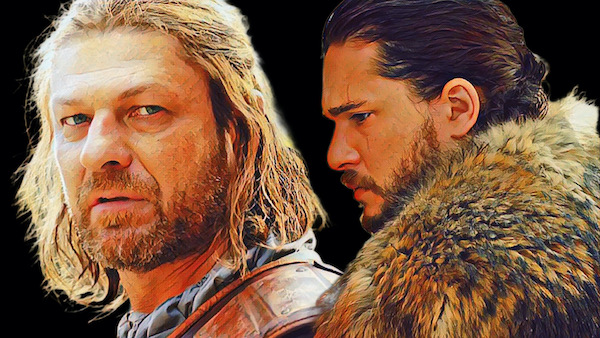
An invisible lineage runs across centuries of the continent’s history, a succession of men who tried to act rightly within a system designed to punish any deviation from cynicism. They are neither saints nor flawless heroes, but they share something rare in Westeros: a refusal to treat people as pieces on a board. Each believed that honor, love, duty, or compassion had intrinsic value. Westeros answered with execution, betrayal, war, or oblivion.
This is not merely about individual goodness but structural misalignment. Westeros does not destroy good men for being good; it destroys those whose principles clash with the feudal logic of power. In that world, survival requires calculation, unstable alliances, and selective cruelty. Those who refuse to pay that price become errors that the system itself moves to correct.
Robb Stark is perhaps the clearest example of this logic. Young, brilliant on the battlefield, beloved by his men and feared by his enemies, he might have won had he been slightly less human. His downfall does not stem from military incompetence but from a deeply personal gesture: he fell in love with Talisa Maegyr. Strategically, it was fatal. Morally, it was an attempt to repair a transgression. Westeros does not reward repair; it rewards calculation. The Red Wedding is not just a massacre but a brutal declaration that feelings are exploitable weaknesses.

Ned Stark, in turn, does not die from childish naïveté, as superficial readings often claim. He dies from coherence. Ned understands the political game perfectly well but refuses to play it to its logical end. His decision to warn Cersei before acting is not stupidity but mercy. He seeks to spare innocent children, echoing the trauma of Robert’s Rebellion and the murder of Rhaegar’s heirs. It is an ethical gesture in an environment where ethics are treated as a competitive disadvantage. His public execution is not merely a Lannister victory; it is the moment Westeros proves that honor has no place in King’s Landing.
Jon Snow inherits this curse in an even harsher form. Ned’s symbolic son, he attempts to lead the Night’s Watch with rationality and empathy, recognizing that the wildlings are not monsters and that the true threat lies beyond the Wall. Politically, the decision is correct. Morally, it is necessary. Socially, it is suicide. His own brothers murder him not for treason but for their inability to accept a broader vision of the world. Jon is punished not for being wrong, but for being right too early.
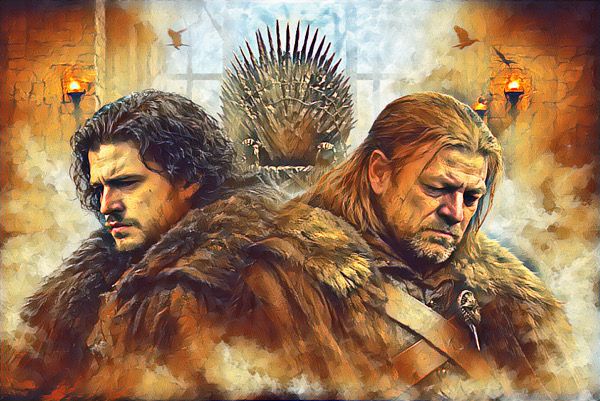
If the Starks represent northern honor, idealistic Targaryens embody another kind of tragedy: that of the reformer crushed by ancient structures. Baelor Breakspear, a prince respected by nobles and commoners alike, dies during the Trial of Seven while fighting to secure justice for a poor knight. The symbolism is almost cruel. The perfect heir falls not in war against external enemies but in an internal ritual of justice. The system devours its finest product.
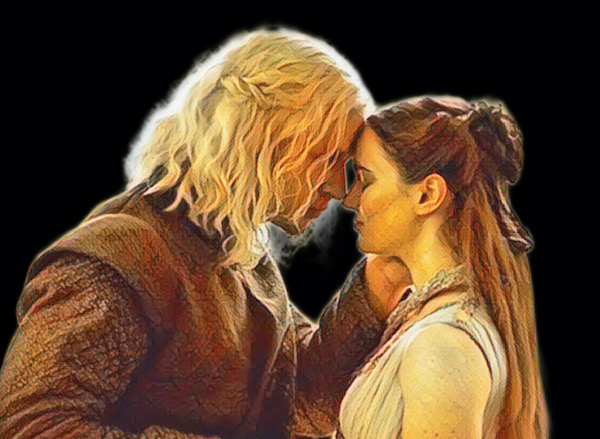
Rhaegar Targaryen is an even more ambiguous and fascinating figure. He was not a tyrant, a hedonist, or a conventional conqueror. He was introspective, scholarly, obsessed with prophecy, and possibly driven by a sincere belief that he needed to save the world. His error was not malice but isolation. Acting according to destiny rather than politics, he unleashed a war that destroyed his family and reshaped Westeros. If he believed he was fulfilling a greater mission, he died without seeing any redemption for that choice.
Baelor and Rhaegar point to an uncomfortable truth: good intentions do not merely fail; they often magnify catastrophe.
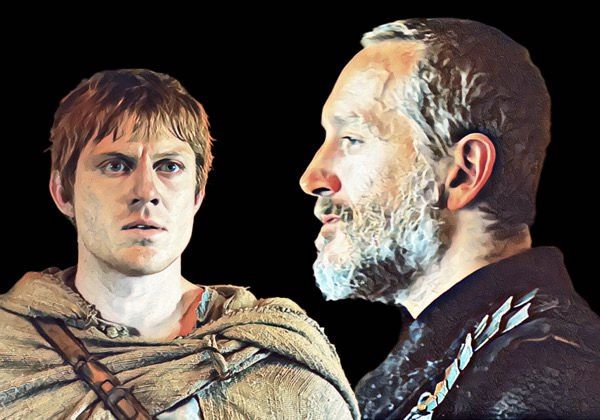
Aegon V, the young Egg of the Dunk and Egg tales, may be the most devastating example of all. Unlike princes raised in the insulated world of court, he knew the common people, traveled in disguise, witnessed injustice, and ascended the throne determined to improve the lives of the smallfolk. His reforms met fierce resistance from the nobility, and his desperate attempt to restore dragons to strengthen the crown ended in the tragedy of Summerhall. Egg does not become a tyrant nor abandon his ideals; he is consumed by them. The boy who wanted to protect the realm ends up destroying part of his own family.
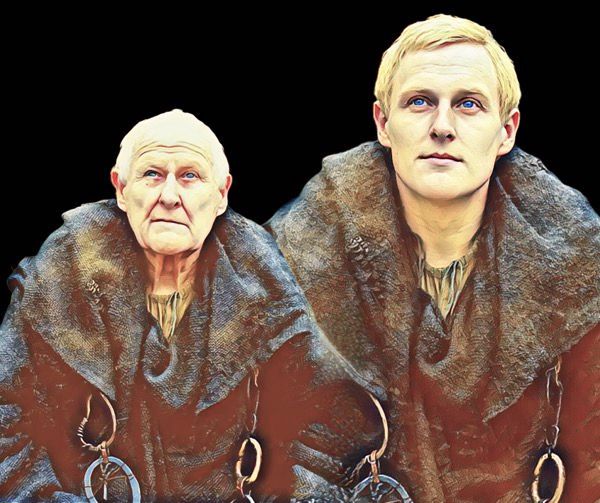
Maester Aemon represents another variation of punished goodness: absolute renunciation. He relinquishes his claim to the throne to prevent succession conflicts, devoting his life to knowledge and duty at the Wall. He lives long enough to see his house nearly extinguished and dies far from everything that might once have been his. His wisdom does not prevent suffering; it only makes him more aware of it.
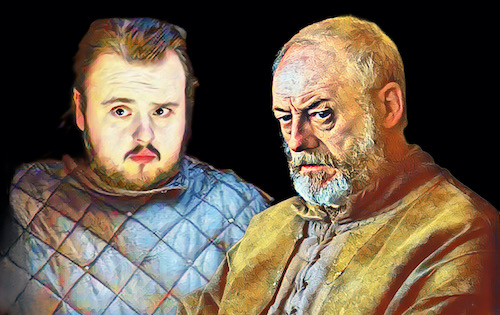
Among knights, the irony is even harsher. Westeros glorifies chivalry while punishing those who truly believe in it. Ser Arthur Dayne, the Sword of the Morning, dies defending what he sees as his rightful duty, a symbol of honor whose story ends in an isolated tower, far from heroic chronicles. Barristan Selmy survives, but his longevity is almost a sentence. He serves both good kings and monsters, witnessing the decay of everything he swore to protect. Davos Seaworth, one of the few genuinely decent men in politics, loses sons, status, and security, surviving only because his goodness is tempered by pragmatism.
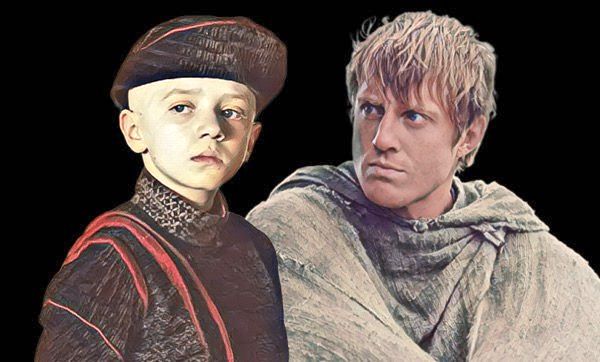
Even more ambiguous figures are drawn into this moral gravity. Jaime Lannister, after saving King’s Landing from destruction, is forever branded a traitor. Tyrion, for all his irony and cynicism, remains one of the few capable of genuine empathy and pays for it with familial rejection and constant isolation. Quentyn Martell, perhaps the archetype of the dutiful young noble attempting an impossible mission, dies almost absurdly, as if the universe itself denies him even the dignity of a heroic death.
What unites all these destinies is not absolute moral purity but the inability to reduce the world to power games. They insist on seeing people where others see instruments. In Westeros, this is not a strategic virtue but a misreading of the system.
There is also a generational element to this tragedy. Each new “good man” seems to arise as an answer to the failure of the previous one, as if the world keeps producing decent figures even while knowing it will destroy them. Ned falls, and Jon emerges. Egg fails, and decades later, Rhaegar attempts a salvific mission. Baelor dies, and history continues to produce princes who believe in the possibility of a just realm.
Martin does not present these fates as morally uplifting nor as proof that goodness is useless. What he suggests is more unsettling: integrity does not shield against tragedy, yet it prevents the world from becoming wholly nihilistic. These men rarely win, but they leave marks, inspire others, and alter trajectories in invisible ways. They lose battles but define the moral horizon of history.
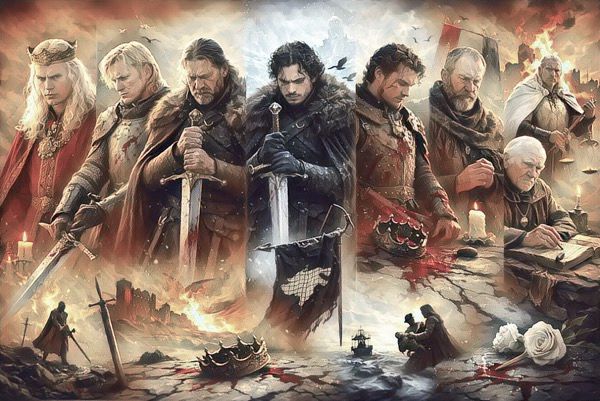
In the end, the message is not that goodness is futile. It is that it is costly. Exceedingly costly. It demands sacrifices that few are willing to make, and the system does not hesitate to exploit. In Westeros, being a good man does not mean living peacefully or dying heroically. It usually means being remembered with sadness, respect, and the uncomfortable sense that the world would have been better had more people been like him.
Perhaps that is why these stories continue to resonate so powerfully. Not because they offer comfort, but because they recognize an ancient and unsettling truth: integrity does not prevent the fall. Sometimes, it is precisely what makes it inevitable.
Descubra mais sobre
Assine para receber nossas notícias mais recentes por e-mail.
 miscelana.com