
The second and final part of Season 4 confirms something the series has perhaps always known but rarely admitted: the pleasure of Bridgerton lies not in novelty, but in refined repetition. It is a universe built to offer the security that everything will turn out well, even as it makes us suffer until the last minute, as if it might not. This is classic Jane Austen sensibility filtered through contemporary television melodrama, where predictability is not a flaw but a pact with the audience.
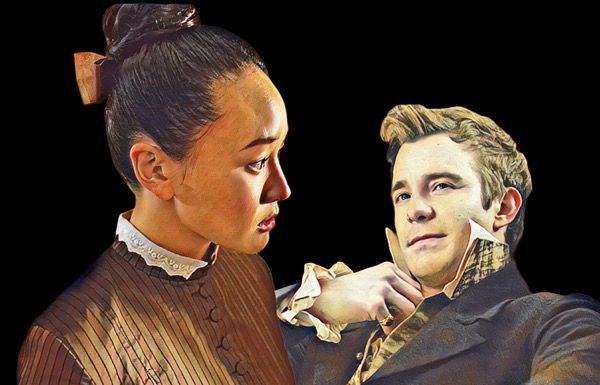
This time, the romance between Benedict Bridgerton and Sophie Baek openly embraces its fairy-tale roots, specifically a Cinderella variation, complete with a masked ball, hidden identity, cruel stepmother, and the seemingly insurmountable social barrier between nobleman and maid. The series follows the book with relative structural fidelity, preserving the major narrative beats while rearranging emotional timing and revelations to sustain television tension. The central conflict — Benedict asking Sophie to be his mistress rather than his wife — functions less as a moral scandal and more as a symptom of a man incapable of understanding the social weight of what he is offering. Here, the adaptation attempts to modernize the source material, shifting the focus from male “redemption” to female dignity, even if the fantasy of love taming a free spirit still lingers beneath the surface.
Other critics have pointed to fatigue with the formula, and it is not difficult to see why. Much of the dramatic anguish stems from misunderstandings that could be resolved through a frank conversation, a classic romantic device that now feels almost artificial. Still, the show manages to turn this structural weakness into emotional propulsion, because its characters inhabit a world where speaking plainly is itself a transgression. Silence, pride, and self-censorship are not merely narrative conveniences but internalized social rules.
Characters from previous seasons return organically rather than as mere fan service. Penelope now grapples with the consequences of being Lady Whistledown at a new stage of life, Colin displays a calmer maturity, and the Featherington family provides a comedic and emotional counterbalance to the central drama. Violet Bridgerton, meanwhile, gains her own storyline as she explores the possibility of love after widowhood, broadening the show’s emotional range and reinforcing the idea that romance does not belong only to young debutantes. Lady Danbury continues to serve as the bridge between generations and classes, a social strategist whose presence reminds us that behind every love story lies a game of power.
And then there is Queen Charlotte, who once again steals every scene with the authority of someone who knows the series revolves around her as much as it does around the Bridgertons. Golda Rosheuvel has created one of the most distinctive characters on recent television: simultaneously extravagant and deeply melancholic, comic and intimidating, almost caricatured on the surface yet painfully human underneath. After the emotional depth revealed in the spin-off centered on her youth, every gesture now carries an implied memory, turning seemingly trivial remarks into echoes of a life shaped by duty, solitude, and a love that had to survive illness and time. In this season, Charlotte acts less as a social antagonist and more as an experienced observer of other people’s passions, someone who recognizes patterns because she has lived through them all.

The conclusion is deliberately satisfying, closing Benedict and Sophie’s arc with the sense that the universe has returned to its natural balance while leaving wide-open doors for the future. It is not a surprising ending, but one that fulfills its emotional promise with almost mathematical precision. We know there are many books left to adapt and many siblings left to marry, and the series makes sure to remind us of that without overshadowing the current couple.
If there is fatigue, it is less creative than structural: Bridgerton remains faithful to what it has always been. Pastel gowns, stylized intimacy, whispered honorifics, and contrived obstacles resolved at the last possible moment are part of the show’s language. The real question is not whether the series has changed, but whether the audience has. For viewers willing to accept the pact, Season 4 delivers exactly what it promises: luxurious escapism, grand romance, and the comforting illusion that, in a rigidly stratified world, love can still rearrange everything.
And perhaps that is precisely why it endures culturally. We do not watch Bridgerton to discover what will happen, but to feel — again and again — what it is like to believe that it will all work out.
Descubra mais sobre
Assine para receber nossas notícias mais recentes por e-mail.
 miscelana.com