
It’s profoundly moving — and also strangely inevitable — about the fact that, after a quarter century spent reinventing the very idea of a pop band, Gorillaz now arrives at an album shaped by death, grief, and a kind of serene melancholy that Damon Albarn had been hinting at in interviews for years, as if he already knew this work was coming. From the beginning, the project he created with Jamie Hewlett functioned as a space where Albarn could displace emotions that did not fit within the traditional framework of British rock, first escaping the enormous shadow of Blur and later freeing himself from the expectation of endlessly repeating the persona of the ironic, urban frontman of the 1990s. Gorillaz was born as a satire of the industry and celebrity culture, but it quickly became something far more intimate, almost an emotional laboratory in which Albarn experiments with identities, sonic geographies, and states of mind ranging from hedonism to spiritual exhaustion, from political commentary to veiled confession.

Death has always been there, sometimes disguised beneath danceable beats, sometimes emerging explicitly, as in “El Mañana,” with its suspended lament, or in “On Melancholy Hill,” whose almost childlike sweetness hides an existential emptiness that only reveals itself when heard as an adult, or in “Souk Eye,” perhaps the most openly sad song Albarn has written under the Gorillaz banner, a farewell to a lover that also sounds like a farewell to oneself. Over the years, he has spoken repeatedly about depression, isolation, and the permanent sense of dislocation that accompanies decades in the spotlight, but rarely in literal terms, preferring to transform those feelings into hazy soundscapes populated by guest voices and animated characters that function simultaneously as shields and mirrors. The deaths of his parents, which occurred within a relatively short span in recent years, seem to have broken that mediation, bringing an emotional urgency that no longer needed to hide behind irony or fiction, and the symbolic gesture of scattering his father’s ashes in the Ganges — something Albarn described as both devastating and strangely peaceful — became the conceptual seed of the new album.
In The Mountain, released yesterday, this experience translates not into a dark record in the traditional sense but into a contemplative, almost spiritual work in which death appears not as violent rupture but as continuity, transformation, and dissolution of the ego, ideas that resonate directly with the South Asian philosophies Albarn encountered during his travels and creative residencies. Musically, the album expands Gorillaz’s global vocation by incorporating instruments and melodic structures inspired by Indian, Middle Eastern, and West African traditions, yet it does so with a delicacy that avoids superficial exoticism, favoring atmospheric textures, hypnotic drones, and arrangements that seem to breathe rather than simply advance. The result is a work less concerned with immediate singles and more with the experience of continuous listening, as if each track were a chapter in a meditation on finitude and memory.
Within this context, “The Empty Dream Machine” emerges as one of the album’s most devastating and beautiful moments, a song that sounds simultaneously technological and ghostly, as if an artificial intelligence were trying to recreate the human sensation of longing and missing someone and failing by mere millimeters, which makes it even more painful. Albarn’s voice appears fragile, almost depersonalized, surrounded by synthesizers that pulse like machines at rest and harmonies reminiscent of a distant choir, while the lyrics suggest a world in which dreams continue to be produced even after the dreamer is no longer there, a transparent metaphor for the persistence of memory after death and also for the very logic of Gorillaz, a virtual band that survives independently of its creator’s physical body. It is difficult not to hear this track as an echo of “Every Planet We Reach Is Dead,” another meditation on emptiness and transcendence, now filtered through two additional decades of experience, losses, and fatigue.
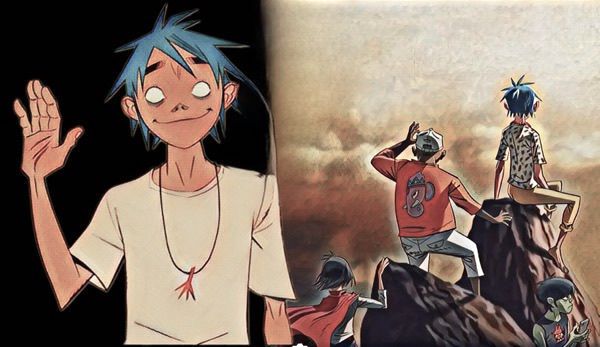
The videos and short films accompanying the album reinforce this reading by presenting the animated characters not as irreverent caricatures but as wandering figures in vast, silent landscapes, crossing deserts, mountains, and ghostly cities that seem to exist outside historical time, while the visual aesthetic favors desaturated colors and slow movements, as if everything were being observed through a veil. The tour announced for this year promises to incorporate this contemplative dimension through immersive staging and continuous projections, less like a traditional concert and more like an audiovisual installation, something consistent with Albarn’s current phase, as he has increasingly moved toward operatic, collaborative, and interdisciplinary projects.
What is most striking is that, rather than sounding like an epilogue, The Mountain conveys the sense of an artist who no longer needs to prove anything to anyone and therefore can allow himself radical vulnerability without the veneer of cynicism that marked much of 1990s Britpop. If Gorillaz began as a critique of the emptiness of pop culture, it now arrives at a point where it seeks meaning within that same emptiness, accepting that death may be the only truly universal theme that remains once all ironies have been exhausted. For those who have followed Albarn’s trajectory for decades, listening to this album feels like watching a circle close with unexpected gentleness, not as a definitive conclusion but as the deep pause between breaths, that instant in which silence ceases to be absence and becomes presence.
Descubra mais sobre
Assine para receber nossas notícias mais recentes por e-mail.
 miscelana.com