
For years, the Screen Actors Guild Awards — now renamed simply as the Actor’s Awards — has functioned as a sort of “Oscars’ dress rehearsal”, but in 2026 that logic feels even more transparent because the ceremony arrives with the curious sense that the main categories are almost already set, and precisely for that reason it has the potential to ignite the areas where real uncertainty still exists. The prize, voted on by a vast body of union performers, remains the most direct barometer of what the Academy is likely to follow in the final stretch.

The first step is to distinguish what appears “decided” from what remains open. The Best Actress race, as the season has unfolded so far, feels largely settled, not because of a lack of strong contenders but because the frontrunner’s narrative has consolidated early. The key factor is not merely who is ahead, but the kind of victory the union tends to reward, since recognition from peers often functions as emotional validation from the industry itself, and when that validation occurs without controversy, the campaign arrives at the Oscars with an aura of inevitability.
Best Actor presents a slightly different picture because a clear favorite exists, yet the context adds tension. Timothée Chalamet emerges as the name with the strongest sense of destiny, supported by a rare combination of visibility, professional respect, and generational narrative, almost as if the industry were ready to formally consecrate him. Still, the season has shown enough volatility to prevent any absolute sense of preordained victory. When people say the Actor’s Awards speak directly to the Oscars, this is exactly what they mean: the public spectacle of a professional community choosing, in front of everyone, whom it wants to push toward the finish line. Chalamet, notably, has won the SAG before and still lost the Oscar, a reminder that even the strongest signal is not an iron guarantee.
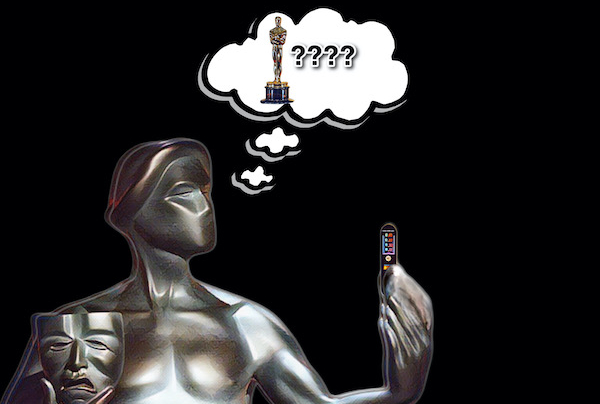
This is where the most contested and potentially decisive categories of the night come into play. Supporting performances often become the pivot point when the lead races seem to be moving on their own momentum. If Best Actress appears headed toward Jessie Buckley and Best Actor strongly toward Chalamet, then the question shifts: which film, which campaign, and which narrative will gain emotional force from a supporting trophy precisely as the season enters its final curve.
This year’s landscape strongly favors that kind of shift because there has been no consensus whatsoever in the supporting races. Each major ceremony has crowned a different winner. At the Golden Globes, Teyana Taylor won Supporting Actress for One Battle After Another, while Stellan Skarsgård took Supporting Actor for Sentimental Value. The Critics’ Choice Awards went in a completely different direction, honoring Amy Madigan for Weapons and Jacob Elordi for Frankenstein. The BAFTAs then selected yet another pair, awarding Wunmi Mosaku for Sinners and Sean Penn for One Battle After Another. The result is a fragmented race with no dominant narrative and none of the inevitability that usually emerges when the season converges around a single contender.
That fragmentation turns the Actor’s Awards into the moment when the industry will likely try to break the tie. When a season reaches this stage without a recurring winner, the union’s choice can serve as the first clear sign of alignment among actors or, conversely, confirm that the contest will remain unpredictable until the final Oscar ballot. More than rewarding an isolated performance, the outcome can reposition an entire film in the industry’s imagination and supply the emotional argument a campaign needs to become dominant at precisely the decisive moment.

In this context, even the discussion of who was not nominated carries weight. In the case of Wagner Moura, his absence from the list does not equal irrelevance, particularly for a Brazilian actor who has built a solid international career increasingly integrated into the Anglo-American circuit. The Actor’s Awards does not merely honor performances; it also functions as a ritual of belonging. Circulating in these spaces, being recognized by peers, and participating in the industry’s conversation builds a form of symbolic capital that rarely makes headlines but directly shapes future opportunities.
If the Oscars are the monument, the Actor’s Awards are the rehearsal room where the industry decides what it wants to turn into a monument. And in 2026, with Actress and Actor seemingly moving toward narratives that are already nearly written, it is the supporting categories that may rewrite the final paragraph of the season.
Descubra mais sobre
Assine para receber nossas notícias mais recentes por e-mail.
 miscelana.com