
When Noel Gallagher, the principal songwriter of Oasis and one of the authors who helped define Britpop, stepped onto the stage at the BRIT Awards 2026 to receive the Songwriter of the Year prize, the moment did not feel like a sudden coronation but like an inevitable recognition. There was no recent release cycle to anchor the narrative, and that is precisely what makes the gesture revealing. The ceremony chose the survival of his songs over time, chose the catalogue, chose the idea that certain pieces of music eventually cease to belong to their author and begin to function as shared emotional heritage.
Noel has never cultivated the fantasy of the divinely inspired artist who writes in a blaze of genius and then pretends to be surprised when the world applauds. He may be arrogant, but his arrogance is rarely framed as “I am a genius.” What he claims, again and again, is something else entirely: focus, discipline, and the daily obsession of someone who treats songwriting as work. That aligns perfectly with the central paradox of the 2026 award. He was honored even while admitting he had not written a new song in two years, a remark that sounded unmistakably Noel, half-amused, half-provocative, entirely self-aware: “I haven’t written a song in two years. It’s quite mad.”

Onstage, he began by acknowledging the people who transformed his compositions into cultural events, starting with his brother and the musicians who embodied those songs: “I’ve got to thank my brother… Bonehead, Guigsy, Tony McCarroll, Alan White, Gem, and Andy. They brought those songs to life.”
He followed with a line that sounded like a joke but revealed something essential about scale and myth in rock music: “Without them, I’d just be a singer-songwriter, and nobody gives a shit about singer-songwriters.” What lies beneath that sentence is not false modesty but perspective. A good song becomes historic only when it acquires bodies, friction, performance, cultural timing, and, in the case of Oasis, a volatile chemistry that cannot be engineered.
He then pointed to the element that truly sustains a catalogue for decades rather than a single hype cycle: the audience. “More importantly, I’d like to thank you, the people who have kept these songs alive for the last 35 years.” In that sentence lies the real explanation for the award. The songs did not survive merely because they were once popular; they survived because people kept using them, singing them, carrying them forward.
Influences: British pop tradition with stadium ambition
As a songwriter, Noel is a powerful synthesizer of postwar British pop tradition. The backbone comes from the melodic architecture of the Beatles, deceptively simple until one attempts to reproduce the same inevitability, combined with mod spirit and guitar rock designed for communal singing. He has always aimed to write songs that behave like anthems, pieces that feel familiar from the first chord, as if they had always existed. That familiarity is not accidental; it is method. Direct progressions, expansive choruses, lines that refuse to lock into a specific story and instead invite listeners to inhabit them.
Successes: anthems that outgrew the band
In the 1990s, as Oasis’s principal songwriter, Noel produced a sequence that became grammar for British pop culture, not merely the repertoire of a band: “Live Forever,” “Wonderwall,” “Don’t Look Back in Anger,” “Champagne Supernova.” These songs crossed generations because they were not tied to a single moment. They outlived Britpop and the 15-year breakup of Oasis, resurfacing as a collective catharsis whenever Britain needs to recognize itself in something.
Later, with Noel Gallagher’s High Flying Birds, he remained a respected author even if the cultural dominance of the 1990s could not be replicated. The key point is that respect for the songwriter never disappeared, because “Noel the author” has always been larger than “Noel the band of the moment.” The 2026 award rests on that distinction.
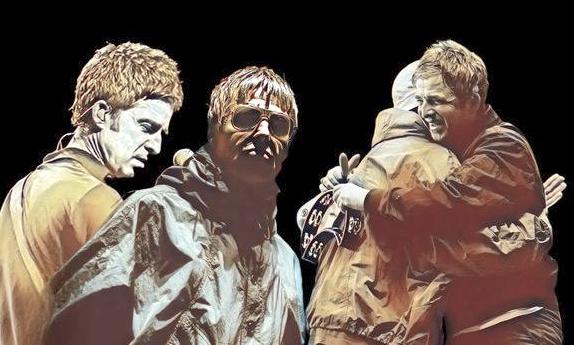
Style: constructed simplicity, controlled emotion
Noel’s style is paradoxical. Musically, he works with limited resources and yet produces a sense of grandeur. Lyrically, he favors ambiguity, lines that suggest transcendence without becoming a closed confession. The result is emotional appropriation. Each listener can sing the song as if it were their own.
That helps explain why the award makes sense even without a recent release. In 2026, the BRIT Awards did not honor present productivity but the ongoing emotional utility of the catalogue.
Discipline instead of genius
Noel is not humble, but neither does he cultivate the image of mystical talent. He speaks of songwriting as labor, repetition, and showing up every day. The controversy over winning without new material becomes part of the narrative itself: discipline can mean building something so solid that it continues to resonate even during periods of creative silence.
In the brief interview after the ceremony, he repeated the same dry disbelief: “I haven’t written a song in two years. It’s quite mad.” There was no apology in the statement, only ironic astonishment.
He also reflected on the longevity of Oasis’s audience, noting how the band’s music has passed from one generation to the next. Parents now bring their children to shows, proof that the songs have detached from their original context and acquired a life of their own. He recalled writing them in a modest Manchester council flat without imagining any long-term impact, evidence that the scale of the legacy was never planned.
Reception: tribute or nostalgia?
The decision divided opinion. Some celebrated it as overdue recognition of one of Britain’s most important songwriters of his generation. Others questioned honoring “the year” when the achievement being acknowledged spans decades. Yet the controversy itself reinforces the central point. The award does not attempt to prove Noel’s relevance through a current release. It asserts that he remains relevant because the songs never stopped circulating.


A prize that recognizes cultural endurance
The BRIT Awards 2026 victory functions almost like a living epitaph for Britpop, though without the melancholy of closure. It is a reminder that certain authors acquire a second life once their songs enter a nation’s emotional vocabulary.
That is why Noel, even without recent “new” work, walks onstage with the authority of someone who wrote the soundtrack to millions of lives and can acknowledge, without false modesty, what it became.
Perhaps that is the clearest definition of legacy: when time stops being an adversary and begins working in the work’s favor.
Descubra mais sobre
Assine para receber nossas notícias mais recentes por e-mail.
 miscelana.com