
In June 1976, a film about the birth of the Antichrist premiered in theaters and forever changed the landscape of religious horror. Fifty years later, The Omen (1976) remains one of the most influential classics of the genre, driven by Gregory Peck’s performance, the deeply unsettling figure of Damien Thorn, and above all, the monumental score composed by Jerry Goldsmith. Renewed interest following the release of The First Omen has brought the film back to the center of pop culture, confirming that its impact is far from fading.

When I wrote about the franchise in 2024, upon the prequel’s release, it was already clear that the original had become not merely a box-office success of the 1970s but a cultural landmark whose influence spans decades and formats. Earlier still, in 2021, I devoted an entire piece to Jerry Goldsmith’s score, precisely because it functions not as background music but as the emotional backbone of the film. Revisiting the movie now, on the eve of its fiftieth anniversary, reveals how inseparable these two dimensions — narrative and musical — truly are.
The story of The Omen (1976) begins with a premise so brutally simple that it becomes devastating. American diplomat Robert Thorn loses his newborn son in Rome and, persuaded by a priest, agrees to replace the child with another baby whose mother supposedly died during childbirth that same night. His wife, Katherin,e never learns the truth, and the boy grows up as the legitimate heir to a powerful family. His name is Damien. For several years, everything appears normal until increasingly sinister events begin to surround them. Mysterious deaths, hostile animals, panic in the presence of religious symbols, and the sudden arrival of an ominous nanny suggest that something is profoundly wrong. A desperate priest claims the boy is the Antichrist. Yet, the film’s power lies in how long Thorn resists believing it, because the horror emerges from rational disbelief colliding with the impossible.
Widely regarded as one of the greatest films about the Antichrist ever made, The Omen places evil inside the family and within structures of power. Unlike many demonic narratives, the danger does not come from chaotic external forces but from something carefully protected by institutions, wealth, and political prestige. That choice remains disturbing because it suggests that the threat may arise precisely where security is assumed.
Screenwriter David Seltzer reinforces this unease by blending biblical references with invented material, including the famous prophecy quoted in the film, often mistaken for an authentic passage from Revelation despite being created specifically for the story. In this case, cinema does not merely depict religious imagination — it reshapes it, producing new mythologies that become absorbed into popular culture.

Much of the emotional weight rests on Gregory Peck’s performance. Known for portraying morally upright figures, he presents Robert Thorn as a man shattered by guilt and loss, unable to accept the supernatural until denial is no longer possible. Lee Remick crafts a Katherine increasingly undone by the sense of danger within her own home, while Billie Whitelaw delivers an unforgettable Mrs. Baylock, whose absolute devotion to the child is as chilling as her composure. Four-year-old Harvey Spencer Stephens barely speaks, yet his silent presence dominates the film. Damien Thorn became one of horror’s most enduring icons precisely because he never needed to reveal his true nature openly.
The film’s violence, though memorable, is remarkably restrained. Director Richard Donner staged deaths as extreme accidents, evoking biblical punishments without graphic excess. The nanny’s suicide at the birthday party, the baboon attack, the hospital fall, and the infamous decapitation of the photographer became permanent images in the genre’s collective memory. Each scene feels less like shock for its own sake and more like confirmation of an inescapable destiny, as if an unseen force were rearranging the world around the child.
Jerry Goldsmith’s Score and the Power of “Ave Satani”
If one element elevates The Omen from a strong horror film to something almost ritualistic, it is Jerry Goldsmith’s score. Over his career, he received eighteen Academy Award nominations, winning his only Oscar for this very work — a remarkable achievement in a genre often overlooked by awards bodies.
In my 2021 article, I noted that the music establishes the film’s emotional language even before any dialogue begins. The opening choral piece in Latin, “Ave Satani,” remains one of the most striking in cinema history. Rather than relying on jump scares or dissonant noise, Goldsmith chose liturgical grandeur that evokes sacred music while completely subverting its meaning. The result is a sense of ominous ceremony, as though the events unfolding are part of an irreversible cosmic design.
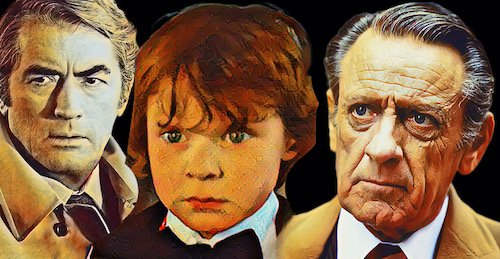
“Ave Satani” was nominated for Best Original Song — an extraordinary rarity for a horror film — while the score itself won the Oscar. Its contrast with the tender theme associated with the Thorn family intensifies the tragedy, suggesting a fragile normalcy destined to collapse. This musical duality is central to the film’s lasting power and influenced countless later works that use religious choral elements to signal supernatural inevitability.
Why Does The Omen Still Terrify After 50 Years?
Because its horror does not rely on visual spectacle or sudden shocks but on the deeply unsettling idea that evil can grow within normal life, protected by love, power, and institutions. The film transforms an apocalyptic narrative into a family tragedy, sustained by powerful performances and Goldsmith’s monumental score. What lingers is not merely fear of the supernatural but the possibility that no one will recognize the danger until it is too late.
Legacy and the Franchise’s Revival
The success of The Omen (1976) launched a long-running franchise that includes sequels, a remake, a television series, and, most recently, the prequel The First Omen, which explores the events leading to Damien’s birth and the conspiracy behind it. The new film has reignited interest in the original and highlighted how many of its unanswered questions continue to fascinate audiences.

Yet none of the subsequent installments has fully replicated the impact of the first film. What made The Omen unique was the rare convergence of historical moment, cast, restrained direction, and a score of overwhelming presence. It is a film that does not depend on narrative twists to disturb, because its true power lies in its atmosphere of inevitability.
Half a century later, Damien Thorn remains one of cinema’s most unsettling figures, and “Ave Satani” is instantly recognizable even to those who have never seen the film in full. Few horror classics have aged with such authority. The Omen does not feel like a relic of the past but like a prophecy that never stopped echoing, reminding us that some stories endure because they address fears that never truly disappear.
Descubra mais sobre
Assine para receber nossas notícias mais recentes por e-mail.
 miscelana.com