
If approved, the acquisition of Warner Bros. Discovery by Paramount Skydance will not be just another mega corporate deal. It will represent a structural reorganization of the global audiovisual industry, comparable to the great consolidations of the past, but with one crucial difference: this time it unfolds under the dominance of technology platforms, enormous debt burdens, and an industry already weakened by the pandemic, strikes, and shrinking advertising revenues.
Ted Sarandos himself let slip, perhaps unintentionally, what is truly at stake. Commenting on the rival proposal, he was blunt in saying the plan depends on massive cuts. “It means less production, fewer people working.” In another moment, he detailed the scale of the reductions promised to lenders: more than $16 billion in cost cuts over roughly 18 months. This is not simply integration. It is a survival surgery.
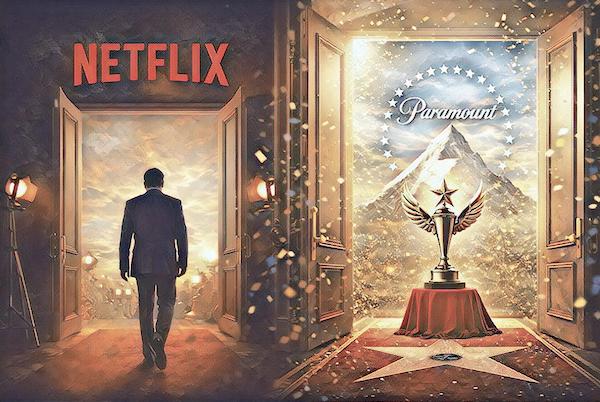
This assessment aligns with what financial insiders and executives have been repeating privately. Paramount did not pursue Warner out of classic expansionist ambition, but because it urgently needed scale to compete with Netflix, Amazon, and YouTube. According to people close to the deal, the acquisition was viewed as existential. For Netflix, a desirable asset. For Paramount, a matter of life or death.
A costly victory loaded with risks
What made the agreement possible was not only the $110 billion price tag, but also the personal financing guarantee provided by Larry Ellison, Oracle’s founder and one of the world’s richest men. That guarantee convinced Warner’s board that Paramount could close the transaction despite its heavy debt load.
The price of that security, however, is the need for deep cuts afterward. Sarandos described the scenario with unusual candor for a CEO in the middle of an industry battle: the largest cost centers are people and production. In other words, exactly what sustains Hollywood’s creative economy.
At the same time, he called for the deal to undergo the same regulatory scrutiny faced by Netflix. “It should be examined under the same microscope.” This is not merely institutional self-defense. It is a warning that approval is far from certain.
There are antitrust hurdles, reviews across multiple countries, and the challenge of integrating two century-old conglomerates with large linear television businesses, precisely the segment under the greatest pressure from streaming.
A new giant, but not necessarily an invincible one
Interestingly, Sarandos also downplayed the immediate competitive impact. Commenting on the combination of HBO Max and Paramount+, he quipped, “One and a half plus one and a half still equals three,” referring to audience share.
The remark suggests that the real challenge is not the sum of content libraries, but execution. Integrating platforms, brands, corporate cultures, and global strategies while cutting billions is an almost impossible balancing act.
Paramount itself has already gone through waves of layoffs and internal restructuring to reduce costs even before acquiring Warner. That indicates rationalization will not begin after the merger. It is already underway.

The domino effect beyond the United States
If Hollywood is affected, the international repercussions may be even more profound. Warner and Paramount operate television networks, studios, sports rights, and local businesses across Europe, Asia, and Latin America.
In Latin America, Paramount controls strategic assets such as Telefe in Argentina, one of the region’s largest television production hubs. In recent years, the company carried out significant layoffs and cost reductions that already signaled a structural shift. Absorbing Warner could intensify this process, centralizing decision-making and reducing local production in favor of global or large-scale regional content.
For Brazil, the outlook is ambiguous. On one hand, integration could generate greater investment in projects capable of traveling internationally. On the other hand, there is a real risk of cuts to local operations, fewer commissions, and concentration of production in a handful of hubs.
Historically, mergers of this magnitude rarely preserve redundant structures. Two marketing teams, two legal departments, two regional production divisions, all tend to be unified.
Politics, power, and the new Hollywood
Another element that makes this deal singular is its political dimension. The Ellison family’s proximity to the U.S. government and the influence of billionaire donors turned the corporate contest into a matter of strategic leverage. The agreement would place historic studios, rival news networks such as CBS and CNN, and global streaming platforms under a single corporate umbrella.
This reinforces the sense that the entertainment industry is entering a phase shaped not only by media executives, but by technology capital and geopolitical interests.

The real test begins after approval.
Even if all authorizations are granted, closing the deal will not be the end of the story. It will be the beginning. Integrating conglomerates of this size can take years, with unpredictable consequences for production, distribution, and employment.
Sarandos, perhaps with a mix of relief and strategic calculation, summarized Netflix’s position in revealing terms by saying Warner was something they wanted but did not need. By walking away, the company preserved capital and avoided enormous integration risks.
For Paramount, however, there is no turning back. The company has gone all in.
If the merger succeeds, it could create a truly global competitor capable of challenging technology platforms. If it fails, it could accelerate the contraction of traditional production and deepen the audiovisual crisis, especially outside the United States.
The next chapters will not be written at award ceremonies or box offices, but in spreadsheets, budget cuts, and regulatory decisions. And as the industry has already begun to realize, the cost of this transformation may be paid primarily by the people who actually make the content exist.
Descubra mais sobre
Assine para receber nossas notícias mais recentes por e-mail.
 miscelana.com