
Little by little, as more information about the cast of Season 4 of The Gilded Age becomes official, it is getting easier to “sketch,” or rather speculate, about what might happen when we return to 19th-century New York, especially after the turbulent ending of the third season.
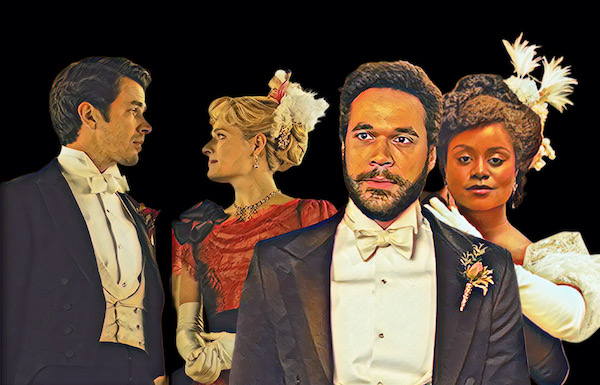
One of the expected announcements, now confirmed, is that Kelley Curran, who has played Enid “Turner” Winterton since the first season, has officially been promoted to series regular. It was somewhat obvious, after all, since she agreed to the marriage of convenience with Oscar Van Rhijn, which means she will now be a constant presence on 63rd Street by Central Park. Still, it matters to have that confirmation because anyone who loves Oscar and hopes for his happiness will now have to reckon with Enid being part of the plan.
In the same way, once Dr. William Kirkland proposed to Peggy Scott, Jordan Donica was also promoted to series regular. Naturally, we want to see much more of this couple, which has become one of the most compelling dynamics in the series.
Grover Cleveland and politics in Gilded Age New York
Other names gradually reveal the kinds of figures who will circulate through New York society during the Gilded Age through guest appearances.
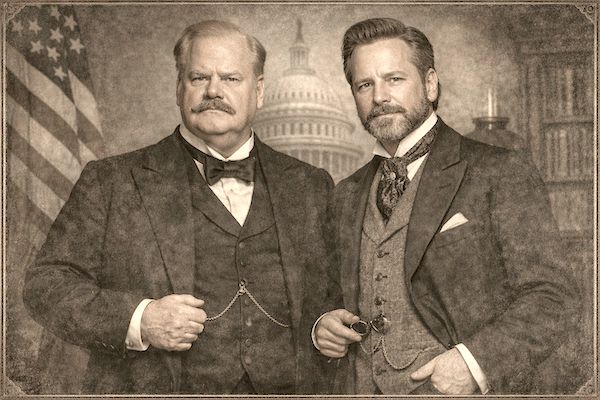
For example, Jim Gaffigan will portray U.S. President Grover Cleveland. It is a historically precise choice. Few American leaders were as deeply connected to the politics and elites of New York as Cleveland was. He was not simply the President of the United States at that moment. In many ways, he was a product of the political machinery of New York State and of the reformist atmosphere that marked the final decades of the 19th century.
A lawyer in Buffalo and Cleveland built an unusual reputation for the time by presenting himself as a reformer determined to combat corruption and political patronage. That image solidified when he became mayor of Buffalo in 1881 and, soon after, governor of New York State in 1882, when he began attracting national attention.
New York was the political and economic heart of the United States during the Gilded Age. Whoever controlled the state had, in many ways, a clear path to the presidency. Cleveland won the presidential election of 1884 by an extremely narrow margin, and New York State was decisive in that victory. The result there was so tight that many historians still point to it as one of the most delicate electoral moments in American history.
That political dependence explains why Cleveland maintained a constant relationship with the city even after becoming president. New York was not merely an important urban center. It was the country’s great financial hub, dominated by banks, investors, railroad magnates, and industrial families who, formally or informally, influenced the direction of national politics.
Presidents often had to negotiate with this economic elite, whether to guarantee financial stability or to maintain political support.

It is within that context that the idea of Cleveland visiting New York to cultivate relationships with high society makes sense. The presence of a president in the city’s drawing rooms, speaking with businessmen and influential figures, was not simply a social gesture. It was an essential part of politics at the time.
The Gilded Age was defined precisely by this intersection of money, social prestige, and institutional power. In other words, Cleveland will certainly be on the radar of George and Bertha Russell.
As mentioned earlier, the dedication of the Statue of Liberty will reportedly play a role in the season, and the American president was present at the ceremony. Cleveland delivered a speech about liberty and democracy that echoed the image of the United States as a destination for immigrants arriving through New York’s harbor.
Yet Cleveland never had a completely comfortable relationship with the great millionaires of his era. Although he was respected for his fiscal conservatism and for defending economic discipline, he was also willing to confront business interests when he believed it necessary. He vetoed legislation that benefited railroad companies and criticized excessive corporate power at times, which gave him the ambiguous reputation of both ally and adversary to the great fortunes of the Gilded Age.
That is precisely why Grover Cleveland’s presence in a narrative like The Gilded Age makes so much sense.
Daniel Manning and the power behind the scenes
Another confirmed addition is Dallas Roberts, who will portray Daniel Manning, a seasoned politician who served as Secretary of the Treasury during Cleveland’s administration.
If Cleveland’s presence represents the direct connection between the White House and New York’s elite, the inclusion of Daniel Manning may be even more revealing about the kind of power that operated behind the scenes.
Manning was not only an important Democratic Party figure. Above all, he was a highly influential political operator in New York, someone who moved comfortably between newspapers, election campaigns, and the world of finance.
He began his career in journalism and became editor of the Albany Argus, one of the most important Democratic newspapers in the state. That position allowed him to participate directly in the formation of political alliances and the orchestration of election strategies.
In the second half of the 19th century, newspapers were not merely vehicles of information. They functioned as centers of political power capable of mobilizing voters, pressuring parties, and shaping public reputations.
Within that environment, Manning became a central figure in New York’s Democratic Party. He helped organize campaign strategies, negotiated alliances, and gradually earned a reputation as one of the party’s most respected strategists. His influence grew especially during the rise of Grover Cleveland, whose political career he supported from its early stages.
When Cleveland became governor of New York and later President of the United States in 1885, Manning was already considered one of his most trusted allies. It was therefore no surprise when Cleveland invited him to occupy one of the most powerful positions in the federal government: the Department of the Treasury.
Between 1885 and 1887, Daniel Manning served in that role, placing him at the center of American economic policy during a moment when the United States was experiencing rapid industrial expansion and unprecedented financial growth.
The position required precisely the kind of political skill Manning possessed. He had to manage the federal budget, oversee fiscal policy, and deal with constant pressure from businessmen, bankers, and politicians.
Yet Manning was never merely a technocrat. He remained a sophisticated political operator who understood that economic decisions were also political decisions. His closeness to Cleveland reflected a rare level of trust within American politics at the time.

Health problems, however, cut his tenure at the Treasury relatively short. In 1887, Manning left the position and returned to New York, where he remained connected to business and finance until his death later that same year.
Daniel Manning’s presence in a narrative like The Gilded Age makes perfect sense because he represents a particular form of power that defined that historical period.
Virginia Saville and the other side of New York
There is also space for new fictional characters who promise to move the story in different directions.
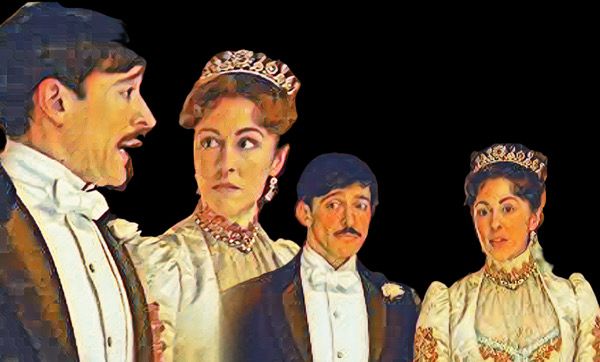
One of them is nurse Virginia Saville, portrayed by Elizabeth Marvel. She works at the Neighborhood Settlement House, an institution devoted to social assistance in the Lower East Side.
Settlement houses emerged in the United States in the 1880s and 1890s as community centers aimed at immigrants and working-class populations, especially in overcrowded neighborhoods such as New York’s Lower East Side. These institutions offered education, basic medical care, English classes, cultural activities, and social support for newly arrived families.
This movement was deeply connected to the explosive growth of the city at the time. Between 1880 and 1900, New York received millions of immigrants from Europe, many of them Eastern European Jews, Italians, and Germans. Urban infrastructure did not keep pace with this growth, and entire neighborhoods began living under extremely precarious conditions.
It was within that context that philanthropic and reformist initiatives emerged in an attempt to improve living conditions for those communities.


Introducing a nurse connected to a settlement house into the narrative of The Gilded Age likely signals a thematic expansion of the series. Until now, the story has focused primarily on New York’s social elite and on the disputes between old aristocratic families and the so-called “new money.” By bringing in characters linked to the Lower East Side and to social reform work, the show may begin to explore another side of the city.
This development also connects with the trajectory of Peggy Scott (Denée Benton). Peggy has already functioned as a bridge between different social realities within the series, addressing racial, intellectual, and professional questions that rarely appear inside elite drawing rooms.
It may also represent what Marian Brook (Louisa Jacobson) understands as her “new path.”
Marian has always been modern in her thinking and concerned with social issues, which makes it entirely plausible that she might embrace such a cause. And the idea that The Gilded Age will portray, in some way, the tension between exuberant wealth and profound social inequality feels particularly appropriate.
After all, one of the defining elements of the very expression “Gilded Age,” coined by Mark Twain, is precisely that paradox. Twain used the term to describe a society covered by a thin layer of brilliance while concealing far deeper structural problems.
Another character who might draw inspiration from Virginia Saville is Bertha Russell. Bertha, inspired by Alva Vanderbilt, will eventually become a reformist woman, and she has already hinted at that direction by welcoming divorced women at her Newport ball. This could open another path for her, perhaps even a way to reconnect with George.
Porter, Jack, and the new millionaires
The final name officially announced is Andrew Burnap, who will play Porter, a young member of high society educated at an Ivy League university and interested in investing in exciting new ventures.
Here lies the connection with Jack Trotter, played by Ben Ahlers, now a millionaire himself and still creatively inclined, already investing in new ideas. Could Porter also become a new romantic interest for Marian?
And yes, forgive me for still searching for a partner for her. In those days, being single was hardly a comfortable social position, as Ada has already pointed out.


If the series jumps ahead two years from the moment when Marian and Larry were still considering rekindling their relationship, then, unless she is already Mrs. Russell, finding “new paths” does not exactly sound like a hint of reconciliation.
But we will see.
If Season 3 showed how power can be conquered, Season 4 seems ready to explore something even more interesting: the moment when that power begins to exact its price.
And in The Gilded Age, the most decisive battles rarely happen in public. They take place in drawing rooms, at dinner tables, and within the quiet alliances that ultimately determine who truly belongs to society.
Descubra mais sobre
Assine para receber nossas notícias mais recentes por e-mail.
 miscelana.com
1 comentário Adicione o seu