
In a year that will bring yet another version of Pride and Prejudice to the screen, this time with Emma Corrin playing Lizzie, the premiere of The Other Bennet Sister, which arrives on March 15 in the United Kingdom on the BBC, offers a curious and delightful way to return to the universe of Jane Austen without simply retelling the same story. Or at least not exactly.
Among the many characters orbiting Pride and Prejudice, few seem as forgotten as Mary Bennet.
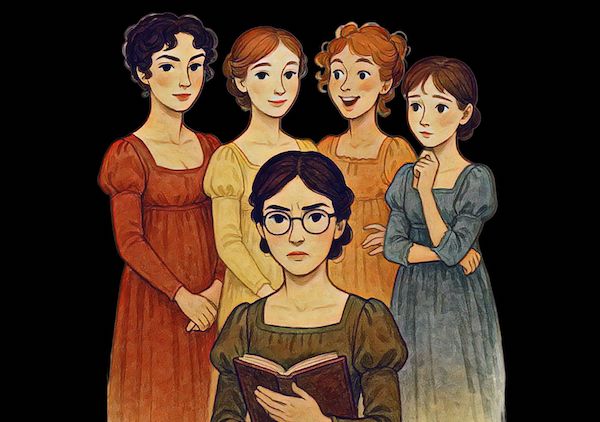
In the original novel, published in 1813, Mary occupies a peculiar place in the narrative. She is always present in the family scenes, yet she is rarely truly seen. She does not possess Jane’s serene beauty, Elizabeth’s ironic brilliance, Lydia’s impulsive energy, or the social ease Kitty gradually acquires throughout the story. Mary often appears as the pedantic and moralizing sister, slightly out of step with everyone else, always ready to quote passages from conduct books and to play the piano with dedication that does not necessarily match her talent.
This peripheral figure finally takes center stage in The Other Bennet Sister, the novel by Janice Hadlow that serves as the basis for the television adaptation. The new series begins with a simple but deeply intriguing question for anyone familiar with Austen’s universe: what happened to Mary Bennet after the happy endings of her sisters?
What happens to Mary after Pride and Prejudice
The story begins exactly where Pride and Prejudice ends. Jane is married to Bingley, Elizabeth to Darcy, Lydia to Wickham, and Kitty spends long periods visiting her married sisters, gradually acquiring more refined manners. Mary remains at home in Longbourn with her parents. In practical terms, she is the only Bennet sister who has been left behind.
This starting point reveals something that Austen’s novel only hinted at. Mary grew up in a family where beauty, charm, and social intelligence were highly valued currencies. From an early age she was compared to her sisters and learned that she lacked the qualities that attracted admiration and attention. Over time she built an identity around what she believed to be her only possible advantage: virtue. Mary reads moral treatises, quotes edifying authors, and attempts to construct an ethical superiority that might compensate for what she lacks.
In the original novel this attitude often appears as comic relief. Elizabeth Bennet frequently shows little patience for her sister’s interventions. When Mary tries to turn delicate situations into moral lessons, Elizabeth immediately perceives the gap between theory and reality. During social gatherings, such as the famous Netherfield ball, Mary’s enthusiasm for playing the piano longer than expected causes embarrassment for her sisters, and Elizabeth must intervene to bring the performance to an end.
The dynamic between the two is never hostile, but it is not especially close either. Elizabeth tends to see Mary primarily as the pedantic sister, someone whose worldview appears excessively rigid and impractical.
It is precisely this emotional gap that the contemporary reinterpretation chooses to explore.
The journey that changes Mary’s destiny
Mary’s first real transformation begins when she temporarily leaves Longbourn to visit the Gardiners, the sensible aunt and uncle who also play an important role in Elizabeth’s story.
Away from the family dynamic that always placed her in the role of the dull sister, Mary begins to realize that other people can see her differently. Her intelligence no longer appears as pedantry but as intellectual curiosity. Her reserve, once interpreted as moral rigidity, begins to look more like thoughtful reflection.
This shift marks the beginning of a deeper journey of self-discovery. As she encounters new environments and people, Mary begins to question many of the ideas that shaped her understanding of the world.
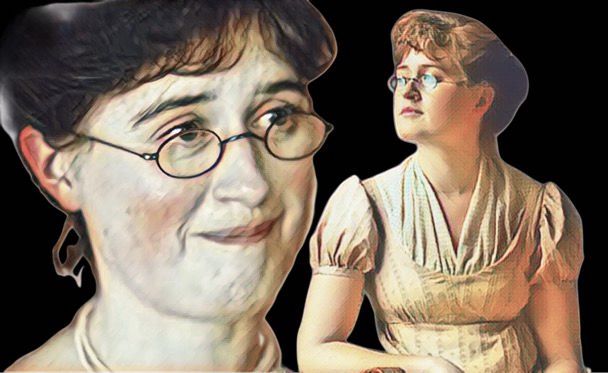
The conduct books she admired presented life in simple categories of virtue and error. Real experience reveals something far more complex. People are contradictory, driven by circumstances and emotions that rarely fit neatly into moral judgments.
At the same time Mary begins to understand that her moral rigidity functioned as a form of emotional protection. In a household where her sisters were constantly admired, she constructed an identity based on the idea that if she could not compete in beauty or charm, she might at least claim ethical superiority.
The two men who compete for Mary’s heart
It is during this period of transformation that the romantic storyline also emerges.
The first significant suitor is Mr. Hayward, a young and respectable clergyman. In many ways he appears, at first glance, to be the ideal match for Mary. Intellectual, moralistic, and disciplined, he admires in her precisely what she has always believed to be her greatest quality: virtue.

Hayward falls in love with the version of Mary she spent years constructing, the devout young woman who quotes conduct books and views the world through clear moral rules. For Mary, his attention represents something almost unprecedented. For most of her life she believed she would never attract romantic interest.
As the narrative unfolds, however, it becomes clear that this romance rests on an image that is slowly disappearing. Hayward admires the very traits that Mary is beginning to question.
At this point the true romantic counterpart of the story appears: Mr. Ryder.
Ryder belongs to a slightly different social world from the one in which Mary was raised. He is not impressed by moral lectures or formal displays of virtue. When he observes her carefully, he notices something that others rarely see. Genuine intelligence, emotional sensitivity, and a real capacity for reflection.
While Hayward represents the predictable path Mary always imagined for her life, Ryder represents the possibility of a more authentic existence.

The choice that defines who Mary truly is
The romantic tension of the novel emerges from this contrast. Mary must eventually realize that the man who initially seems most appropriate for her is actually the one who would keep her confined within the identity she created out of insecurity.
When she ultimately refuses Hayward, the decision represents more than a romantic choice. It marks the moment when Mary recognizes who she is becoming.
Her relationship with Ryder at the end of the story is not portrayed as a sweeping, dramatic passion. Instead it develops into something more mature and balanced, built on mutual recognition.
At the same time her relationship with Elizabeth also begins to change. Lizzie starts to perceive qualities she had previously overlooked. The sister who once seemed merely pedantic now reveals a distinct perspective on the world. Mary, in turn, abandons her constant reliance on conduct books and begins to speak with greater authenticity about her own experiences.

Why Mary Bennet may be Austen’s most modern character
By the end of the story Mary emerges as a far more emotionally balanced figure. She is not the most dazzling heroine in Austen’s universe, but she becomes something perhaps rarer: a woman who has finally learned to understand herself.
By telling the story of the forgotten sister, The Other Bennet Sister reveals something intriguing about the world created by Jane Austen. Not every woman in that society was a brilliant heroine like Elizabeth Bennet. Many were simply quiet figures trying to find their place in a system that valued very specific qualities such as beauty, charm, and marriage.
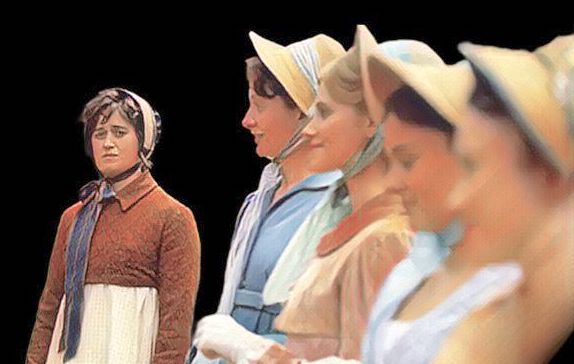
Perhaps that is why Mary Bennet ultimately feels like one of the most modern characters in this universe. Her journey is not about achieving a perfect romantic destiny or resolving every social conflict. It is about learning to see herself clearly. And after more than two centuries living at the margins of one of literature’s most famous stories, that may be the most radical transformation of all.
Descubra mais sobre
Assine para receber nossas notícias mais recentes por e-mail.
 miscelana.com