
At first, DTF St. Louis feels like a series still trying to decide exactly what it wants to be. The opening minutes carry something slightly awkward and even uncomfortable. The narrative moves in fragments, the characters seem oddly detached from their own lives, and the tone shifts between bitter comedy, marital drama, and a strange unease that recalls some recent American suburban stories. The initial result can feel confusing, almost as if the series is deliberately testing the viewer.
That impression changes when the plot reveals its real axis. Once the crime enters the story, everything reorganizes. What initially looks like a tale about marital frustration and midlife crises turns into something far more compelling: a moral mystery about desire, lies, and the consequences of seemingly small decisions.
The premise revolves around an app called DTF, shorthand for “down to fuck,” used by married people looking for discreet extramarital encounters. The idea carries its own irony from the start. The app promises excitement without consequences, yet it becomes precisely the trigger for a chain of events that quickly spirals out of control.
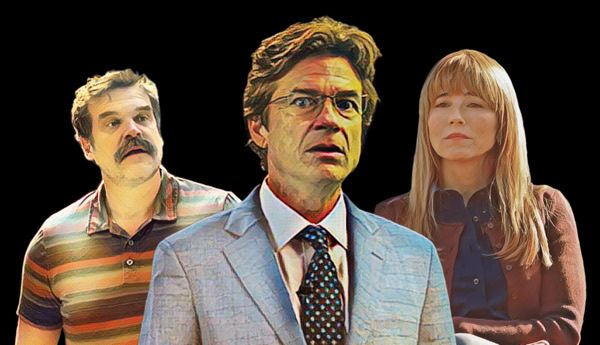
At the center of the story is Clark Forrest, played by Jason Bateman, a local meteorologist whose life appears perfectly ordinary until it begins to unravel. Clark is secretly involved with Carol, portrayed by Linda Cardellini, who is married to Floyd Smernitch, a character played by David Harbour. Floyd works as a sign language interpreter and seems, at least initially, like a quiet man living a stable marriage and predictable routine.
The dynamic among the three forms the dramatic core of the series. Clark, driven by a mixture of guilt, desire, and recklessness, eventually encourages Floyd to join the same app that is already turning his own life into a complicated web. What might look like another example of hypocrisy or self-deception soon becomes the first step in a far more dangerous chain of events.
When Floyd is found dead, apparently poisoned, the narrative shifts decisively. From that moment on, DTF St. Louis stops being simply a portrait of stagnant marriages and becomes a thriller about guilt and manipulation. The investigation begins to reveal that each character is hiding far more than initially suggested and that the app, far from being just a provocative detail, functions as the catalyst for the most reckless choices everyone makes.
At this point, the series begins to echo two distinct storytelling traditions. There are clear traces of classic film noir, particularly Double Indemnity, in the idea that desire and conspiracy between lovers can lead to murder. At the same time, there is something of Fargo in the background, that familiar sense that perfectly ordinary people can make increasingly disastrous decisions until reality itself becomes impossible to control.
The cast helps sustain this tonal shift. Jason Bateman once again explores the kind of character he plays with surgical precision, a man who appears composed but slowly loses control of his own situation. Linda Cardellini gives Carol a layered ambiguity, moving between vulnerability and calculation in a way that keeps the viewer constantly questioning her motives. David Harbour brings Floyd a curious mixture of innocence and melancholy, turning him into something more complex than the typical betrayed husband the premise might suggest.

But the real standout in these early episodes is Richard Jenkins. His presence on screen carries a particular energy, as if he fully understands the strange tone the series is attempting to build. Jenkins finds the precise balance between irony and intensity, giving his character a dimension that stabilizes the narrative whenever it risks drifting too far into its own eccentricities.
The overall effect is intriguing. DTF St. Louis begins as a series that feels slightly off balance, almost uncomfortable within its own tone, but once the crime takes center stage, that initial awkwardness begins to work in the show’s favor. What first appeared confusing reveals itself as part of a broader design in which every apparently banal detail of suburban life may conceal something darker.
If the following episodes can sustain this mixture of dark humor, moral tension, and crime mystery, DTF St. Louis may well become one of the most unusual series of the season. Because beneath the provocative title and its scandalous premise lies a very old narrative question. What happens when ordinary people believe they can flirt with danger without ever paying the price for it?
Descubra mais sobre
Assine para receber nossas notícias mais recentes por e-mail.
 miscelana.com