
In 1986, Madonna was probably the most famous woman in the world. Not just a pop star, but an omnipresent face in the planet’s visual culture. Magazines, tabloids, television, record covers, music videos, and fashion campaigns all seemed to revolve around her. The only female figure who rivaled that level of attention was Diana, Princess of Wales. The two represented completely different versions of celebrity in the 1980s, but they shared something essential: they were obsessively watched.
Madonna was only 27 years old and living through one of those rare moments when fame stops being merely success and becomes a cultural phenomenon. Her first two albums had made her a pop star. The third, released on June 30, 1986, would turn her into something more enduring. True Blue is the album that establishes Madonna as both an artist and an icon.
Love, Sean Penn, and the origin of True Blue
The album was born during a moment of intense passion. In early 1985, Madonna began dating actor Sean Penn, whom she would marry only a few months later, on her 27th birthday. At the time, she described Penn as “the coolest guy in the universe,” a phrase that carried a subtle play on words, as it could mean both the best and someone famously hot-tempered, which fits perfectly with the actor’s explosive reputation.
The title of the album also came from that relationship. “True blue” was one of Sean Penn’s favorite expressions. In American English, it suggests absolute loyalty, pure love, and deep devotion. Madonna turned the phrase into the name of the record and dedicated the album to her husband.
It is impossible to listen to True Blue without noticing how that passion runs through the entire record. Critic Lucy O’Brien famously described it as “the sound of a woman in love,” and the description still feels accurate forty years later. The songs are bright, optimistic, and almost adolescent in their portrayal of love. At the same time, they reveal an artist beginning to understand how to transform her own life into a pop narrative.
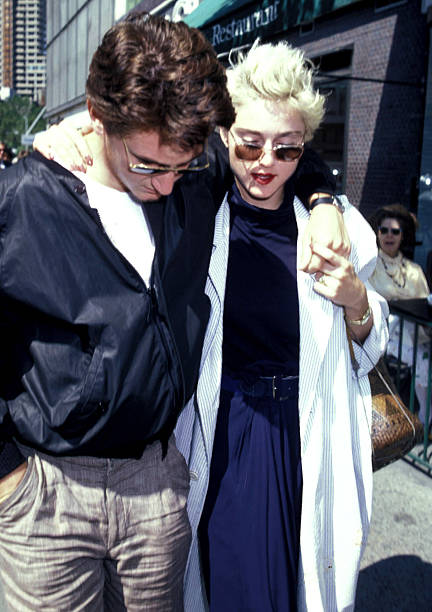

That contrast also defined Madonna’s marriage to Sean Penn. While she seemed comfortable at the center of global attention, he hated the spotlight. Penn clashed with paparazzi, argued with journalists, and frequently got into confrontations with photographers. Their marriage increasingly became a battleground between two opposing visions of celebrity. Madonna understood fame as part of her art. Penn saw it as an enemy.
The irony is that True Blue captures the most passionate moment of that relationship, just before it began to unravel. Three years later, during the Like a Prayer era, the couple would divorce.
Madonna’s first “true voice.”
Musically, the album also represents an important transformation. For me, True Blue is the first album where we hear Madonna’s “true voice.”
On her first two records, especially Madonna (1983) and Like a Virgin (1984), she sang in a higher, almost girlish register, full of high notes that worked well in the studio but were harder to sustain live. During the Virgin Tour in 1985 it became clear that this register was difficult to maintain night after night on stage.
From that point on, Madonna began singing in a more natural, slightly lower tone that would become her signature voice. On True Blue, that shift is already noticeable. Her voice sounds more secure, more mature, and more emotional.
Critics noticed the change immediately. The Los Angeles Times observed that her voice felt better tailored and more expressive, while Rolling Stone praised the greater emotional quality of her singing. What had once been perceived as a limitation was becoming a style.

Patrick Leonard and the musical leap
That maturation also had to do with the people around her. It was during the Virgin Tour that Madonna met Patrick Leonard, who had been hired as the tour’s musical director. The two soon began writing together and quickly developed one of the most important creative partnerships of Madonna’s career.
The first songs they created were “Love Makes the World Go Round” and “Live to Tell.” The latter would become one of the most powerful ballads of Madonna’s career. Originally conceived as an instrumental for a film, the track gained lyrics written by Madonna and ended up in At Close Range, a movie starring Sean Penn.
Leonard brought something that had been missing from her earlier records: musical sophistication. His arrangements expanded Madonna’s sonic palette. True Blue remains fundamentally a dance-pop album, but its references are broader. There are echoes of Motown, influences from 1960s girl groups, and, in some tracks, Latin elements that would later become recurring in Madonna’s music.
Another key collaborator was Stephen Bray, Madonna’s former boyfriend and a contributor to Like a Virgin. While Leonard expanded the musical reach of the songs, Bray had a particular talent for crafting direct, classic Top-40 pop.
Most importantly, True Blue marks the first time Madonna assumed full creative control over a record. She co-wrote and co-produced every track. That was still unusual for a female pop singer in the mid-1980s. By becoming a producer of her own work, Madonna gained far greater control over her art.
The songs and the portrait of an artist in love
Recorded between December 1985 and April 1986 at Channel Studios in Los Angeles, the album contains nine tracks that combine romance, pop energy, and growing artistic ambition.
“Papa Don’t Preach” became one of the most controversial songs of Madonna’s career. Originally written by Brian Elliot, the track tells the story of a teenage girl who becomes pregnant and decides to keep the baby, confronting her father’s disapproval. The song sparked heated debates among feminist groups, religious organizations, and cultural commentators. Madonna was criticized by some for appearing to encourage teenage pregnancy and praised by others for portraying female autonomy.
“Open Your Heart,” by contrast, is direct and irresistible pop. The song began as a rock track titled “Follow Your Heart,” originally written for Cyndi Lauper, who never heard the demo, as Madonna got it first. Madonna changed the lyrics, reshaped the arrangement, and turned it into one of the album’s defining songs.
“Live to Tell” reveals another side of the record. The ballad deals with secrets, mistrust, and emotional survival. It is strikingly melancholic for an album that, in many moments, celebrates love.
“La Isla Bonita” represents perhaps the most visible stylistic shift. The song blends flamenco guitar, Latin percussion, and Spanish lyrics. It was the first time Madonna incorporated explicit Latin influences into her music. Interestingly, the song had originally been offered to Michael Jackson, who turned it down. Leonard then played the demo for Madonna, who wrote the lyrics while filming Shanghai Surprise.
The rest of the album also reveals an artist expanding her references. “White Heat” pays tribute to actor James Cagney and the 1949 film of the same name. “Jimmy Jimmy” recalls Madonna’s youthful fascination with James Dean. “Love Makes the World Go Round” closes the album with a pacifist message built on Latin percussion and samba-influenced rhythms.
The music videos and the creation of a new Madonna
If the songs consolidated Madonna as an artist, the music videos of the True Blue era helped define a new phase of her public image.
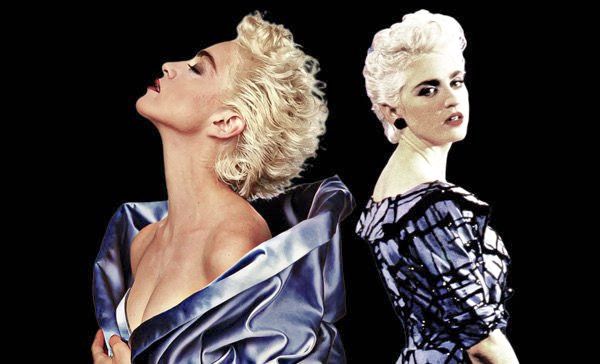
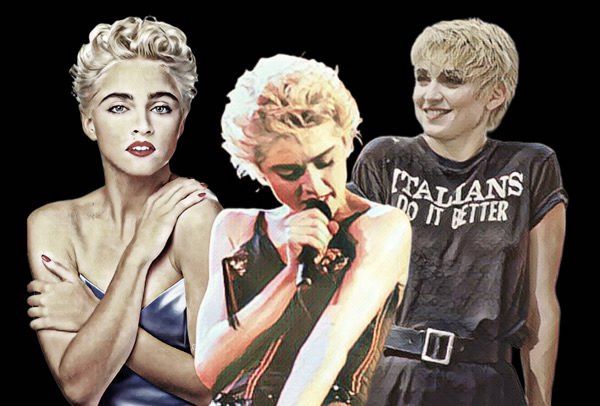
The Madonna who appears in these videos is different from the playful provocateur of “Like a Virgin.” She is slimmer, physically stronger, with short platinum-blonde hair that would become one of her visual signatures of the 1980s, bright red lipstick, and often a leather jacket that reinforces a tougher, more cinematic image.
“Papa Don’t Preach” delivered the first major shock of this new aesthetic. The video presents Madonna in a more realistic and dramatic narrative, telling the story of a young woman confronting her father after discovering she is pregnant. At the same time, another Madonna appears in the same video, dancing in a dark studio wearing a leather jacket and torn jeans, a look that instantly became iconic. The combination of social narrative and pop performance made the video one of the most discussed works on MTV that year.
“Live to Tell” followed a completely different path. The video abandons the visual excess typical of the era and embraces simplicity. Madonna appears almost motionless, singing directly to the camera while scenes from At Close Range are intercut throughout. The aesthetic is restrained and introspective, reinforcing the sense that this was a more mature Madonna.
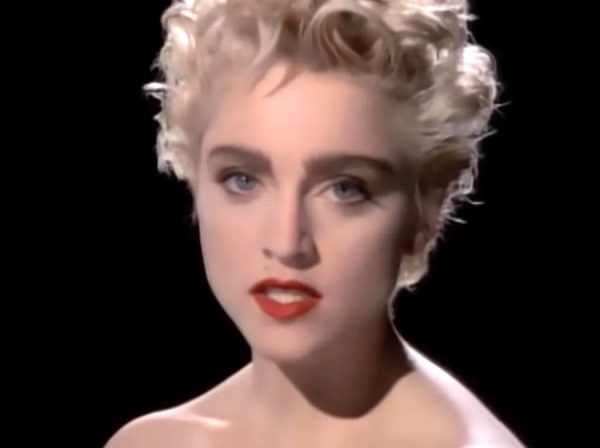

“True Blue” leans into deliberate nostalgia for the 1950s. The video is set in an all-blue diner filled with vintage cars and choreographed dancers, evoking the imagery of American youth culture from that decade. The song already drew inspiration from 1960s girl groups, and the clip amplifies that retro mood.
“La Isla Bonita” expands Madonna’s visual vocabulary even further. Directed by Mary Lambert, the video presents two versions of the singer: a devout Catholic young woman and a sensual flamenco dancer. The Latin aesthetic, with guitars, candles, red dresses, and religious imagery, created one of the most memorable visual worlds of the era.
But no video from that period generated as much discussion as “Open Your Heart.” Directed by Jean-Baptiste Mondino, the clip portrays Madonna as a dancer in a peep show who befriends a young boy watching her performance. The narrative blends eroticism, vulnerability, and innocence in ways that unsettled a part of the critical establishment. Some critics questioned the presence of a child in that environment, while others read the video as a metaphor about the male gaze, desire, and control over the female body.
As often happened throughout Madonna’s career, controversy only amplified the cultural impact of the work. The video also stood out for presenting a rare reversal of power for the time. Madonna controls the spectacle. She decides when to perform, when to look, and when to deny the audience access.
Herb Ritts and the creation of an iconic image
If the music videos helped define the aesthetic of the True Blue era, the album cover helped transform Madonna into an icon.
The photograph was taken by Herb Ritts, one of the most influential photographers of his generation. The image shows Madonna in profile, her head tilted back, platinum-blonde hair flowing against a deep blue background. It is simple, almost sculptural.
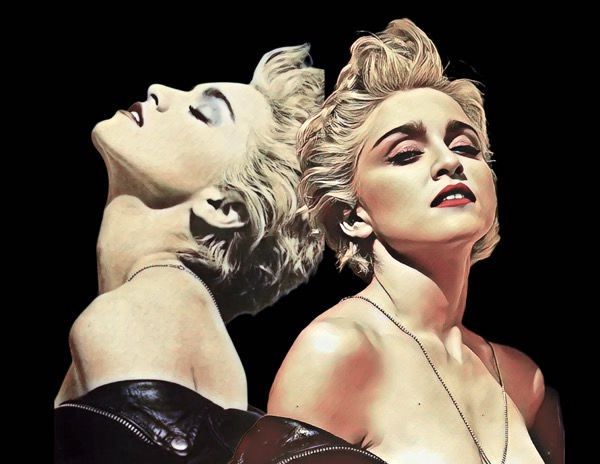
The original photograph was shot in black and white. The blue tone was later applied in the Warner Bros. art department, creating the effect that would turn the cover into one of the most recognizable images in pop history.
Lucy O’Brien described the photograph as a moment of “Warholian pop art,” combining innocence, idealism, and icon-making. For the first time, Madonna seemed less like a provocative pop star and more like a classical, almost mythic figure.
The global phenomenon
The commercial impact of True Blue was extraordinary. The album reached number one in 28 countries and sold more than 25 million copies worldwide, becoming the best-selling album of 1986.
Five singles were released, and all of them reached the top five of the Billboard Hot 100. Three climbed to number one, confirming Madonna as one of the most dominant artists of the decade.
The album was promoted through the Who’s That Girl World Tour in 1987, Madonna’s first global tour. The show expanded the theatricality already present in her music videos and transformed the stage into an extension of her visual storytelling.
Forty years later
Four decades later, True Blue remains a turning point in Madonna’s career.
It may not be her most experimental album or her most complex. But it is the moment when everything aligns. The artist, the public image, the ambition, and the music begin operating as parts of the same project.
It was the album that definitively turned Madonna into a global icon. And looking back now, it may also be the first chapter of the artist she would become in the years that followed: the woman who used pop culture not only to dominate the charts, but to provoke debate, reinvent images, and continually redefine what it means to be a star.
Descubra mais sobre
Assine para receber nossas notícias mais recentes por e-mail.
 miscelana.com