
For years, it seemed impossible to imagine Oasis on the same stage again without everything collapsing before the first chord. The 2009 breakup, marked by public arguments, sharp interviews, and a constant exchange of barbs between Liam Gallagher and Noel Gallagher, turned the band into a myth frozen in time, a symbol of an era that felt definitively over. Fifteen years later, the reunion was not just a musical event. It was a cultural moment that demanded to be recorded, interpreted, and, above all, understood.
That is where Steven Knight comes in. Best known as the creator of Peaky Blinders, Knight does not belong to the Manchester universe that shaped Oasis. He comes from Birmingham, from a different geography and a different kind of British working-class narrative. And perhaps it is precisely that distance that allows him to see the reunion with more dramatic clarity than sentimental attachment. By taking on the Live ’25 tour documentary, he seems less interested in nostalgia and more focused on structure, on arc, on story.
Because, according to him, that is exactly what the film has. A story.

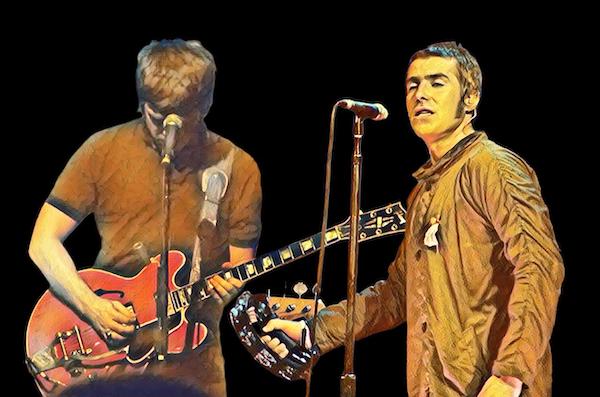
The cameras followed not only the stadium shows around the world, but also what the public never saw. The early conversations, the rehearsals, the first meetings between brothers who had spent more than a decade building nothing together. There is something inherently theatrical in that material, a tension that does not need to be staged because it already exists. The promise, reinforced by Knight himself, is of a documentary that unfolds like a narrative, with a beginning, a middle, and transformation, something rare in music projects that often settle for celebration.
What we know so far reinforces that ambition. The initial cut reportedly ran to four hours, a sign that the material goes far beyond a behind-the-scenes record. There is excess, there is density, there is accumulated time. Shaping that into a final runtime will likely be the greatest challenge of the edit. But it is also a clear indication that this is not simply about revisiting hits or replicating the energy of the shows. It is about understanding what happened between 2009 and 2025, and why, after all, this reunion became possible.
The tour itself already offered clues. Live ’25 was not built merely as a commercial comeback, but as a gesture of reconciliation carefully watched by audiences. In cities like Manchester, where it all began, the shows carried an added layer of meaning, as if the band were rewriting its own origins in front of a new generation. In São Paulo, at the final concert, Liam thanked the crowd with words that sounded less like a farewell and more like a promise. A reunion that no longer wanted to end in rupture.
“We love you, thanks for all your energy. Take care of yourselves, and we’ll see you again sometime.”
Liam Gallagher in São Paulo, 2025
This context turns the documentary into something larger than a byproduct of the tour. It becomes a central piece in shaping the memory of that return. And perhaps that is why expectations are so high, even within the band itself. Noel Gallagher has said he has only seen fragments, but that if the film captures even a small fraction of what those shows were, it will already be astonishing.
There is also another element that makes the project even more compelling. Directors Dylan Southern and Will Lovelace have a track record of treating music as emotional experience rather than mere performance. In their previous work, they managed to translate the relationship between stage and audience into something almost intimate, an approach that may prove decisive here, especially given a story that is both collective and deeply personal.

There is still no official release date, but the expectation is that the film will arrive in 2026. Until then, what remains is the sense that we are looking at a rare document. Not just a record of a successful tour, but an attempt to shape into narrative one of the most turbulent relationships in British music history.
In the end, that may be what makes the project so fascinating. It is not just about the return of Oasis. It is about how two people who spent years tearing each other apart in public chose, at some point, to share the same space again. And how that decision, so simple on the surface, carries within it everything that music alone was never able to resolve.
Descubra mais sobre
Assine para receber nossas notícias mais recentes por e-mail.
 miscelana.com