
It has long been said that Succession was “inspired” by the family of Rupert Murdoch. For years, that felt like enough. The series created by Jesse Armstrong has been widely regarded as one of the most sophisticated portrayals of power, inheritance, and moral decay in contemporary television.
But something shifts when watching Dynasty: The Murdochs, the documentary directed by Liz Garbus for Netflix. This is not simply about recognizing parallels. It is about confronting the limits of fiction when faced with a reality that operates on another scale, one that is rawer, more unstable, and ultimately more unsettling.
And the documentary makes this explicit from the very beginning. Within its opening moments, it directly invokes Succession and delivers a revelation that feels scripted, yet is entirely real. Yes, Rupert Murdoch’s children were watching the series. Yes, they were following closely a fictional version of their own family dynamics. And more than that, it was one of the most striking episodes of recent television, the death of Logan Roy, that acted as a trigger.
Faced with that uncomfortably close mirror, the family realized something that had remained suspended. The succession was not defined. Rupert Murdoch could die at any moment. And confronted with that possibility, they acted.
There is something deeply unsettling in this inversion. It is not simply life imitating art. It is fiction actively shaping reality.

Garbus herself points in this direction, explaining that the project was never only about telling the story of a powerful family, but about understanding how media dynasties shape the way we see the world. By questioning who controls these companies and what their personal agendas are, the documentary moves beyond storytelling and into the realm of public responsibility. What is at stake is not merely who inherits an empire, but how that empire directly influences politics, information, and collective perception.
It is here that the realization becomes unavoidable. If Succession felt brilliant, the documentary suggests it was, in some ways, restrained. The reality of the Murdochs presents dramas, betrayals, and reversals that surpass any constructed narrative, not because they are more theatrical, but because their consequences are real and measurable.
There has always been an attempt to map the Murdochs onto the logic of the series. Lachlan Murdoch as Kendall Roy, James Murdoch as a more rational version of the heir, Elisabeth Murdoch as Shiv Roy.
But the documentary corrects this reading.
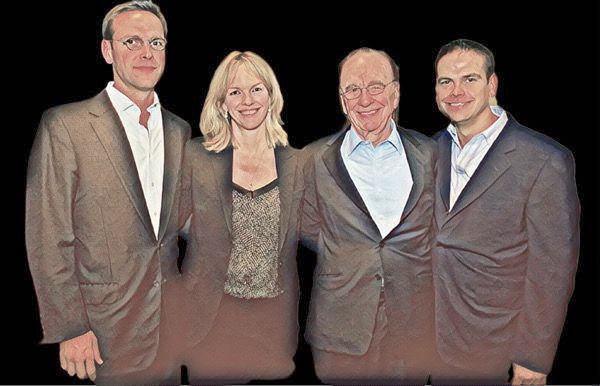
Lachlan is not Kendall. He aligns far more closely with Roman Roy, the son who ultimately aligns with the father and becomes the viable heir. James resembles the heir who breaks away and loses, the one who attempts to redefine himself outside the empire and, in doing so, distances himself from it. Elisabeth occupies a space that never fully materializes, even when it seems possible.
It is in this shift that reality asserts itself. Because it does not need to sustain the ambiguity that makes fiction so compelling.
The conflicts between Lachlan, James, and Elisabeth unfold over years, involving legal strategies, leaks, quiet restructurings, and carefully calculated moves. These are not merely personal disputes. They are decisions that shape one of the largest media conglomerates in the world and, by extension, global public discourse.
The title Dynasty reinforces this reading on multiple levels. It captures the core theme of succession and continuity of power, while also echoing Dynasty, a defining symbol of televised melodrama, built on family feuds, wealth, and heightened conflict. The reference carries even more weight considering the show’s enormous popularity in Australia, where the Murdoch empire began. The documentary seems aware of this cultural echo, yet what it presents is not stylized exaggeration but structural drama, where spectacle is not constructed, but inevitable.
There is also a layer of fascination that the series does not attempt to hide. There is undeniable pleasure in watching this story unfold, in recognizing echoes of fiction, in seeing how real figures occasionally mirror familiar archetypes. And yet, that pleasure is constantly undercut by discomfort. The documentary insists on reminding us that this is not a self-contained game, but a system of power that shapes political narratives, influences elections, and reshapes the media landscape.

For those still feeling the absence left by Succession, Dynasty: The Murdochs is essential viewing, though not as a replacement. It works instead as an expansion, and perhaps a correction. Where the series thrived on instability and the constant possibility of change, the documentary points toward something more unsettling. Power does not require dramatic twists to assert itself. It consolidates, reorganizes, and ultimately, it chooses.
That choice, embodied in Lachlan’s rise, arrives without catharsis. There is no grand climax, no collapse, no traditional narrative resolution. There is only the confirmation of a system that had always been moving in that direction. And that may be what makes the documentary so striking.
What remains is not simply the sense that reality has surpassed fiction, but the realization that we may have been watching a softened version of the story all along. And that the real drama was never in what we imagined, but in what we preferred to keep at a distance.
Descubra mais sobre
Assine para receber nossas notícias mais recentes por e-mail.
 miscelana.com