
The ending that returns to the beginning
When Tommy Shelby ends his journey by saying “In the bleak midwinter,” Peaky Blinders: The Immortal Man is not simply revisiting a verse that has accompanied the series as mood or emotional texture. It is closing a cycle that began long before Birmingham, before power, before money, before even the family as we came to know it. A cycle that begins in the war and never truly ends.
These final words do not point to what he built. They point to what built him.

The tunnels: where everything truly began
Season four, particularly its second episode, is where the series makes explicit what had long been fragmented. Tommy speaks about the tunnels not as memory, but as something still inhabited. He describes the work of the tunnellers, men sent to dig beneath enemy lines, where the world was reduced to darkness, confinement, and the constant anticipation of death.
There was no heroism in any conventional sense. There was proximity. Bodies in the dark. Decisions made in seconds. The knowledge that any mistake meant the end. Tommy killed men in those tunnels. More than that, he learned there that life could end at any moment, without warning, without logic, without witness.
There was a moment, shared among him, his brothers, and other men, when death ceased to be a possibility and became a certainty. Trapped, cornered, with no control over what would come next, they believed those were their final hours.
And yet, they survived.

Dead men living on borrowed time
That survival is not framed as victory. It is framed as displacement. When Tommy and his brothers return from the war, they do not resume their lives. They exist differently.
Tommy makes it clear that everything that followed was “extra.” Not continuation, but excess. They see themselves as men who have already died and who, for reasons they do not understand, are still here.
This idea reshapes everything.
Violence is no longer an exception but a method. Ambition is no longer a choice but a reflex. Fear loses its function because there is nothing left to protect when one believes the essential has already been lost. The Peaky Blinders, as a force, as a family, as an empire, emerge not simply from desire, but from the attempt to fill a void that cannot be filled.
The trauma that never ends and the body that pays for it
The war does not stay in the past. It settles into the body, into habits, into silence. Tommy does not sleep. He relives what happened. He remains in a permanent state of alert. The world around him may have changed, but he continues to respond as if he were still at the front.
It is within this context that his relationship with opium must be understood.
The substance is not portrayed as a casual vice, but as a regulation. A way of muting what cannot be turned off. Opium allows him to slow down, to reduce the internal noise, to find a brief suspension from that constant tension.
But the relief is never lasting. It does not resolve the trauma. It only makes it bearable for a moment. What the series suggests is that there is no full return. There is function, there is power, there is movement forward. But there is no cure.


“In the Bleak Midwinter” as shared memory
The phrase, originating in the poem by Christina Rossetti and reinterpreted in the score by Anne Dudley, evokes a frozen world, suspended, on the verge of stillness.
In the series, it becomes something more than a reference. It becomes memory.
It is not a formal code between the characters, not a spoken password or a repeated signal. And yet, throughout the narrative, it appears in moments of extreme danger, loss, or confrontation with mortality. Each time, it carries recognition. As if that original moment in the tunnels, when death felt inevitable, were resurfacing.
When the Shelbys evoke “In the bleak midwinter,” what is activated is not only the present danger, but a past that never ended. The memory of the moment when life and death blurred, and everything that followed became something like an extension rather than a continuation.
The final words and the weight of everything before them
That is why these words, at the end, feel so definitive.
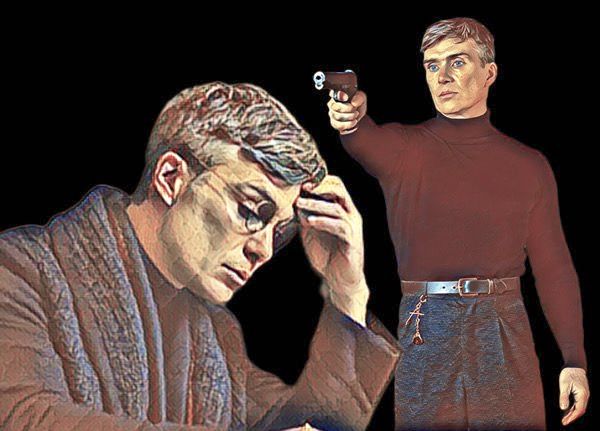
Tommy does not conclude his story as a leader, a strategist, or a businessman. He ends it as a soldier. As the man who, in the darkness of a tunnel, believed he was going to die and who, after surviving, never fully found his way back to the living.
“In the bleak midwinter” does not point toward redemption. It does not reorganize the past. It does not offer resolution. It marks a return to the only moment that, for him, never truly ended.
The invisible legacy of war
By ending in this way, Peaky Blinders expands the meaning of Tommy’s journey. This is not only the story of a man shaped by war, but of an entire generation unable to fully return to the world they left behind.
Trauma does not end with the war. It moves through families, shapes decisions, alters relationships, and sustains structures of power born out of absence.
By saying “In the bleak midwinter,” Tommy Shelby is not simply saying goodbye. He is finally naming what has always been at the center of everything. A man who survived his own ending and spent the rest of his life trying to give meaning to time that, from the very beginning, no longer felt like his own.
Descubra mais sobre
Assine para receber nossas notícias mais recentes por e-mail.
 miscelana.com