
History was written in Canterbury, with echoes that go beyond the walls of the cathedral and reach the very structure of the Anglican Church. Witnessed by the heir to the British throne, Prince William, and Catherine, Princess of Wales, the appointment of the first woman as Archbishop of Canterbury breaks a tradition of more than 1,400 years.
The choice of Dame Sarah Mullally for the highest position in the Church of England marks a shift that goes far beyond its unprecedented nature. In the main institution of the Anglican tradition, this decision reshapes not only the structure of power but also the very image of religious authority. Since its early days, consolidated as a national institution in the 16th century under Henry VIII, leadership had been exclusively male. This continuity was not accidental, but the result of a theological and social construction that linked spiritual authority to masculinity, grounded in biblical interpretations, the idea of apostolic succession, and social structures that, for centuries, restricted women’s space.
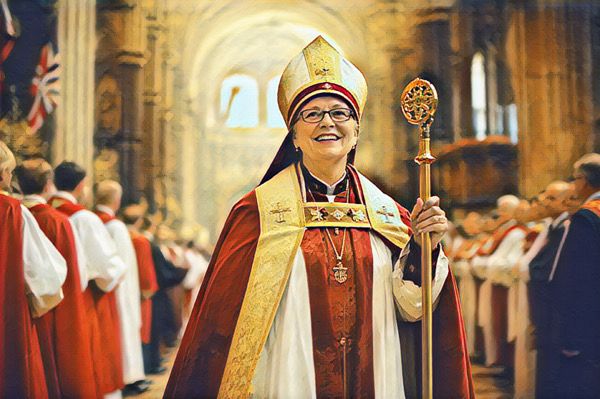
The symbolism of this change took shape in a ceremony deeply rooted in tradition, yet marked by signs of renewal. The installation, historically known as enthronement, began with Mullally striking the doors of Canterbury Cathedral three times before being received. Throughout the ritual, she moved through different parts of the cathedral before taking the so-called “Chair of St Augustine,” the ultimate symbol of her authority as Primate of All England. She swore her oath on a new version of the Bible, the first to be used in this context since 1945, a detail that in itself suggests an attempt to balance continuity and change.
The ceremony gathered around two thousand guests and was shaped by elements reflecting the contemporary diversity of the Anglican Communion, with readings and hymns in multiple languages. At the same time, it retained the full weight of history. Each gesture, each movement within the cathedral, reinforces the symbolic dimension of a role that is not merely administrative, but deeply ritualistic.
This symbolic weight makes the pace of change even more striking. Women were only ordained as priests in the Church of England in 1994. The episcopate followed two decades later. Reaching the top of the hierarchy now highlights the uneven speed at which institutions absorb changes that, outside them, may already seem settled.
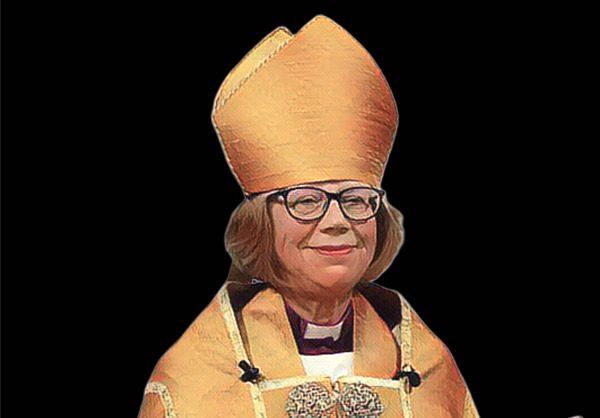
Dame Sarah Mullally arrives at this position with a trajectory that helps explain the significance of her appointment. Before entering ordained ministry, she had a long career as a nurse and rose to one of the highest positions within the British public health system. That experience shapes a leadership often associated with care and listening, qualities that resonate at a time when the Church faces deep criticism, particularly regarding its handling of abuse cases.
At the same time, her rise does not eliminate internal tensions. There are still sectors that reject the ordination of women, just as there are leaders in other parts of the Anglican tradition who do not recognize this change and seek alternatives to maintain more conservative interpretations. Inclusion, in this context, does not resolve conflicts but makes them more visible.
What emerges, therefore, is not simply an expansion of access but a reconfiguration of authority. The figure of the religious leader shapes how the sacred is perceived. For centuries, that representation was tied to a single model. When that model shifts, the transformation reaches the collective imagination as well.
At the same time, this advance reveals its own limits. Inclusion does not guarantee unity or resolve historical conflicts. In many cases, it intensifies them, bringing to the surface disagreements that were previously diluted within quieter institutional practices. The Anglican Church, as a decentralized global tradition, now faces the challenge of navigating increasingly divergent interpretations of what defines its identity.
This movement does not happen in isolation. Other religious traditions face similar pressures, though at different paces. Some have already incorporated women into leadership roles, while others maintain strict restrictions. Although such progress exists across different contexts, it rarely occurs at the top of a structure as ancient, institutionalized, and symbolically charged as the Church of England.
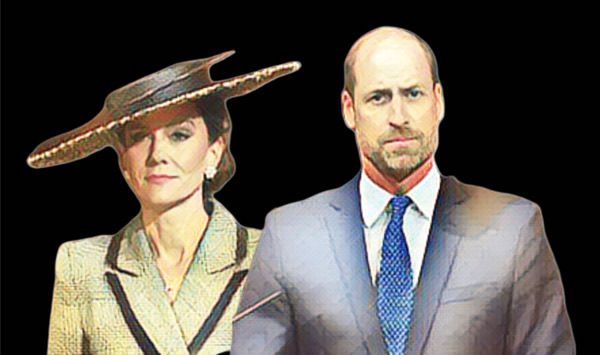
The presence of Prince William and Catherine during the ceremony adds another layer to the moment. Representing King Charles III, Supreme Governor of the Church of England, the couple occupies a position that connects religious tradition and monarchical continuity. The role of Archbishop of Canterbury is not formally for life, but in practice is usually held until retirement, typically around the age of 70. This opens the possibility that, in the future, should William be crowned king, it could be Mullally who leads the coronation ceremony at Westminster Abbey, a role historically reserved for the Archbishop of Canterbury.
Even as a possibility, this reinforces the symbolic reach of the shift. The image of a woman leading the coronation of a British monarch captures, in a powerful way, the transformation now underway.
But that transformation comes with concrete challenges. Mullally assumes the role at a time of intense public scrutiny, with ongoing debates about institutional safety, inclusion, and the role of the Church in an increasingly secular society. The authority now being reshaped will also be tested.
What is at stake is not only who occupies the position, but what the position itself comes to mean. The appointment of a woman does not resolve the tension between tradition and change, but brings it to the forefront, forcing the Church of England to confront it more directly.
And it is at this point that symbolism ceases to be merely a gesture and becomes a process.
Descubra mais sobre
Assine para receber nossas notícias mais recentes por e-mail.
 miscelana.com