
The man behind the legend
For a long time, d’Artagnan was treated as one of those rare cases in which literature seemed to create something greater than any possible biography. The problem is that he was never just a character. Charles de Batz de Castelmore, born in Gascony in the early 17th century, built a trajectory that already felt like a ready-made novel. The son of minor provincial nobility, he followed the classic path of advancement through the sword and loyalty, joining the French royal guard at a moment when Louis XIV’s power was beginning to consolidate.
His career unfolded within one of the monarchy’s most sensitive inner circles. D’Artagnan was not simply a skilled soldier, but someone trusted by the king with delicate missions, including political arrests and operations that required absolute discretion. This quieter profile, almost bureaucratic on the surface, contrasts with the image that would later become famous. Real life was less flamboyant, but no less remarkable. He died in battle in 1673, during the siege of Maastricht, struck by a musket ball at the height of his career.
Perhaps the most curious detail is this: unlike what fiction would suggest, there was no staged, glorious ending. There was a body lost in the middle of a European war and a name that, for a long time, remained confined to military records.
How Alexandre Dumas turned history into myth
Nearly two centuries later, Alexandre Dumas encountered that name in semi-fictional memoirs published in the early 18th century and attributed to Gatien de Courtilz de Sandras. The material already blended reality and invention, giving Dumas the freedom to do what he did best: amplify.
In The Three Musketeers, d’Artagnan shifts from an efficient officer to the emotional center of a story about friendship, ambition, and youth. Athos, Porthos, and Aramis emerge as perfectly constructed archetypes, while the protagonist becomes the observer who gradually earns his place among them. Dumas’s world is more vibrant, faster, sharper. Politics is present, but always filtered through duels, romance, and wit.
This transformation was not a simple exaggeration. It was a narrative choice that helped define the modern hero: someone both talented and flawed, impulsive and strategic, deeply human even when moving through a near-mythic setting.
What fiction changed
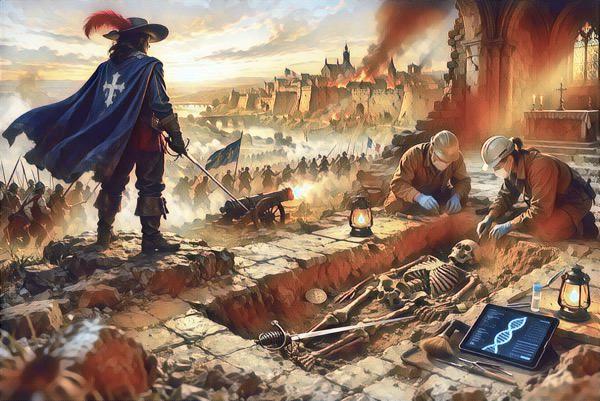
The differences between the historical man and the literary character say more about the 19th century than the 17th. The real d’Artagnan operated within a rigid structure of power in which loyalty to the king was the ultimate currency. Dumas’s d’Artagnan, on the other hand, moves between duty and desire, questions authority, hesitates, and becomes entangled in personal conflicts that rarely appear in historical records.
There is also a difference in rhythm. Fiction compresses events, intensifies relationships, and creates a sense of urgency that reality did not possess. The grand gestures, memorable confrontations, and sharp dialogue are constructions that organize what would otherwise be a more fragmented life.
And yet there is an underlying fidelity that explains why the story works. The ambition to rise, the displacement of a young provincial man into the center of power, the need to prove oneself in a hostile environment — all of this was present in the original trajectory.
The fate of d’Artagnan in fiction and in life
In literature, d’Artagnan evolves across different stages. He matures, gains status, and in The Vicomte of Bragelonne reaches the rank of captain of the musketeers. His death carries symbolic weight. He dies in battle after completing a mission tied to the king, in a moment that blends duty with late recognition.
Real life did not offer the same framing, but the point of convergence is striking. The historical d’Artagnan also died in battle, during the siege of Maastricht on June 25, 1673. The difference lies in the record. In the novels, death is an ending. In history, it was another episode in a long and complex war, without certainty about where his body was buried.
That absence is precisely what the current discovery attempts to resolve.
The discovery that reopens the story
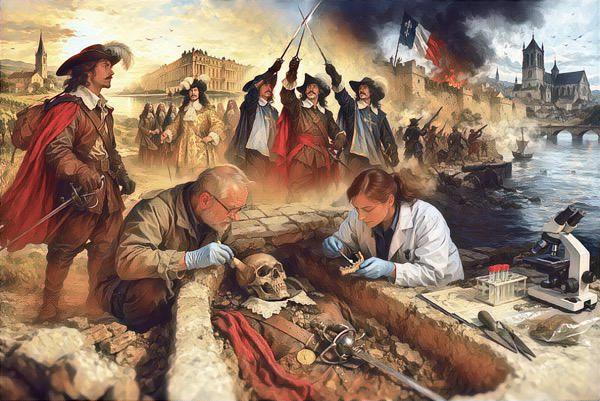
The possibility that his remains have been found in a church in Maastricht is more than an archaeological curiosity. It touches directly on one of the most uncertain elements of this story. For centuries, d’Artagnan’s physical fate remained undefined, almost as if fiction had absorbed what reality could not provide.
Now, archaeologists are working with evidence that includes the burial site, objects found nearby, and, most importantly, DNA analysis being compared with possible descendants. The process still demands caution, but the mere existence of a body that can be tested already shifts how the story is told.
There is something symbolic in that. A figure who has lived for centuries as image and narrative may finally recover a physical dimension that was never fully available.
The many faces of d’Artagnan
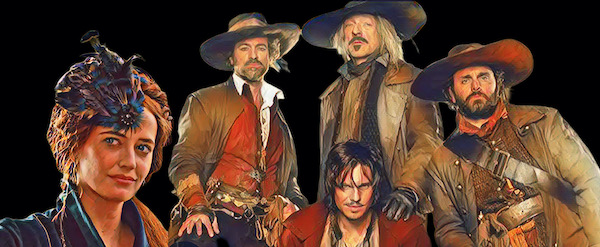
The strength of this figure is also explained by how often he has been reinterpreted. In film and television, d’Artagnan has never had a definitive form. Gene Kelly brought lightness and musicality, while Michael York leaned into irony. Decades later, Chris O’Donnell reflected the tone of 1990s adventure cinema, and Logan Lerman emphasized youthful energy in a more stylized version.
More recently, François Civil offered a performance that balances historical realism with emotional intensity, reflecting a contemporary desire to revisit classics with greater depth.
Each of these versions reveals less about the 17th century and more about the time in which it was made. D’Artagnan became a mirror, a character capable of absorbing shifting ideas of heroism.
When will we know the truth?
The definitive answer depends on DNA tests currently underway, expected to be completed in the coming weeks. Comparison with known descendants may provide a rare level of certainty for a case of this kind, even if absolute confirmation remains elusive.
Until then, the story remains suspended exactly where it has always been. Between document and imagination, between body and myth.
If the identification is confirmed, this will not simply be the discovery of a man. It will be the convergence of two narratives that have long existed side by side. And perhaps, for the first time, we will be able to look at d’Artagnan not as a character who gained life, but as a man whose life became a character.
Descubra mais sobre
Assine para receber nossas notícias mais recentes por e-mail.
 miscelana.com