
As April 2026 arrives, Hacks returns for its fifth and final season.
Before it says goodbye, the series returns to a point that never really disappeared: the relationship between Deborah Vance and Ava Daniels. Everything Hacks has built over the years — the success, the awards, the constant struggle for space — begins there, in that unlikely encounter between two women at very different moments in their lives, yet driven by the same need for validation.
Revisiting the first two seasons now is not simply an exercise in memory. It is a way of seeing how quickly the series found its form, and how that form already contained the tensions that would later become central. What initially seems like a generational clash gradually reveals itself to be something more complex, less comfortable, and therefore far more compelling.
Because Hacks was never really just about comedy. It has always been about what is required of a woman to remain relevant, and what is lost in the process.
This is where it all begins.
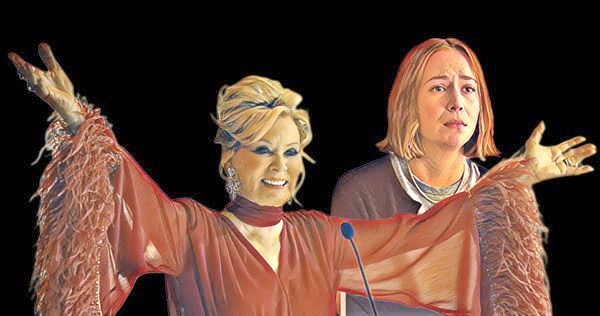
Season 1: The encounter that shouldn’t work (and that’s why it does)
The first season of Hacks opens with a shift that, at first glance, seems merely professional but quickly reveals itself to be something deeper. Deborah Vance, a legendary stand-up comic firmly rooted in Las Vegas, begins to sense that her place is no longer guaranteed. An industry always in search of renewal starts to treat her as something close to the past, even if that past is still very much alive.
On the other side, Ava Daniels arrives carrying a different kind of rupture. Young and talented, but marked by a public misstep that cost her opportunities, she enters the story not as a rising voice, but as someone trying to rebuild her own narrative.
Their meeting is immediately hostile. And, at the same time, inevitable.
What begins as a purely functional arrangement — a comedian in need of new material and a writer in need of work — gradually becomes something more layered. Not because they recognize themselves in each other, but because they don’t. Friction, not identification, is what drives the season.
Living and working together forces unexpected proximity. Deborah resists any change that does not originate from herself. Ava, meanwhile, tries to understand a voice that is not her own, while confronting everything that voice represents. Slowly, the work stops being purely technical and begins to demand emotional investment.
It is in this process that the series begins to expose cracks in Deborah’s public image. The long-standing narrative about her burning down her ex-husband’s house, for instance, gains a new dimension when it is revealed as something she ultimately absorbed into her own persona — regardless of its truth. What once felt like legend becomes construction. And that construction begins to show signs of wear.
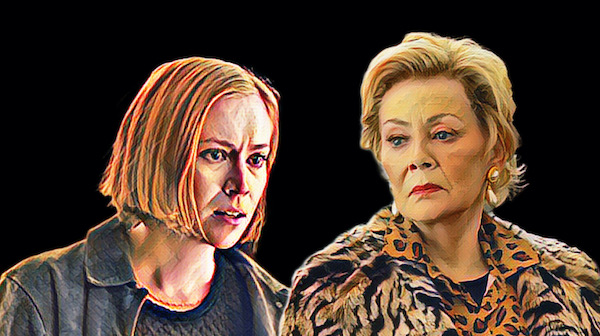
Ava is the first to see this more clearly. By revisiting Deborah’s past, she encounters not just material, but a different version of her — more open, more vulnerable, still in formation. That discovery changes how she writes, but more importantly, how she sees.
But this closeness is never stable.
Their relationship moves forward and backward constantly, often through gestures that reveal more than dialogue ever could. Deborah publicly humiliates Ava when she feels challenged. Ava crosses boundaries, trying to force a level of intimacy that has not yet been earned. What emerges is a continuous negotiation between trust and sabotage.
And still, something takes shape.
Moments that might seem peripheral — watching television together over the phone, a trip that leads nowhere, conversations shaped by substances and delayed truths — become more meaningful than any direct attempt at connection.
It is also in this season that one of the show’s central ideas takes hold: the cost of staying relevant. Deborah is not only fighting time or the industry, but the very image she created to survive within it. Any attempt at change involves risk, including the risk of losing what still sustains her.
In that sense, Ava functions as a catalyst. Not because she has answers, but because she insists on asking the questions Deborah avoids.
The season’s ending brings that tension into focus.
Faced with the possibility of losing her footing, Deborah must choose between repeating what works and risking something new. The decision does not come without rupture. Her relationship with Ava reaches a point where the professional and the personal can no longer be separated. There are accusations, distance, and impulsive decisions.
But there is also recognition.
Choosing to perform new material — even imperfect — suggests an openness Deborah rarely allows herself. And her return to Ava’s world, in a moment of personal loss, reveals something the series never fully articulates but consistently sustains: this relationship cannot simply be replaced.
The season ends without resolving that tension. Instead, it shifts it.
Deborah and Ava move forward together, now in motion, with the promise of a tour that functions as an extension of their unstable bond. There is no guarantee it will work.
In Hacks, that may be precisely why it does.
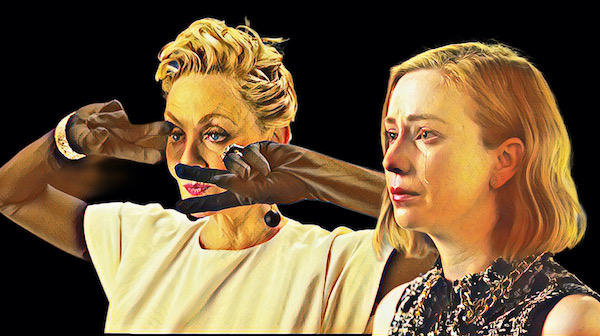
Season 2: Proximity, reflection, and inevitable rupture
If the first season was about the encounter, the second is about what happens when that encounter can no longer remain superficial.
Deborah and Ava return to Las Vegas carrying not only the promise of new material but also the weight of what has not been said. The trust between them, already fragile, becomes further strained by something more difficult to manage: the awareness that their connection goes beyond the professional, and is therefore easier to damage.
The tour becomes a space of constant exposure. Removed from any sense of stability, they are forced into continuous proximity, testing not only jokes, but boundaries. The stage is no longer the only site of performance. Everything becomes material.
It is in this movement that the series deepens one of its central ideas: it is not enough to have a voice; one must sustain it as it begins to change.
Deborah, long accustomed to controlling her image with precision, struggles with material that demands more than technique. As she incorporates more personal elements, largely encouraged by Ava, she moves toward something more honest, but also more vulnerable. And vulnerability does not come without resistance.
Ava, in turn, stops being merely an observer. By confessing to sending an email that exposes Deborah in deeply personal ways, she crosses a line the series had carefully built toward. The act is not only professionally risky but emotionally devastating. And still, Deborah does not immediately push her away. Instead, she transforms the relationship into something else: a field of sustained tension.
That decision defines the tone of the season.

What could have been a definitive break becomes forced coexistence. Deborah keeps Ava close, but reorganizes the relationship through a more explicit emotional distance. The collaboration continues, but now marked by silence, resentment, and, paradoxically, a sharper form of dependence.
Along the road, smaller events reveal what the series does best: showing that what appears episodic is, in fact, structural. A failed show, an unresponsive audience, and environments that push Deborah out of her comfort zone all function less as isolated incidents and more as symptoms.
Because what is at stake is not just the quality of the material.
It is the ability to adapt.
There are moments when that adaptation happens. When Deborah finds a new tone, more open and self-aware, there is a sense of genuine movement. Not just because the audience responds, but because she briefly sustains a truth she has long resisted.
But that movement is never linear.
The relationship with Ava remains central. Not because they agree, but because they understand each other in ways neither finds elsewhere. Ava begins to grasp the cost of staying, but also the cost of leaving. That ambiguity is what keeps her there.
Deborah, meanwhile, reveals something the series had only hinted at before: the cost of having made it. By admitting she once sabotaged another comedian out of fear, she reframes her trajectory. It is no longer only a story of resilience, but also of complicity.
It is one of the season’s most honest moments.
And one of the hardest to reconcile.
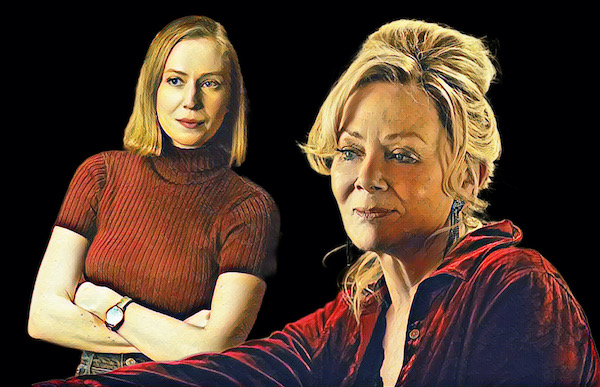
As the narrative moves toward its conclusion, there is an apparent alignment. The special comes together, recognition returns, and success seems once again within reach. It appears that Deborah has found a new position for herself.
But Hacks does not resolve its tensions that way.
The decision to push Ava away, precisely when the partnership feels strongest, is not merely strategic. It is entirely consistent with Deborah’s trajectory. She chooses control — even at the cost of losing the one relationship that truly challenges her.
Ava does not leave defeated.
She leaves displaced.
There is a crucial difference. She finds a path of her own, but one shaped by a rupture that is not fully resolved. What existed between them does not disappear. It simply shifts.
And that is what the second season leaves open.
What once seemed impossible becomes real. And once it becomes real, its limits are revealed.
Because in Hacks, the relationship was never the problem.
The problem is what to do with it once it is no longer optional.
Descubra mais sobre
Assine para receber nossas notícias mais recentes por e-mail.
 miscelana.com