
The final episode of Love Story begins where the series has always been most compelling: in the attempt to understand what remains unsaid. Carolyn and John are in therapy, trying to make sense of a recurring dream in which they are both present at the assassination of his father. For the analyst, this is less about the past and more about the symbolic weight they carry in the present. For John, it is fame. For Carolyn, it is something more intimate, more corrosive. They are no longer speaking the same language.
The suggestion of a temporary separation emerges almost as an inevitable diagnosis, but they resist it. There is still affection, still memory. At the bar, they manage to laugh about it. At home, they try to reconnect physically, as if the body could resolve what language no longer can. It works for a moment. As it has so many times before.

By morning, the fracture returns. Carolyn wants to keep talking, to name what is wrong. John, already running late, tries to move forward. Their dynamic becomes clearer when he speaks with Caroline and later when Carolyn talks to Lauren. The two sisters, each in her own way, say the same thing: it is not possible to live suspended between what was and what could be. A choice has to be made.
Carolyn chooses, even if hesitantly. She goes to the George magazine party, surprises John, reappears beside him in public. The flashes are almost violent, as if the series wants to remind us that this relationship was never just theirs.
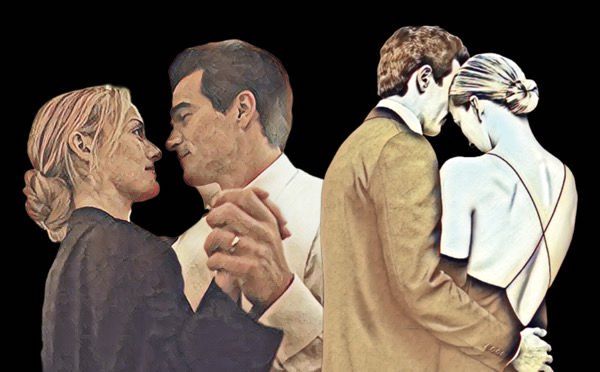
The real reunion happens at the restaurant where they had their first date. This time, John arrives on time. For the first time in the episode, they speak honestly about fear, failure, and expectation. He promises to put her first. She gives in on something she had been resisting: she agrees to go to the wedding in Hyannis Port. “I miss dancing with you,” she says. It is a simple line, but it carries everything they are still trying to save.
From that point on, the series makes a clear narrative choice. It builds this final moment of reconciliation to make what follows even harder to bear.
The opening scenes of the series return, now with a different weight. And then the plane appears.
This is where Love Story abandons any restraint. The decision to show the crash from the passengers’ perspective is not about documentary precision, but emotional impact. Inside the fog, after the right turn, something is wrong. John does not know what. They are already falling without realizing it. Carolyn tells him to breathe. And then, blackout.
The episode shifts its axis. It leaves intimacy and enters the collective.
The news spreads, the search begins, and hope lingers for a few days. The press turns everything into spectacle. When the wreckage is found, there are still thirty minutes left in the episode, and that is no accident. The series wants grief to take up space.
Caroline Kennedy carries that weight. Reliving loss once again, under public scrutiny, makes everything more cruel. The episode details the likely cause of the crash, spatial disorientation, when the body betrays the pilot, and the sensation of control becomes an illusion. The technical explanation acts as a cold counterpoint to a deeply human tragedy.
On the other side, grief fractures. Carolyn’s family feels excluded, diminished, and erased by the public narrative surrounding the Kennedys. Her mother, Ann, explodes. Not only because of the loss, but because of how that loss is being handled. By the press, by the practical decisions, by the weight of a name that is not hers.
The confrontation between Ann and Caroline is one of the episode’s harshest moments. There are no villains here, only two devastated women trying to give shape to what has none. Ann reminds her that she has lost two daughters. Caroline tries to explain that she, too, is trying to survive. Neither of them truly reaches the other.
Amid all this, a small detail becomes devastating. John’s card was left before the trip. A gesture of hope displaced in time, as if the future were still negotiable.
“Meet me back at the beginning.”
The line echoes as both irony and an impossible wish.

The decisions surrounding the bodies, the implicit dispute over belonging, the invasive presence of the crowd outside the building, everything reinforces what the series has been building from the start: this story was never only about love, but about exposure.
The episode slows down toward the end. Ethel Kennedy appears almost as a quiet conscience, someone who has already understood that certain losses cannot be overcome, only carried.
At the memorial service, the choice of the poem “Death Is Nothing At All,” by Henry Scott-Holland, is not accidental. The idea of continuity, of invisible proximity, functions almost as a narrative consolation. As if the series, after everything, still wants to offer some form of peace.
The ending unfolds at sea. Caroline scatters the ashes of John, Carolyn, and Lauren. The final image returns the couple to a space without noise, without press, without history. Just the two of them, facing the horizon.
Love Story ends the way it began: trying to organize what was never fully understandable. But in the end, it makes something clear. Perhaps it was never about understanding. Only about remembering.
Descubra mais sobre
Assine para receber nossas notícias mais recentes por e-mail.
 miscelana.com