
The third season of House of the Dragon arrives surrounded by an expectation that is not sustained only by the scale of the events to come, but by a quiet shift in tone that is beginning to take shape.
Over two seasons, the series managed to strike a delicate balance between tragedy and identification, allowing the audience to find emotional anchor points amid the political chaos and growing violence. It was a story about the dispute for power, but also about belonging, about legitimacy, and, to some extent, about choice.
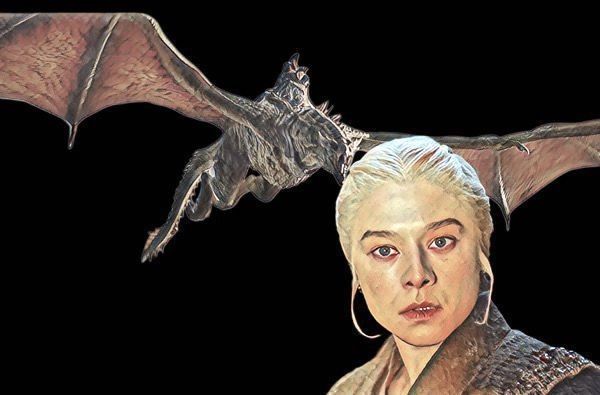
I am part of the group of purists, those who would like to see an almost literal fidelity to the book that gave origin to the series, but, having said that, it is necessary to recognize that most of the audience following the show has not read a single page written by George R. R. Martin — and yet is deeply engaged with the work led by Ryan Condal. I also acknowledge a certain hypocrisy in this position. I myself fell in love with Game of Thrones before finally reading the books. And, even after reading them, I still believed that many of the simplifications and changes made by television worked within that language, even if the conclusion was problematic. Translating into images something that already exists in the collective imagination is never a simple or comfortable gesture.
Returning to the series, a large part of the readers tend to align with the so-called Blacks, on the side of Rhaenyra Targaryen, who, even deeply flawed on the page, still occupied the place closest to that of a protagonist. There is among fans a sense that the adaptation has been trying to shift that perception, especially by humanizing the Greens, and it must be acknowledged that the cast has managed to give depth to characters who could easily fall into caricature. This is, perhaps, one of the series’s greatest achievements so far.
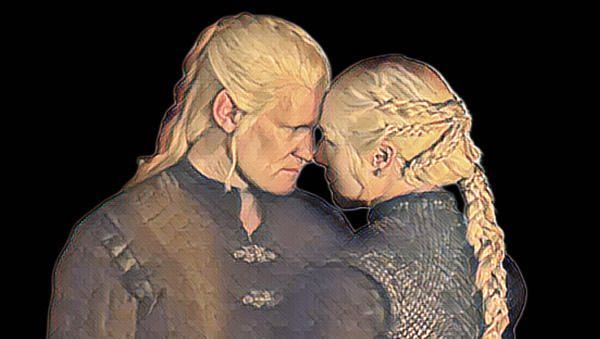
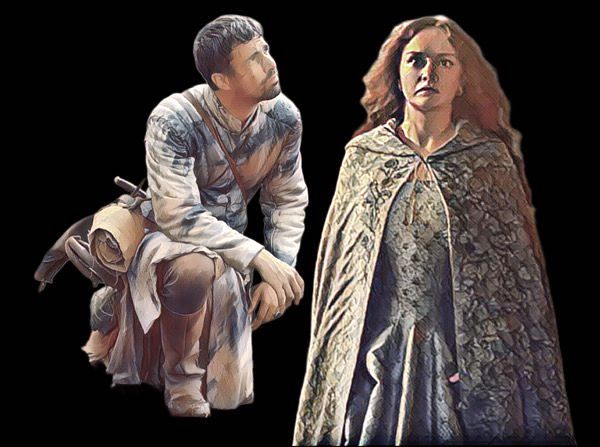
In light of the public criticism coming from the author himself, what begins to emerge for the penultimate season is less a course correction and more a change in logic.
As the adaptation advances into the harsher sections of Fire & Blood, the war stops being merely a conflict between factions and begins to function as a mechanism of deformation. It is not only the events that intensify. It is the characters who begin to escape any comfortable reading. And perhaps that is the true turning point of the series, more profound than any battle or death to come.
Rhaenyra Targaryen and the erosion of power
At the center of this shift stands Rhaenyra Targaryen precisely. From the beginning, her trajectory was built as that of an heir who needed to justify her own existence within a system that rejects her. Identification with her was never accidental. The series organized its narrative in such a way that her cause seemed not only legitimate but morally defensible. The problem is that legitimacy does not prevent erosion.
What the original material suggests — and what the third season finally seems willing to explore — is a process of wear that does not manifest as rupture, but as accumulation. Surrounded by losses, betrayals, and increasingly violent political pressures, Rhaenyra stops reacting to the world and begins to close herself off from it. Paranoia does not emerge as exaggeration, but as a consequence. And when that happens, what once seemed firm begins to shift.
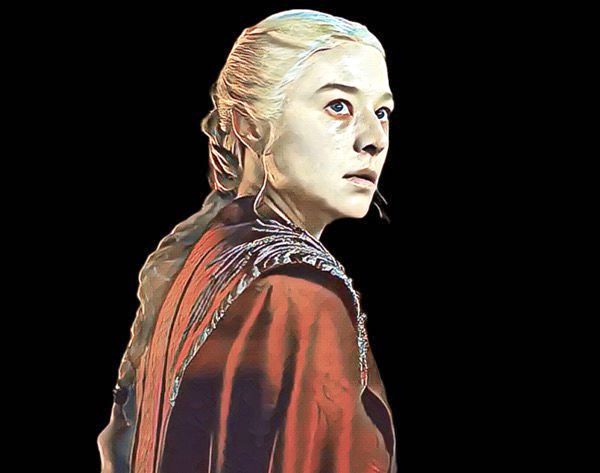
Until now, the series has chosen to frame her within a more palatable logic, softening edges that, in the original text, were always present. There is in her an impulsiveness that often borders on recklessness, but which has been balanced by a perspective that privileges her vulnerability and her position within a system that rejects her. It is precisely this autonomy as a princess that awakens the resentment of her greatest antagonists, Alicent Hightower and Criston Cole, former allies who, in different moments, felt used, manipulated, and discarded by her.
Even so, we continue to root for the one who presents herself as the rightful queen. And perhaps this is one of the greatest differences between book and series. Because, on the pages of Fire & Blood, Rhaenyra was never exactly virtuous.
Criston Cole and a morality that breaks without explaining itself
If Rhaenyra Targaryen moves toward hardening, Criston Cole offers a more uncomfortable movement. Few characters have been so rejected, and not without reason. His trajectory so far has been marked by impulsiveness and by a moral rigidity that often turns into violence. The murder of a guest at a wedding remains one of the most difficult moments to reconcile within the logic of the series. Even if his proximity to Alicent Hightower can be read as a kind of “salvation”, the fact that Viserys I Targaryen imposed no punishment — not even in relation to House Velaryon — remains one of the weakest choices of the adaptation, especially when compared to the more coherent version in the book.
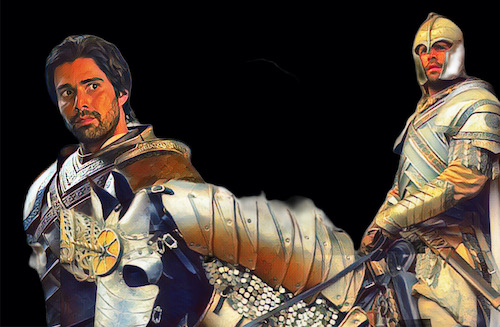
Still, the second season began to suggest something different by removing him from the court and placing him before war. Outside the environment that amplified his worst decisions, a character emerges who does not become better, but becomes more legible. What is missing, in the television version, is the authority and leadership described in the pages, and what we see is a man crossed by consequences rather than someone capable of commanding them. At certain moments, there is even the suggestion of a kind of regret, although never fully elaborated.
The third season, on the other hand, should not offer redemption, but may offer something more uncomfortable, which is the possibility of understanding. And this, for a character constructed as an antagonist, completely alters the dynamics of the audience’s gaze. His rupture with Rhaenyra Targaryen is born from a feeling of moral fall, of having broken vows that define his identity, but this same rigor disappears when he himself establishes a relationship with Alicent. It is not simply hypocrisy. It is a character whose morality is less stable than he himself believes — and one that the series, so far, has not fully contextualized.
Alicent Hightower and the weight of choices that cannot be undone
Alicent Hightower is another character whose arc demands a more evident shift in the third season. And there is a quiet irony that runs through her entire trajectory. She is one of the few survivors of the civil war, which she was a crucial part in setting into motion — not only as a participant, but as someone who helped, even if indirectly, to make it happen.

Much of the first season revolves around misunderstandings that, on their own, could seem small, but that become catastrophic once accumulated. Alicent stands at the center of all of them. Her youth and her closeness to Rhaenyra Targaryen shift what would be a blood feud into a relationship marked by friendship and mutual betrayal, one that almost destroys the Targaryens.
Raised to obey, Alicent always accepted her role within her father’s structure of power, without a voice of her own. The influence of Otto Hightower shapes her from the beginning, and her marriage to Viserys I Targaryen reinforces that place. It is a marriage without love, sex without pleasure, in which she gives the king four children, including the male heirs he wanted. And yet, to everyone’s surprise, he becomes resistant to removing his firstborn daughter from the line of succession.
Alicent took time to fully embrace the conflict on behalf of her children, but watching Rhaenyra take lovers, have illegitimate children, and still retain the Crown deepens the tension even further. Even so, it is her misunderstanding of Viserys’ final words that places her at the center of what becomes the civil war.
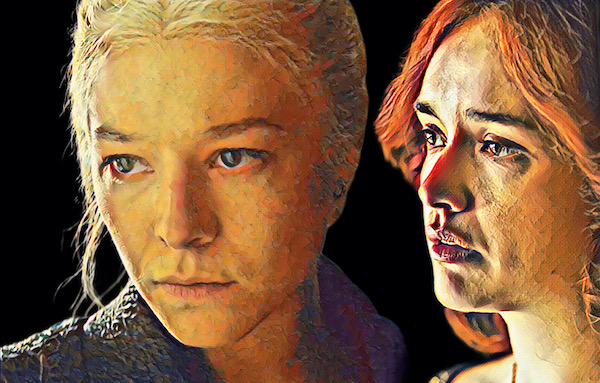
In the second season, the series places Alicent in a gray space. She is not portrayed as a devoted or particularly committed mother, and she is once again pushed to the background by her own sons, Aegon II Targaryen and Aemond Targaryen, as well as by her lover, Criston Cole. As losses begin to multiply, she negotiates with Rhaenyra, offering submission in exchange for her own freedom and that of Helaena Targaryen.
In the third season, we will see Alicent fighting for her own survival, as the Blacks neither sympathize with her nor trust her, and the agreement collapses with Aegon’s escape.
Aemond Targaryen and the construction of an enemy who believes he is right
Aemond Targaryen is a figure as mythic as his uncle, Daemon Targaryen, of whom he seems almost like a reflection. There is something performative in him, as if he were constantly embodying an idealized version of power.
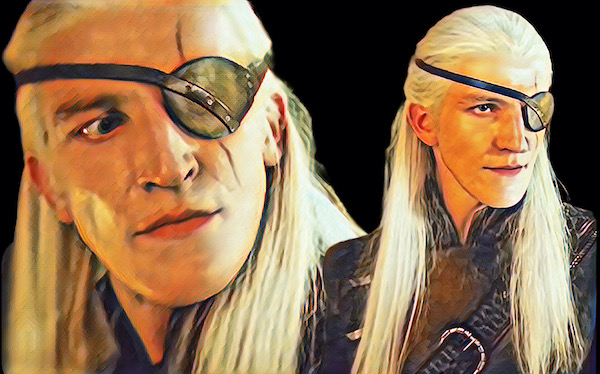
Born as the “spare”, Aemond could have remained marginal, but the lack of preparation, the recklessness, and even the limitations of his brother, Aegon II Targaryen, torment him — and not without reason. We saw him as a humiliated child, unable to claim a dragon, using arrogance as a shield. He absorbed everything around him with an intensity that not even Alicent demonstrates with the same force. Those who had what he never would — and yet he saw himself as the only one truly prepared for the throne.
Losing an eye in a fight with his nephews and being constantly diminished by his own brother led Aemond to two decisive acts: accidentally killing Lucerys Velaryon and intentionally nearly killing Aegon. This latter change from the book — where Aemond remains blindly loyal to his brother — is one of the most interesting aspects of the television adaptation. It adds an even more unsettling, cold, and cruel layer to a character who now operates with context, purpose, and intent.
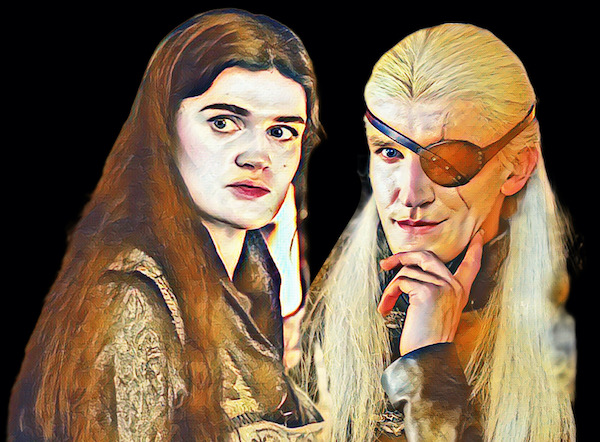
In the third season, during his regency in Aegon’s absence, Aemond will effectively become king, if only temporarily. And while certain revelations, such as Helaena Targaryen’s foreshadowing, may have diminished some of the suspense, the journey still leaves room for one of the most anticipated arcs of the Dance of the Dragons: his relationship with Alys Rivers. It is a dynamic that promises to reveal yet another layer of a character already defined by intensity.
Hugh Hammer and the risk of power through rebellion
Among the emerging tensions, Hugh Hammer represents a particularly unstable variable. The series introduces a context for his future betrayal and ambition through the tragedy that is set to fall upon his family. In the book, he is driven by ambition in its most direct form. In the third season, it will be frustration, resentment, and rebellion that move him.
His rise as a dragonseed was presented as a spectacle, but what follows shifts the focus from conquest to consequence. Power, when it arrives suddenly, does not organize; it exposes. And at this point in the narrative, loyalty ceases to be a fixed trait and becomes a constantly renegotiated choice. Hugh is dangerous not only for what he conquers, but for what he has yet to decide to become.

Aegon II Targaryen and the lesson that comes only through loss
Aegon II Targaryen embodies a type of transformation that the series has not yet fully explored. His trajectory so far has been that of an unlikely king, sustained more by the structure around him than by any personal conviction. Thanks to the performance of Tom Glynn-Carney, Aegon is not simply a detestable prince or a spoiled ruler. His layers run deeper: a son without truly present parents, a boy who grew up without a defined role, who only felt seen and validated once he wore the crown — naturally creating conflicts and tensions precisely because neither Alicent, Otto, nor Viserys ever trained him for it.
His actions against Aemond cost him a crucial ally and created another antagonist. His physical destruction becomes a striking metaphor for a man melted, deformed,d and in pain.

What the third season suggests, by removing him from the center of power, is the possibility of a late construction. The experience of loss, fragility, and distance creates a form of awareness that the throne never demanded from him. And it is in that displacement that a fundamental irony resides. While Rhaenyra hardens within power, Aegon may begin to understand it from the outside — and perhaps even develop the leadership he was never taught, but now needs to claim legitimacy.
Daemon Targaryen and the exhaustion of one who has always been chaos
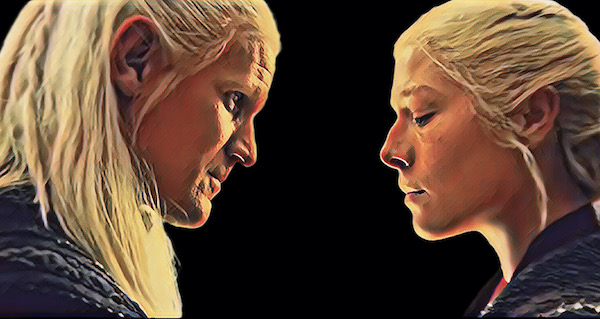
Daemon Targaryen may be the character who best translates the shift in tone of the series. For much of the narrative, he functioned as a destabilizing force, someone whose unpredictability was both a narrative engine and a source of fascination. Matt Smith brings exactly the right balance of arrogance, frustration, and a desire for recognition that, in the book, fed a more direct ambition to become king. In the series, that impulse is more ambiguous.
Daemon loves and does not love, wants and does not want. He understands the logic of power better than anyone else, but what drives him is not simply the desire to rule, but a deep discomfort with what he perceives as weakness. The kindness and diplomacy of Viserys I Targaryen, as well as those of Rhaenyra, appear to him not as virtues, but as openings — invitations for the unworthy to claim space they should never occupy.

The second season had already suggested a shift by placing him in a more introspective, almost suspended state. Confronted with a prophecy he once dismissed, he now embraces Rhaenyra’s cause with greater conviction, even if that conviction is not fully articulated.
The return to war in the third season does not necessarily mean a return to the same character. What begins to emerge is a weariness that does not eliminate his violence, but runs through it. And this changes not only what he does, but how those actions are perceived.
The absence of certain elements from the book, such as his relationship with Nettles, shifts the analytical focus, but does not reduce his complexity. On the contrary, it opens space for the series to deepen an ambiguity that is already present. His marriage to Rhaenyra, born as an alliance, carries traces of love — or perhaps not. With Daemon, even love remains unresolved.
When the series stops guiding the audience
What unites all of these movements is not simply character evolution, but a structural shift in how the series operates.
Until now, there was still an attempt to guide the audience, to offer some form of moral framework, however unstable. From this point on, that mediation disappears.
The war remains the backdrop, but what truly changes is the relationship between narrative and viewer.
Because when no one is fully justifiable anymore, the conflict ceases to be about who will win. It becomes about what remains.
Descubra mais sobre
Assine para receber nossas notícias mais recentes por e-mail.
 miscelana.com