
There is something curious, and perhaps even unexpected, about the trajectory of Jon Hamm. For many, he seems to emerge fully formed as the enigmatic Don Draper in Mad Men, between 2007 and 2015, a role that earned him an Emmy and turned him into a global star. Before that, however, Hamm had already been moving through television in smaller appearances in series such as CSI: Miami, Charmed, and Gilmore Girls, roles that rarely held the audience’s attention in the same way.


With the recognition that followed, it would have been natural to expect a direct transition into film or a succession of leading television roles. Instead, Hamm chose a different path. He moved between comedy and drama across a range of projects, often without occupying the narrative center. His work in Fargo is a clear example of how he can shift his screen presence without losing impact, while appearances in shows like The Morning Show place him in more ambiguous territory, somewhere between antagonist and romantic interest.

The title recalls the work of Neil LaBute, but the connection is tonal rather than narrative. Andrew “Coop” Cooper is still trying to process the end of his marriage after discovering his wife’s affair with his best friend, while also dealing with the abrupt loss of his job as a hedge fund manager. The collapse is swift, but not explosive. It settles in.
Without income, yet still bound to the expectations of a neighborhood that demands the appearance of stability, Coop begins breaking into his wealthy neighbors’ homes and stealing valuable items to resell. What begins as improvisation quickly becomes method, and what first appears to be a desperate solution reveals something deeper. By entering these homes, he discovers that the idea of perfection sustaining that world is, at best, fragile.
The premise of a man turning to crime to maintain a lifestyle he can no longer afford is not new. What distinguishes Your Friends & Neighbors is the way it shifts that starting point. This is not only about money. It is about identity.
What season one actually builds
The narrative unfolds as a gradual dismantling. Coop does not transform all at once. He is shaped by a series of small decisions that, taken together, lead him to a point of no return.
His relationship with Mel, played by Amanda Peet, anchors the emotional core of the series. There is an intimacy between them that divorce does not erase, but that also does not allow for an easy reconciliation. Mel sees Coop with a clarity he resists, and that constant recognition prevents him from fully hiding behind the version of himself he is still trying to maintain.
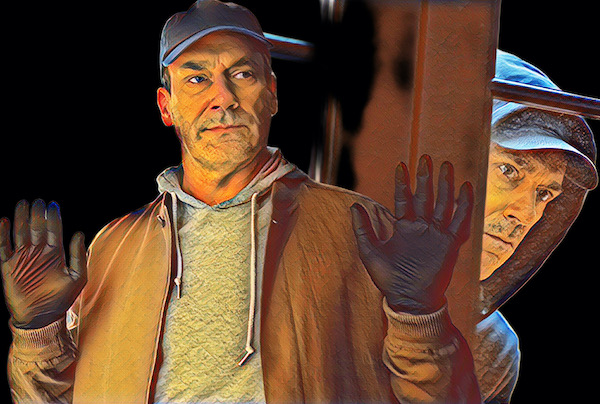
At the same time, the world around them opens up. Each home he enters reveals a fracture, a secret, a contradiction. Coop occupies a paradoxical position, both participant and observer, exposing the hypocrisy of that world while still depending on it.
His involvement with Sam marks the transition into more unstable territory. What begins as an emotional escape becomes the center of the narrative shift, particularly when Coop enters her house and finds Paul dead. From that moment on, the series reframes itself. What once seemed like a story about small-scale crime becomes a murder case, with Coop as the primary suspect.
The construction of this arc is precise because it refuses simplification. Coop is not immediately guilty, but he is also unable to prove his innocence. Evidence accumulates, the police close in, and external perception begins to define him before he has the chance to respond.
Where we are now
The final revelation reorganizes everything without softening what came before. Paul was not murdered. He took his own life, and the scene was manipulated by Sam to secure a multimillion-dollar insurance payout that would not apply in the case of suicide. The staging involves the removal of evidence and an attempt to frame Coop, who was already vulnerable enough to serve as a plausible suspect.
Coop is cleared, but not absolved in any broader sense. Nothing he has done disappears. What changes is how he positions himself in relation to that world.
The final gesture defines this with precision. Faced with the possibility of returning to his career and reentering the structure that once sustained him, Coop chooses not to go back. He steals again. Not out of immediate necessity, but as an assertion of a rupture that can no longer be ignored.
What this means for season two
Season two begins from that point of displacement.
Coop is no longer a man trying to preserve appearances. He is someone who has seen how that system works from the inside and no longer believes in it. This fundamentally alters the nature of risk. It is no longer about being caught, but about how far he is willing to go now that he no longer feels the need to belong.

The arrival of James Marsden suggests a new dynamic within that world, possibly as a mirror or counterpoint, someone who represents what Coop once was or what he might still become. The series has, so far, sustained itself by avoiding easy resolutions, and its continuation depends on that same restraint.
If the first season dismantles the illusion of belonging, the next must confront what emerges in its place. Not as a definitive answer, but as a deepening of the question already at the center of the narrative. What happens when someone realizes that the world they dedicated their entire life to was never as solid as it seemed? And, more importantly, what happens when that person decides not to rebuild it.
Descubra mais sobre
Assine para receber nossas notícias mais recentes por e-mail.
 miscelana.com