
I would bet that, if you haven’t already said that Miranda Priestly from The Devil Wears Prada reminds you of a boss you once had, at least one or two friends have compared their own reality to that fiction. But how do we explain this if not everyone works in fashion or journalism? Mirandas multiply because, here, fiction, inspired by a real figure, reached something close to a perfect archetype, one that, unfortunately, often comes at the cost of women’s physical and mental health.
The quiet discomfort that runs through the film helps explain why, nearly two decades later, Miranda Priestly feels less like a character and more like a shared experience. It is not simply about a demanding boss or the glamour of a fashion magazine. It is about recognition. What the book and the film capture so precisely is not just a leadership style, but a type of bond. And it is this bond that continues to echo far beyond the screen. It is no coincidence that this discomfort resurfaces now, with the upcoming release of The Devil Wears Prada 2, which places these characters back into a world that no longer operates by the same rules.
This is not really about Miranda. It is about Andy Sachs and how so many of us fall into the same trap.

The inspiration behind Miranda was never entirely hidden. The character created by Lauren Weisberger clearly draws from Anna Wintour, her former boss at Vogue, but the impact of the character goes far beyond that reference. Miranda does not need to raise her voice. Her power lies in restraint, in cold precision, in her ability to reorganize the room around her with minimal effort.
Meryl Streep captures this in the many inflections of “that’s all,” repeated in different moments yet always carrying a subtle cruelty. In her calm, she destabilizes the entire team emotionally with very few words, maintaining absolute control. Among the many scenes that illustrate this dynamic, one remains particularly revealing. Andy arrives late, still out of place, not yet understanding the unspoken rules of that environment. Miranda simply observes and notes that everyone has been waiting. There is no direct confrontation, but there is an immediate displacement. Andy is put out of place.
This is how it begins.

In an analytic setting, there are many Andys and even more Mirandas, because this type of relationship is not the exception; it is the pattern. Following Freud’s formulations, Miranda can be understood as an external Ideal of the Ego. She is never just a boss, but embodies an almost unattainable standard of excellence. And Andy, like so many of us, transforms that position into a punitive Superego. Miranda’s voice begins to exist inside her, demanding, judging, pushing further. Once this bond is established, the sense of insufficiency does not disappear when the workday ends.
To make matters even more complex, there is a delicate point that is rarely acknowledged. There is a certain pleasure in being chosen by someone like Miranda. As if being “the chosen one” legitimizes, differentiates, and gives meaning. In the pursuit of that approval, which rarely stabilizes, one remains in the relationship even when it becomes harmful.
At a deeper level, another element intensifies this dynamic. Relationships with figures like Miranda often reactivate earlier experiences with authority, whether maternal, paternal, or tied to caregivers. That is why the intensity feels disproportionate. What appears to be about work is, in fact, about approval, rejection, and validation. And when all of this becomes entangled, the response frequently exceeds the professional context. After all, as Miranda shows, she does not only demand. She also withdraws recognition with precision.
This creates a cycle of attempted repair. One works harder, gives more, trying to recover that gaze that once validated.
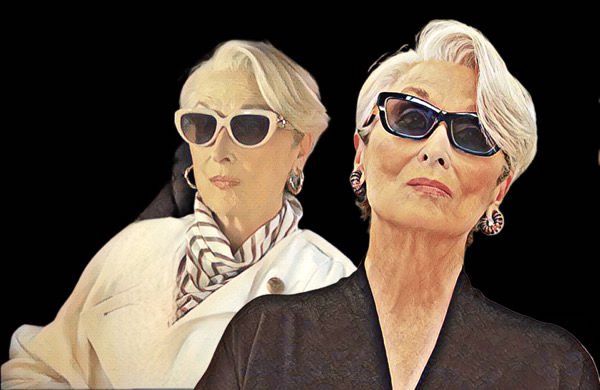
What is often described as transformation is, under a psychoanalytic lens, much closer to a process of identification. Andy, who initially dismisses that world, gradually reorganizes her identity around Miranda’s gaze. It is not about fashion. It is about belonging and recognition.
When we look at this dynamic through a gendered perspective, it becomes even more complex. Women are historically trained to perform competence while also managing emotional expectations, anticipating demands, and avoiding direct confrontation. In highly hierarchical environments, this combination can be exploited in ways that are almost invisible. The demand is not only technical. It is also emotional. And that is precisely why this type of relationship finds fertile ground, because it does not begin at work; it begins much earlier.
In the film, there is a clear breaking point. Andy learns to say no and leaves the job precisely when she receives the validation she had been seeking. One might wish real life worked that way, but that rupture is usually far more complex.
Outside the screen, there are concrete factors that sustain this kind of bond. The material need for a job, the building of a career, the fear of losing ground, and the promise of future recognition. Added to this is something harder to name. The feeling that leaving somehow means failing.
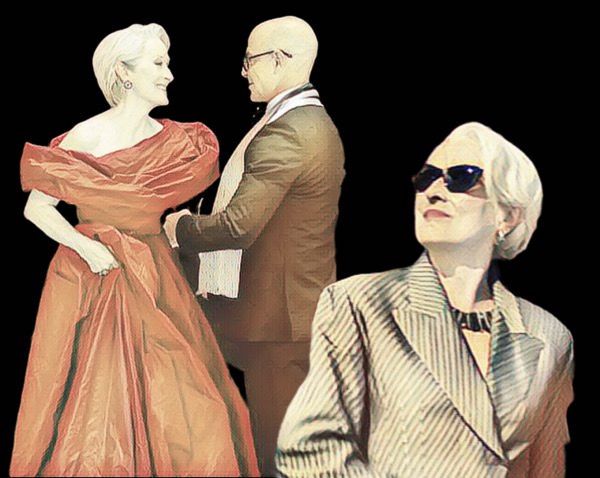
If, at any point, you have recognized a Miranda Priestly in your own life, it may be worth paying attention. The traps are gradual, and excess quickly becomes normalized. The body is often the first to signal that something is wrong. Insomnia, constant anxiety, a permanent sense of alertness, and difficulty disconnecting. The damage does not begin at collapse. It settles in earlier, almost imperceptibly.
Reversing this is not immediate. It begins with recognition, with the ability to name the dynamic and understand that it is not only individual. There is a structural dimension to these relationships that crosses different environments and contexts. Rebuilding boundaries takes time, support, and, often, a redefinition of what success means.
In some cases, leaving becomes necessary. Not as a heroic break, but as an act of preservation. Yes, like Andy Sachs.
And even then, leaving does not resolve everything, because it does not always end the process. The internalized gaze continues to operate for some time. There is a need to reconnect with oneself, to rebuild criteria, to recover autonomy and self-worth.
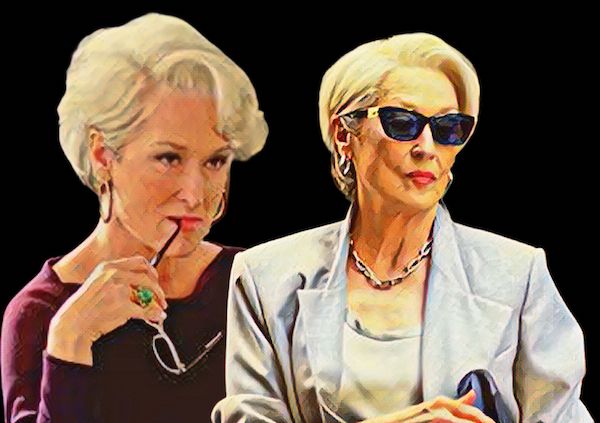
Returning to Miranda, then, is not about judging her, but about understanding what she represents. A model of power that still organizes many workplace relationships, especially for women navigating ambition alongside constant pressure to perform. She is, at once, reference and threat, recognition and limit.
Perhaps that is why so many people see themselves in this story. Not because they had a Miranda exactly like her, but because they have already been in that place of displacement, trying to live up to something that felt indispensable.
And perhaps that is why returning to these characters matters. Not to relive the story, but to look at it from somewhere else.
Descubra mais sobre
Assine para receber nossas notícias mais recentes por e-mail.
 miscelana.com