
There is a very clear turning point in how we consume television, and it is not just about the evolution of storytelling, but about audience behavior. For decades, series like The X-Files and the universe of Star Trek had already mobilized passionate communities capable of discussing episodes, building theories, and forming bonds that extended beyond the screen. But all of this happened in a fragmented way, without the continuity and scale that now feel natural.
When Lost premiered in 2004, that landscape found a new infrastructure. The internet was beginning to consolidate as a social space, and in Brazil, that meant Orkut. An episode no longer marked an ending, but the beginning of another experience, collective, immediate, almost compulsive. Theories were built in groups, clues were organized, and characters were analyzed as if part of an ongoing investigation.
Lost did not create fandom, but it transformed it into a real-time community. In doing so, it permanently altered the logic of television.

The birth of the Lost effect
From that point on, a model took shape that proved irresistible to the industry. Instead of telling a story that contains mysteries, the series began constructing narratives that depend on them. Questions multiply, symbols accumulate, and the promise that everything will eventually be explained becomes the engine of engagement.
This model establishes an implicit contract between the show and the audience. The narrative offers complexity, and the viewer offers time, attention, and emotional investment. In return, there is an expectation of coherence, meaning, and above all, resolution.
The ending of Lost becomes one of the first major examples of tension within this contract in a landscape already amplified by social media. The conversation is no longer individual but collective, organized, and loud. It is not simply about liking or disliking the outcome, but about the sense that something promised was not fully delivered.
This is the moment when what we call the Lost effect begins to fully emerge.
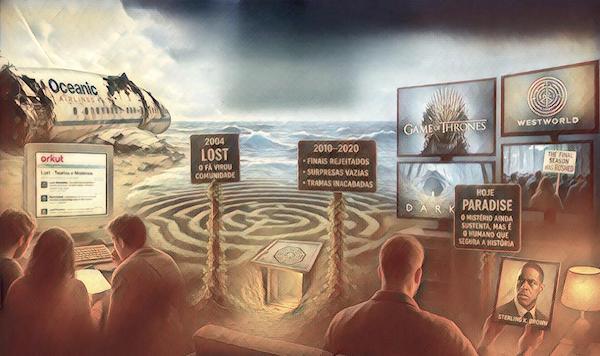
When the model starts to break
In the years that followed, many series adopted this logic, often amplifying its excesses. Game of Thrones built a deep relationship with its audience across seasons filled with clues, theories, and expectations, only to reach an ending surrounded by intense backlash that exposed the gap between construction and conclusion.
Westworld reveals another variation of the same phenomenon. As audiences became increasingly skilled at anticipating narrative moves, the series responded by increasing its complexity in a defensive way, creating a structure that closes in on itself and demands more effort than it gives back.
In this process, certain distortions become clear. Narratives accumulate questions without a clear intention of answering them, twists exist primarily for shock value, and tonal shifts suggest a reaction to reception rather than internal logic. The viewer, once part of the meaning-making process, begins to follow a structure that often feels like it is slipping away from itself.


The exceptions that work
Within this landscape, Dark stands out as a meaningful counterpoint. The German series embraces complexity but sustains it through a consistent narrative architecture, demonstrating that the issue was never ambition or density, but the lack of planning.
When a mystery has structure, it stops being a trick and becomes part of the experience. Complexity does not alienate; it organizes.
The recent case of Paradise
It is within this context that Paradise emerges, a production that clearly dialogues with this legacy. There is a central mystery, a structure built around revelation, and a clear invitation for audience engagement.
But what sustains the series is not exactly that mechanism.
The element that anchors the experience is Sterling K. Brown. There is a gravity in his presence that restores emotional weight to a narrative that could easily lose itself in its own ambitions. When the writing leans toward excess or prioritizes surprise over depth, his performance provides stability.
And this reveals an important limit of the model itself.

What truly sustains a series
Audience engagement was never generated by mystery alone. In Lost, theories mattered because they were tied to characters who sustained the experience. The investment was not only in answers, but in the journey and in the relationships built along the way.
Two decades later, the Lost effect is still present, but it is no longer received with the same naivety. Audiences remain willing to investigate, discuss, and participate, but they have developed a sharper awareness of what is being offered.
Mystery without structure wears out. Surprise without consequence loses impact.
In the end, what becomes clearer is something that runs through the entire history of television. No complex construction sustains itself without a human core capable of giving meaning to what is being told. When that element is present, mystery expands the experience. When it is not, it merely disguises its absence.
Descubra mais sobre
Assine para receber nossas notícias mais recentes por e-mail.
 miscelana.com