
The passage of time and the weight of a classic
In 2026, The Maltese Falcon turns 85 since its premiere on October 3, 1941, by Warner Bros. The number itself might suggest nothing more than a milestone, another round anniversary in film history. But in the case of The Maltese Falcon, time does not function as a commemorative frame, but as proof of something far rarer: a film’s ability not only to survive across decades, but to continue shaping how we think about narrative, character, and desire.
What was consolidated there was not simply a classic. It was a way of seeing the world.
A novel written by someone who knew crime from the inside
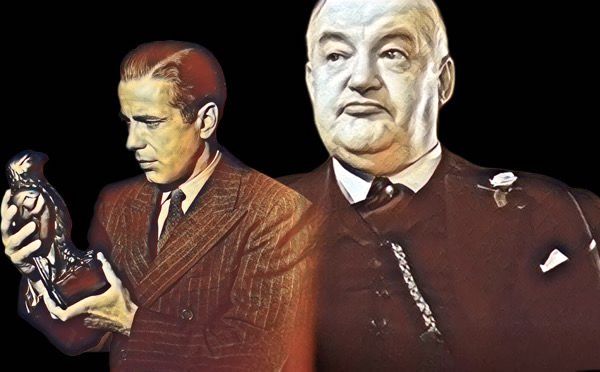
The story begins before cinema, in the novel The Maltese Falcon by Dashiell Hammett. Hammett did not write about crime as a distant observer. He had worked as a detective at the Pinkerton agency, and this experience is embedded in the way his characters speak, hesitate, manipulate, and conceal. There is no illusion of an ordered world, only relationships built on interest, conflicting versions, and the constant sense that truth is always provisional.
When John Huston decides to adapt the book, he understands that the material does not need to be softened or translated into something more conventionally cinematic. Instead, he keeps the dialogue almost intact and preserves a narrative structure centered on a single point of view. This means the audience is not handed answers, but instead follows the construction of meaning alongside the protagonist.
This choice, already noted in the original 1941 review, was unusual at the time. It may also be what gives the film its quiet intelligence, the sense that everything is being said without needing to be explained.
Two forgotten versions and a definitive breakthrough
Before the 1941 version, the studio had already attempted to bring the story to the screen twice. The 1931 adaptation stayed closer to the novel but remained tied to a transitional moment in early sound cinema. In 1936, Satan Met a Lady reshaped the narrative into something lighter, almost unrecognizable, as if it did not trust the strength of the original material, even with Bette Davis in the cast.
What Huston does is recover precisely what those versions lost: tension, ambiguity, and a refusal to offer moral comfort.
Humphrey Bogart before he became Humphrey Bogart
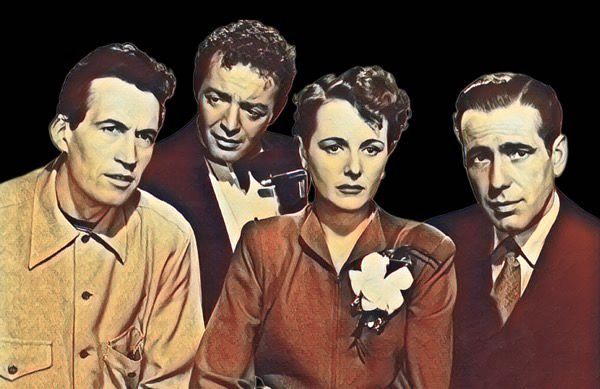
It is impossible to talk about the film without understanding the moment Humphrey Bogart arrives at it. In the early 1930s, Bogart was not a star, nor even a reliable bet. His career was uneven, confined to supporting roles, often playing generic criminals without room to build something more complex.
Off-screen, his relationship with Hollywood was marked by distrust. He saved money obsessively, aware that the studio system could discard him at any moment, cultivating a kind of quiet independence as a way to maintain control in an environment that offered very little security.
The success of High Sierra, also in 1941, changes this equation. The film proves that Bogart could carry a leading role, opening the door to a decisive moment. When George Raft refuses to play Sam Spade because he does not want to work with a first-time director, one of those historical accidents occurs that reshapes everything.
Bogart takes the role and, in doing so, creates something that now feels inevitable, but at the time was far from guaranteed.
Sam Spade and the invention of an archetype
Sam Spade is not a hero in the classical sense. He observes more than he reacts, calculates more than he reveals, and operates according to a code that is never fully explained. Throughout the film, his intentions remain ambiguous, and that ambiguity is sustained until the very end, something that contemporary critics already recognized as one of the great strengths of Bogart’s performance.
The audience never has full access to what he thinks, only to the consequences of his choices.
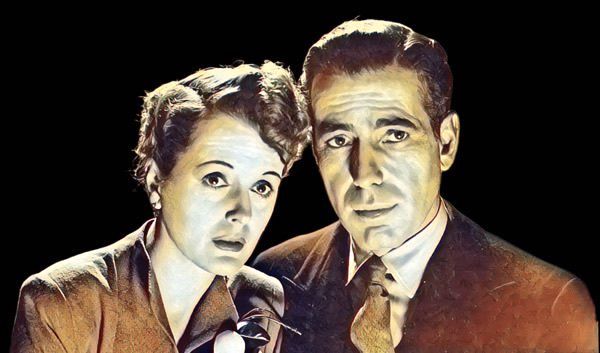
Around him, the cast creates a constant field of tension. The Brigid of Mary Astor is not simply a femme fatale, but a character who shifts between vulnerability and manipulation with unsettling precision. Peter Lorre brings a contained unease, while Sydney Greenstreet constructs a presence that blends sophistication with threat.
Everything feels slightly off, as if each character were performing a version of themselves.
John Huston’s debut and the illusion of total control
For a first film, the confidence of John Huston remains striking. He not only directed, but also wrote the screenplay and storyboarded the entire film before shooting, anticipating framing, movement, and rhythm.
The 1941 review immediately recognized this. It described the arrival of a director with unusual technical and narrative command, someone who understood how to build suspense not only through what is shown, but through what is suggested. Small details, such as the use of the telephone as a suspense device with nearly unintelligible voices, were pointed out as evidence of this sophistication.
Nothing feels improvised, but nothing feels rigid either.
The birth of noir as a language
Although the term film noir had not yet been established in 1941, many of the elements that would define the genre are already present. Arthur Edeson’s cinematography, with its sharp contrasts, creates an environment where light and shadow do more than compose the image; they translate the moral state of the characters.
Spaces feel enclosed, conversations feel weighted, and the sense that something is always being concealed runs throughout the film.
This is not simply a visual style, but a way of structuring a narrative world where certainty is unstable, and intention is rarely transparent.
The falcon as a symbol and irony
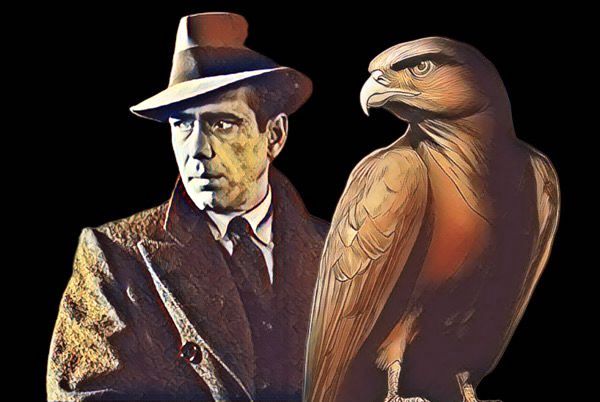
At the center of everything is the falcon, the statuette that drives all the characters. Within the story, it represents wealth, power, and desire. Outside it, it was merely a prop, produced in different versions for the film.
Over time, those objects became highly valuable collector’s items. The irony is unavoidable. The object that symbolizes illusion in the film ends up acquiring, in reality, the very value the narrative questions.
What matters is not what it is, but what people believe it to be.
What 85 years reveal
What the 1941 review already identified was precision, clarity, and the strength of the writing and direction. What time adds is another layer, the realization that The Maltese Falcon understands something fundamental about human behavior.
It is not just about crime, but about desire. Not just about investigation, but about projection. Not just about finding something, but about discovering what that thing reveals about the person who seeks it.
And perhaps that is why, 85 years later, the film does not feel distant. It still feels uncomfortably close, as if we were still trying to decode the same motivations, repeating the same illusions, chasing objects that say far more about us than about themselves.
Descubra mais sobre
Assine para receber nossas notícias mais recentes por e-mail.
 miscelana.com