
In 1987, Stephen King released another bestseller, but one that stands apart from the most recognizable axis of his work. His horror is usually tied to the supernatural, to forces beyond human control, whether through religion, the unexplainable, or the limits of the mind. In Misery, the terror is different. It is direct, grounded, and, precisely because of that, far more unsettling.
Few antagonists created by King feel as disturbingly real as Annie Wilkes, and perhaps the most unsettling realization is that, nearly forty years later, she has never felt more current.

King himself has explained that Annie emerges from two layers that intertwine almost inseparably. The first is literal, and it has to do with fans. After the success of Carrie and The Shining, he began receiving letters from readers deeply invested in his characters, especially those tied to series he abandoned or reshaped. There was admiration, of course, but also pressure, frustration, and a clear expectation of control over the direction of the stories.
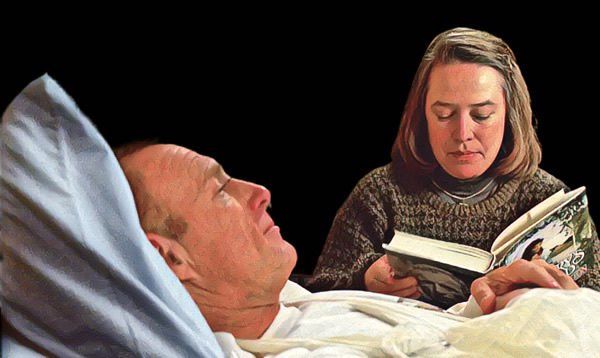
Annie is the extrapolation of that behavior taken to its extreme. She does not see herself merely as a reader, but as someone with authority over the work. When Paul Sheldon decides to “kill” her favorite character, she reacts as someone betrayed, as if that decision were not legitimate.
The second layer is more intimate and perhaps more revealing. Misery was written at a time when King was dealing with addiction and a growing sense of losing control over his own writing. Annie also becomes a representation of that toxic relationship with creation itself, something that both sustains and imprisons. She wants repetition, continuity, familiarity, exactly what creative freedom tends to resist.
This completely changes how we read her. Annie is not only the audience taken to its limit. She is also what prevents the author from moving beyond what he has created.
When admiration turns into control
One of Annie’s most famous lines is “I’m your number one fan.” At first glance, it sounds like admiration. Within the narrative, it functions as a threat. The affection already carries control, surveillance, and expectation.
When she says Paul cannot simply kill Misery because the character means too much to her, she is not discussing narrative, coherence, or construction. She is claiming a right. And perhaps the most revealing moment comes when she insists he can do better, because what sounds like encouragement becomes coercion. Annie does not want him to write better in a creative sense. She wants him to write what she considers correct.
This logic has not remained confined to fiction. It has become recognizable across recent pop culture, especially when audiences begin to act not just as spectators, but as active agents of judgment and pressure.

The debates around the fate of Daenerys Targaryen in Game of Thrones still echo years later precisely because they touch this nerve. The reaction is not only about what was shown, but about the incompatibility between the character the audience constructed and the one that was delivered.
Authorship versus expectation in contemporary television
In The Sopranos, David Chase ends Tony Soprano’s story with an abrupt cut that refuses any form of traditional resolution. The initial reaction was rejection, but over time, critical interpretation reorganized that choice as coherent with the show’s proposal.
In Lost, the issue was not the lack of answers, but a shift in language. The series trained its audience to investigate and decode, and by choosing a more emotional ending, it broke that pact.

In Breaking Bad, Walter White’s trajectory is conducted with a coherence that allows the audience to follow even through difficult decisions. In Succession, the frustration surrounding Kendall Roy does not become rejection because the series never promises otherwise.
On the other hand, cases like Dexter and How I Met Your Mother illustrate what happens when the perception of coherence breaks down, whether through ending decisions or the sense that the emotional path built along the way was disregarded.
When the narrative loses its center
That same sense of displacement appears in Peaky Blinders, especially in its transition to film. Tommy Shelby was always anchored in a very clear internal logic, and when that logic seems to fragment, the audience does not read it as a choice, but as a loss of direction.
This type of rupture does not resolve over time because it is not rooted in reception, but in construction.

And Just Like That and writing under pressure
It is at this point that And Just Like That becomes particularly revealing, because the discussion here is not only about rejection, but about the way the series seems to build itself over time.
If we look closely at the recaps, it becomes evident that the narrative attempts, at the same time, to apologize for the past and reinvent itself, without managing to sustain either direction with clarity or conviction. The result is not exactly transformation, but a constant sense of adjustment, as if the series were reacting to external criticism and expectations rather than developing a path of its own, grounded in a well-defined internal logic.
The absence of Samantha Jones intensifies this scenario in a decisive way, because it is not only an emotional absence, but a structural displacement. Samantha functioned as a point of contrast, boldness, and frankness within the group, and without her, the universe loses internal tension, balance, and, above all, its ability to sustain its own conflicts.

When Michael Patrick King states, in an interview with The Guardian, that he believes And Just Like That will eventually be understood over time, there is something revealing in how this defense is constructed. By suggesting that audiences do not want to see their characters change and that perception may shift in the future, he relocates the discussion to a matter of reception, as if the issue lay in how the show is watched rather than in how it was built.
In this specific case, the issue was never simply seeing Carrie Bradshaw change radically, since that transformation aligns with her age, her moment, and the internal logic of her continuity. What creates friction is something deeper, tied to the rewriting of the past, such as the attempt to shift the emotional center from Mr. Big to Aidan, among other changes that alter not only the present, but the narrative memory of the series.
Even so, King is not entirely wrong in suggesting that once created, a character acquires multiple “owners” who want to recognize her, to keep her close to what made her meaningful. Transformation, which is inherent to any narrative, requires precise and sustained development over time, and there is not always enough space, rhythm, or clarity for that to occur without rupture.
There is, however, a fundamental difference between provoking and reacting. Sex and the City originally provoked, often in uncomfortable ways, without asking permission and without the need to immediately organize responses to every tension it created. In And Just Like That, this logic seems inverted, as the narrative no longer stems from an internal conviction that challenges the audience, but from an ongoing need to respond to it.
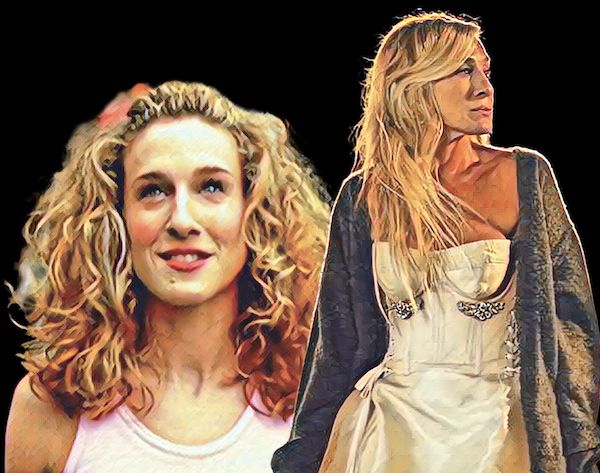
It is within this shift that the series loses something essential. The humor loses its sharpness because it carries too much self-awareness, the drama loses density because it interrupts itself to explain, and the characters are no longer driven by their own impulses, but begin to carry, even subtly, the burden of representing, correcting, or commenting.
And perhaps that is why this reading does not depend on historical distance to solidify. It was already there, diluted episode by episode, in every moment when the series seemed to look outward before deciding, with clarity, where it wanted to go.
Rewriting classics and the dispute over meaning
This logic extends beyond contemporary series and becomes even more sensitive when it intersects with classic works, because here the conflict is no longer only about narrative development, but about cultural memory.
In The Buccaneers, the adaptation deliberately adopts a modern tone that shifts the original material to engage with the present, creating an experience that can be read either as an update or as a rupture. The multiple versions of Pride and Prejudice show how a single work can be reorganized over time, but also reveal that not every reinterpretation is received with the same openness.


The anticipation surrounding a new Elizabeth Bennet in Netflix’s adaptation highlights precisely this limit. There are characters that, over time, cease to be merely literary and become almost fixed constructs within the collective imagination, making any attempt at reinterpretation immediately tense.
This tension becomes even sharper when adaptation moves beyond reinterpretation into appropriation. Emerald Fennell faced strong backlash for using Wuthering Heights as a basis for a deeply personal narrative that diverges from the original. By engaging with Catherine Earnshaw and Heathcliff, the discussion is no longer about reinterpretation, but about displacing characters many consider already consolidated, which inevitably provokes resistance, particularly among those who see themselves as guardians of that tradition.
It is here that anachronism becomes unavoidable. Updating a work implies inserting contemporary sensibilities into structures that belong to another time, and that operation does not always resolve organically. In some cases, it reveals new layers; in others, it exposes the misalignment between form and intention.

Who decides what must be preserved
The question, then, is no longer only about what happens to characters, but about the right to reinterpret the work itself. Who defines what can be updated, who establishes the boundary between contemporary reading and distortion, who decides what must be preserved.
What Annie Wilkes anticipated
Perhaps the most unsettling realization is that Annie Wilkes does not only anticipate the obsessive fan who tries to control the future of a story, but also the one who refuses to accept any rewriting of its past.
When Annie forces Paul Sheldon to bring Misery back to life, she is not simply rejecting a narrative decision, but denying the possibility that the character might exist outside the version she recognizes as legitimate. There is no room for transformation, no room for closure, and certainly no room for reinterpretation.
This same mechanism appears when we debate series finales, when we attempt to correct character arcs, or when we react to new adaptations of classic works. In all these cases, the dispute is not only about what comes next, but about what can be altered in what has already been established.

In that sense, Annie does not only want to decide where the story goes. She wants to preserve a specific version of it, frozen at the point where it became meaningful.
And perhaps that is why she remains so unsettling. Because, contrary to what it seemed in 1987, she is not an exception.
She is a constant possibility within any relationship between audience and narrative.
And, to some extent, one we recognize, even if uncomfortably, in ourselves.
Descubra mais sobre
Assine para receber nossas notícias mais recentes por e-mail.
 miscelana.com