
Pink and Blue – The Cahen d’Anvers Girls, by Pierre-Auguste Renoir, is among the most well-known works in the collection of the MASP. With the release of The Renoir Girls: A Hidden History of Art, War & Betrayal, by Catherine Ostler, it gains renewed prominence. The biography of the two girls repositions a work that once seemed fully absorbed by the eye. Those two girls in light dresses, one marked by pink, the other by blue, are no longer just an exercise in pictorial delicacy. They now carry a tension that does not lie on the surface of the canvas, but in what came after. This shift in perception carries particular weight in Brazil, as the painting has recently been shown again alongside other works by the artist after more than two decades.
Between rupture and what refuses to disappear
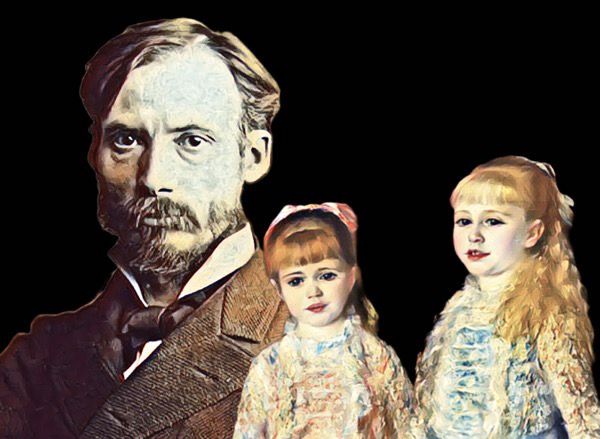
Renoir occupies a singular place within Impressionism. Alongside Claude Monet and Edgar Degas, he took part in the exhibitions that challenged the French academic system from the 1870s onward, yet he never fully abandoned tradition. His work maintains an ongoing dialogue with masters such as Titian and Jean-Honoré Fragonard, while also incorporating the technical innovations of the 19th century, including portable paint tubes and the practice of painting outdoors.
Over the course of his career, this balance between rupture and continuity shifts, and after his trip to Italy in 1881, Renoir began to pursue a more structured approach to form, with softened contours and an almost obsessive attention to the materiality of skin. It is in this moment that he paints the Cahen d’Anvers girls.
The promise of belonging
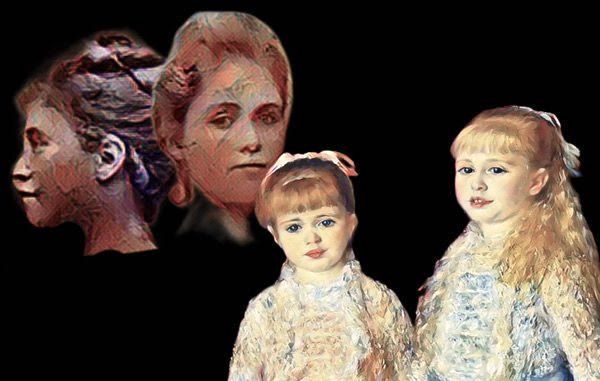
Elisabeth and Alice were six and five years old when they were portrayed. The elder, blonde, was born in December 1874; the younger in February 1876. Renoir produced numerous portraits for families within the Parisian Jewish community, and the Cahen d’Anvers were among the wealthiest and most influential. Louis was a banker, Louise came from a prosperous family in Trieste, and the couple occupied a central position in the social and cultural life of the city.
The artist was introduced to them through the collector Charles Ephrussi, director of the Gazette des Beaux-Arts and also Louise’s lover. The initial commission called for individual portraits of each daughter. Renoir painted the eldest, Irène, now in Zurich, before the family decided to have the two younger sisters depicted together. Numerous sittings were required until early 1881, a process the girls would later recall as tedious, though somewhat compensated by the pleasure of wearing elaborate lace dresses.
What lies beyond the frame
Ostler’s book takes this apparent stability as its starting point and builds another narrative. She approaches the girls through the painting itself, but refuses to keep it confined to the realm of beauty. Drawing on letters, diaries, and family documents, she reconstructs the trajectories of the three sisters, including Irène, tracing their lives through a period marked by profound ruptures, from the Dreyfus Affair to the two world wars. What emerges is not only the story of a family, but the exposure of a limit. The assimilation that once seemed to guarantee belonging reveals itself to be fragile when confronted with rising antisemitism and the political transformations of the 20th century.
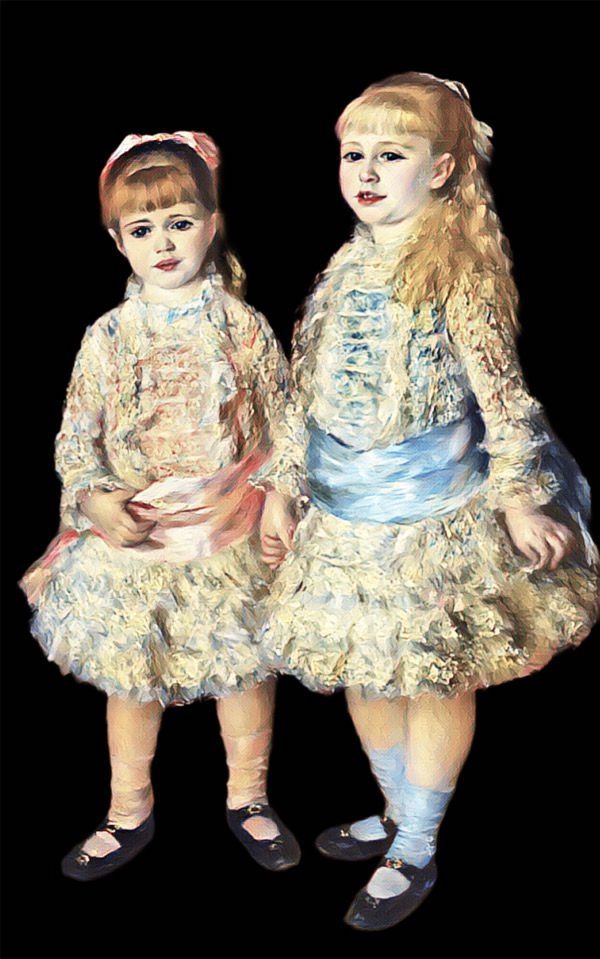
This starting point—the portrait—gains further depth when one considers its own construction. Painted in the family’s residence on Avenue Montaigne, the composition places the two sisters before a heavy curtain, within an opulent interior. Dressed almost identically, they hold hands, as if seeking support to sustain the pose. The younger appears on the verge of tears; the older maintains a more composed demeanor. The delicacy of the painting coexists with a subtle discomfort, almost imperceptible, yet present.
When history cuts through the image
Elisabeth, the girl in blue, would face a tragic fate. She was deported during the Second World War and died on the way to Auschwitz in 1944. This information would only reach the MASP decades later, in 1987, through a letter sent by a relative during an exhibition at the Fondation Pierre Gianadda. Other members of the family were also murdered. Alice, in contrast, survived, living until 1965 in Nice. The divergence of these fates, starting from the same origin, is what structures the book and unsettles the reading of the painting.
A world built to last
Tracing the family’s path, Ostler also reconstructs the environment that sustained that image. The Château de Champs-sur-Marne, restored by the Cahen d’Anvers in the late 19th century, embodies this project of belonging, combining aristocratic tradition with modern comfort, richly decorated salons, an active social life, and an almost programmatic adherence to French culture. Film lovers may recognize it as a filming location for Dangerous Liaisons, among other productions.
The property, which in the 18th century had belonged to Madame de Pompadour, mistress of Louis XV, was not merely a setting, but a statement: an attempt to inscribe the family within a historical continuity that seemed unquestionable. This effort, which included the symbolic restoration of a national past, was not enough to protect them when the political climate shifted.
There is, however, an earlier and quieter displacement that anticipates this rupture. At some point in the late 19th century, the painting leaves the family sphere and reappears in a Paris apartment before entering the circuit of art dealers. There is no clear record of how this transition occurred, but it marks a change in condition: the passage from a private object to a circulating work of art.
Decades later, already part of the international art market, the painting would be acquired in 1952 by the MASP through the efforts of Assis Chateaubriand and Pietro Maria Bardi, as part of the museum’s postwar formation.
And now?
The presence of the painting at MASP, within an exhibition that highlights the breadth of Renoir’s work, makes this history inseparable from the experience of seeing it. It is no longer only about recognizing the artist’s ability to move between genres or observing the formal qualities of his painting. It is about confronting the gap between what the image offers and what history reveals.
For a long time, Pink and Blue was seen as a portrait of childhood and elegance. Today, that reading expands, shaped by a knowledge that can no longer be set aside.
What Ostler’s book ultimately does is to shift the painting’s place. It ceases to be just a familiar image and becomes an entry point into a broader narrative of belonging, identity, and rupture. Seen at MASP, this shift becomes even more apparent, placing the viewer before a work that has not changed, yet no longer means the same thing.
Descubra mais sobre
Assine para receber nossas notícias mais recentes por e-mail.
 miscelana.com