
In general, action films and Brazilian cinema are not often thought of in the same sentence. Not for lack of capability, but out of habit. For decades, national production has been organized around drama and comedy, while action has remained an imported territory, associated with a grammar that never fully belonged to us.
Director Gustavo Bonafé starts precisely from that point. “For a long time, Brazilian cinema didn’t really have a habit of working with genre films, whether action or horror,” he told me. “We worked a lot with comedy, largely because of the history of television and theater in Brazil.” At the same time, he acknowledges something obvious that is rarely stated so clearly: action, as a language, is still perceived as a foreign genre, “mainly North American.”
Rio de Sangue, which opens in theaters on April 16, doesn’t try to deny that influence. But it doesn’t settle into it either.
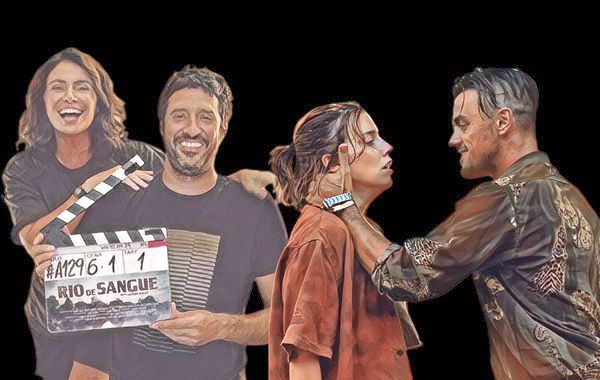
Starring Giovanna Antonelli, Alice Wegmann, and Felipe Simas, the film follows Patrícia Trindade, a police officer suspended after a failed operation and marked for death by the upper ranks of the drug trade. Forced to leave São Paulo, she heads to Santarém, in Pará, where she tries to rebuild her relationship with her daughter, Luiza, a doctor working with an NGO that provides care to Indigenous communities in the Alto Tapajós region. What seems like a fresh start quickly collapses when Luiza is kidnapped by illegal miners, pushing Patrícia into a race against time in a territory she does not control.
The structure is familiar. The displacement is not.
“When you make an action film in Brazil set in urban centers, it could take place anywhere in the world,” Bonafé says. “But when you bring that story into the Amazon, it gains a Brazilian specificity that we don’t usually see.” That is where the film finds its key. Not as an exotic setting, but as a limit.
Shot in Santarém and Alter do Chão, the project was built around a decision that runs through the entire narrative. “We can trim things, reduce elements in the script, but we can’t give up going to the Amazon,” he told me. “Otherwise, the film simply doesn’t happen the way it should.”
The statement sounds simple, but it explains much of what appears on screen.
The relationship with illegal mining, with the river, with movement through the forest is not illustrative. The river is not a backdrop, but a structure. “There’s a very strong connection between mining and the river, and also the damage it causes,” the director says, referring to mercury contamination and the reality of riverside communities. By insisting on this material dimension, the film avoids a common trap: turning the Amazon into an image without consequence.
“The Amazon is a character,” he sums up. And this time, it doesn’t feel like a metaphor.
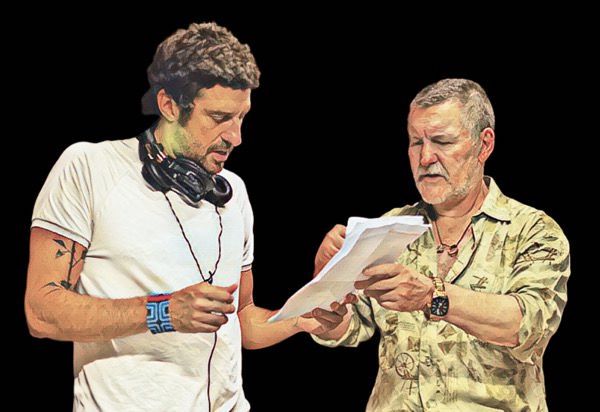
This approach extends to how the film engages with Indigenous communities. From the script stage, there was consultation to avoid basic distortions, but the process went further. Upon arriving at the village where part of the film was shot, the crew was directly questioned. “It was almost like an interview,” he recalls. “They asked why we wanted to make this, what we were bringing to them.” The answer, it seems, couldn’t be purely aesthetic.
From that dialogue came decisions that move the film away from a comfortable representation. “We wanted to treat the subject correctly and truthfully,” he says. This includes, for instance, Indigenous characters who do not fit into an idealized framework. One of them, directly involved in the logic of illegal mining, only took shape because the actor agreed to play him on the condition that this reality would also be acknowledged. “He said: this exists, and it needs to be said.”
It’s the kind of choice that doesn’t resolve tension, but prevents it from being erased.
Behind the scenes, the search for authenticity also took practical form. Unable to film in a real mining site, the team built one in a clay pit, based on research and the guidance of someone who had previously worked in illegal mining. “He explained how it worked, how many people per pit, how they dug. It even helped shape the characters,” Bonafé says.
At the same time, the film doesn’t hide the constructed nature of action. “Cinema is deception,” he says, with unusual candor. In some sequences, the actors take on the risk themselves. “In the car chase, Giovanna and Felipe are actually driving,” he explains. In others, the illusion is carefully controlled. The tension lies precisely in that boundary.
And it is in the encounter between control and chance that the film finds some of its most powerful images.

One of its central sequences was not in the original script. The initial idea involved an execution in a confined space, but it was abandoned when the crew encountered the scale of the Tapajós River. “When I saw that immensity, I thought: they have to abandon this woman in a boat,” he recalls. “It’s much stronger than locking her inside a tank.” The image of a character adrift, surrounded by an expanse that offers no escape, emerges from that shift.
“These are things that come from chance, and you realize they work better,” he says.
In the end, Rio de Sangue is built on that unstable balance. Between a genre still trying to find its place in Brazilian cinema and a territory that resists being reduced to a formula. Between external influence and the attempt to create a distinct identity. Between what is planned and what imposes itself.
It may not be a point of arrival. But it is, certainly, a movement.
Descubra mais sobre
Assine para receber nossas notícias mais recentes por e-mail.
 miscelana.com