
We return for the final season exactly where we left off: with the shock of the news of Deborah Vance’s death. Fans gathered outside her house are still trying to process what happened when she reappeared, alive, and explained that TMZ received incorrect information. The collective scare quickly gives way to something even more revealing: how fast a narrative is built and solidified.
As we know, Deborah refuses to accept how she is being portrayed. The obituaries don’t just celebrate her career; they also highlight her flaws, her conflicts, everything that slips beyond her control. And she understands something essential: to bury a bad narrative, you need to create an even bigger one.
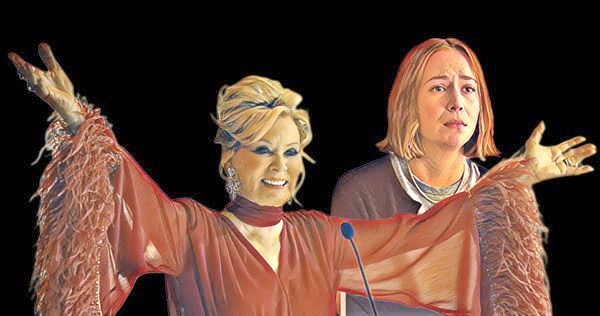
Meanwhile, Kayla and Jimmy are struggling to keep the agency afloat in an increasingly unstable scenario. It’s in this context that they are called to lunch with Deborah, who arrives with a new plan. If obituaries begin with achievements, then she needs to ensure her legacy is undeniable. The solution comes in the form of a clear — and almost obsessive — goal: to achieve an EGOT. She already has an Emmy and a Tony. What she’s missing is an Oscar and a Grammy.
The problem is that her contract prevents her from working in the United States. She can record, but nothing can be released before the end of the freeze period. Still, Deborah doesn’t back down. If an audiobook memoir can get her a Grammy, then that’s the path forward. Ava offers to write it, but Deborah wants a bigger name: Tony Kushner. The choice makes sense on paper, but not in practice. As the material begins to take shape, Ava is impressed; Deborah is not. He’s fired.
Next, she tries a different strategy: recording with a Mexican band, hoping that a guest appearance might earn her a Grammy. At the same time, Jimmy manages to secure a potential role in a film that could place her in contention for an Oscar.
At the center of it all, the relationship between Ava and Deborah remains the most consistent axis of the series. There’s something strange about how in sync they are. What was once productive friction now leans toward a kind of comfort, and that shift may be exactly what feels unsettling.

Deborah’s hysteria, on the other hand, starts to wear thin. As soon as the Oscar project becomes a real possibility, she loses interest. Instead, she decides to perform a clandestine stand-up set that is not supposed to be recorded. It shouldn’t be, but it is. The video is posted, and Deborah ends up being sued by Bob Lipka.
The crisis, however, is quickly reframed as an opportunity. Deborah announces that, as soon as her contract ends, she will perform at Madison Square Garden. The move isn’t spontaneous. Ava was the one who recorded and leaked the video. In their logic, this is no longer betrayal; it’s a strategy. In war, anything goes. Moreover, public opinion is likely to overlook the image of a chaotic comedian and instead rally behind the figure of a censored artist.
Hacks returns at full speed. The season seems determined to reinforce its own legacy, reminding us of the awards and recognition the show has accumulated. It may even win another Emmy. But, at least in this opening, there’s a sense that something no longer pulses in quite the same way.
Descubra mais sobre
Assine para receber nossas notícias mais recentes por e-mail.
 miscelana.com