
There is a recurring trap when looking at a weekly ranking: the assumption that it captures change. Most of the time, it simply rearranges forces that were already in motion. And this week, what emerges is not exactly a competition for attention, but the coexistence of different modes of consumption that no longer directly compete with one another.
Netflix
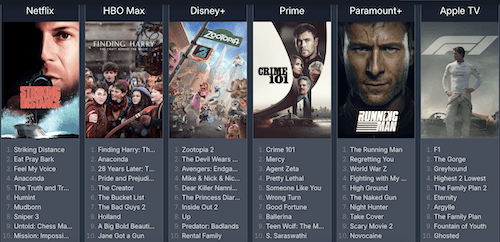
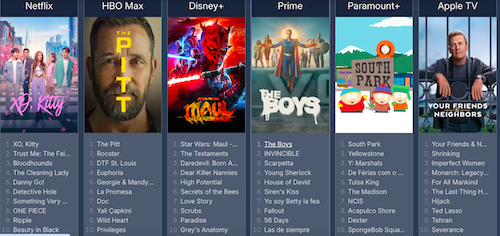
Netflix continues to operate as an inherently unstable system. XO, Kitty takes the lead, but its position does not organize the ranking; it merely occupies it, temporarily. It is the kind of title that rises quickly because it is already adapted to the platform’s ecosystem: episodic, shareable, and emotionally accessible. It does not establish dominance; it circulates.
What happens beneath it is more revealing. Striking Distance appears not as a deliberate choice, but as a consequence. A catalog activation that exists to fill space, to maintain flow. The same applies to Anaconda and other titles orbiting the ranking without truly competing for attention.
There are, therefore, two Netflixes coexisting. The surface one, which renews itself weekly, and the structural one, which recycles its own catalog to sustain volume. Neither depends on the other, yet neither cancels the other out. And that is precisely why the ranking never stabilizes. It is not meant to.
HBO Max
On HBO Max, the movement is quieter, but more decisive. The Pitt does not simply lead; it structures the space around it. There is an important difference between being number one and functioning as an axis, and here the series clearly occupies the latter role.
The rest of the ranking does not attempt to challenge that position. Titles like Rooster and DTF St. Louis appear as transitional presences, occupying space without consolidating it. This is not a sign of weakness, but of distribution. Attention is not meant to concentrate beyond the center.

And then there is Euphoria, which returns without needing justification. It is perhaps the clearest example of a different kind of permanence, one that does not rely on release cycles or algorithmic pushes, but on something more diffuse, tied to how certain titles continue to exist in the cultural imagination even when they are not new.
HBO does not need to fill space. It needs to sustain relevance. And those are not the same thing.
Disney+
Disney+ remains the one environment where the logic of the “event” still operates without resistance. Star Wars: Maul – Shadow Lord takes the top spot with the predictability of a title that no longer needs to prove itself. The audience is already there.
But what sustains the ranking is not just that. It is the parallel movement happening just below. Titles like Zootopia 2 and Avengers: Endgame are not there because they are new, but because they persist. They do not rise; they return.
Daredevil: Born Again occupies an interesting middle ground, supported by recognition, yet no longer capable of generating the automatic mobilization that once defined Marvel releases. This is not quite a decline, but something closer to fatigue.
Disney operates in extended period. What arrives today already carries its past. And it is that past that continues to be consumed.
Prime Video
Prime Video may be the only ranking that genuinely suggests movement, though not in terms of rise, but distribution. The Boys lead, but it does not isolate itself. It opens space.
Invincible, Scarpetta, and Young Sherlock follow closely, not as direct competitors, but as parallel points of interest that coexist without overlapping. This is a ranking that does not organize itself around a single center, but around multiple entry points.
Scarpetta, in particular, stands out for not operating within the logic of immediate impact. Its presence is still understated, but persistent, suggesting a kind of growth that may not be visible in the first week, but builds over time.
Prime does not create concentrated phenomena. It builds ecosystems.

Paramount+
On Paramount+, nothing feels urgent, and that is not a flaw. South Park and Yellowstone occupy the top positions the way they have for weeks, perhaps months, perhaps years, without creating any sense of repetition.
The ranking does not change because it does not need to. It does not respond to cycles of novelty, but to established habits. The viewer does not come here to discover something new. They come to return to something familiar.
It is a less visible model, but an extremely effective one. And contrary to what it may seem, it is not based on stagnation, but on stability.
Apple TV+
Apple TV+ continues to operate with a logic that, compared to others, feels almost counterintuitive. Your Friends & Neighbors leads, but without the aggressive push typical of other premieres. Its presence grows more gradually, as if the platform resists the idea of an immediate peak.
Shrinking and Severance function as anchors, not just for the ranking, but for the platform’s identity. These are titles that do not need to compete for attention because they already define the kind of attention Apple is seeking.
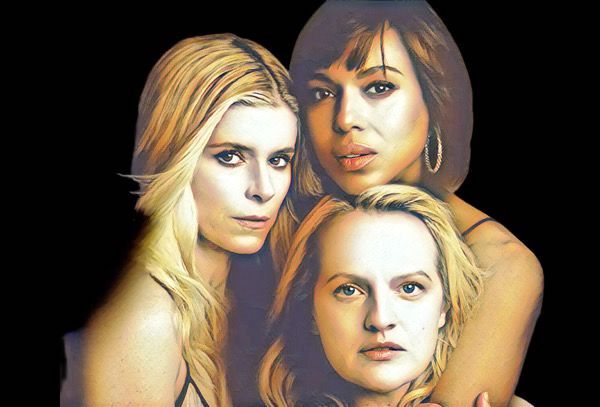
Even newer entries, like Imperfect Women, enter this ecosystem without disruption. Nothing feels out of place.
Apple does not react to audience behavior. It attempts to shape it.
What actually changed
At first glance, the week suggests movement. New titles appear, others rise, some disappear. But that reading is superficial.
What this week reveals, more clearly, is that streaming no longer operates as a field of direct competition. Each platform functions within its own logic, with its own rhythm, its own criteria for success.
The top shifts. The system does not.
And perhaps that is the most significant shift of all.
Top 10 Miscelana
1- Hacks
2- Imperfect Women
3- The Last Thing He Told Me
4- Your Friends and Neighbors
5- Rooster
6- DTF St Louis
7- Blue Moon
8- Shrinking
9- Anaconda
10- Outlander
Descubra mais sobre
Assine para receber nossas notícias mais recentes por e-mail.
 miscelana.com