
In recent years, the term “narcissist” has left the psychiatrist’s office and begun to circulate freely across social media, online forums, and increasingly, in audiovisual storytelling.
What was once a complex and relatively restricted clinical concept has become an almost automatic lens through which to interpret family relationships. A shortcut. An informal diagnosis. An explanation that seems to organize everything — a simplification that helps sustain a particular point of view.
And perhaps that is precisely where the problem lies. Because this shift did not come alone; it came with a certain fascination.
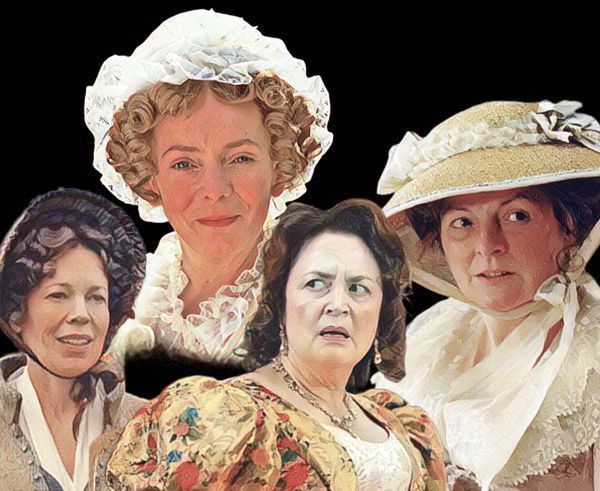
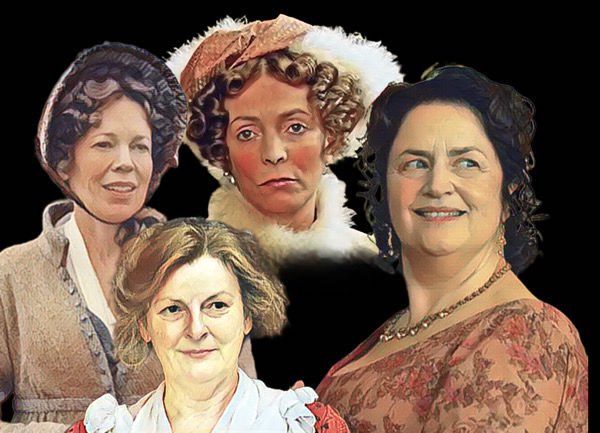
Critics have pointed to the series The Other Bennet Sister as yet another example that captures this shift with precision. The narrative no longer belongs directly to Jane Austen — as I explored in my analysis of the Pride and Prejudice spin-off — but to a different imaginative universe, one in which Mrs Bennet, always a complex and uncomfortable character, becomes the embodiment of the “narcissistic mother.”
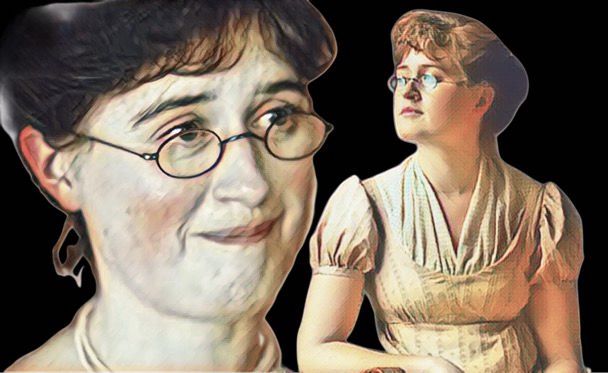
A type that does not emerge from classical literature, but from digital culture.
And once named, it begins to reorganize everything around it.
In the specific case of the Bennet family, it is clear that Mrs Bennet was never a model of motherhood. Austen makes her preference for the impulsive Lydia evident, even when it compromises her other daughters. There is immaturity, vanity, and a lack of judgment.
But there is also context.
Between 1811 and 1812, when the story unfolds, psychoanalysis did not yet exist, and even the notion of subjectivity operated under entirely different frameworks. Reading this character today as “narcissistic” is possible, but it requires caution.
Because there is a crucial difference between narcissism and what contemporary common sense has come to call “narcissistic syndrome.”
And it is precisely within this confusion that our time reveals itself.
What narcissism is, and what it isn’t
Before anything else, it is important to separate the clinical concept from its everyday use.
In psychoanalysis, narcissism is not, in itself, a pathology. On the contrary, it is a fundamental structure of the subject. Since Sigmund Freud, narcissism has been understood as the libidinal investment in oneself, something essential for the formation of identity, self-esteem, and even the possibility of existing as a subject.
There is primary narcissism, which is constitutive, and secondary narcissism, which emerges in relationships.
The so-called narcissistic personality disorder — far less common — involves more rigid patterns: a constant need for admiration, lack of empathy, and the use of others as extensions of oneself.
What has happened in recent years is an expansion of this concept to encompass any dynamic marked by frustration, selfishness, or asymmetry.
And that changes everything.
When narcissism becomes language and weapon
As the term has spread, it has ceased to describe psychic structures and begun to organize narratives.
Calling someone a “narcissist” is no longer just a description of behavior. It creates a moral hierarchy. On one side, the victim. On the other hand, the culprit.
And that has consequences.
Because often what is at stake is not necessarily a pathological trait in the other, but the subjective experience of not being met, not being seen, not being prioritized.
In this shift, narcissism can function as a projection.
When desire is not reciprocated, when limits appear, when the other does not occupy the place we imagined, the interpretation can quickly invert itself: the other is selfish, the other only thinks of themselves, the other is a narcissist.
Language offers a ready-made explanation for a discomfort that, in psychic terms, is structural.
Because the other never fully coincides with what we want.
Family as a field of conflict, not harmony
The work of Jane Austen never fully idealized the family. But it operated within a different logic.
There was conflict, frustration, and inadequacy, but also negotiation, coexistence, and rearrangement.
What we see today, in many narratives, is another logic: rupture as a solution.
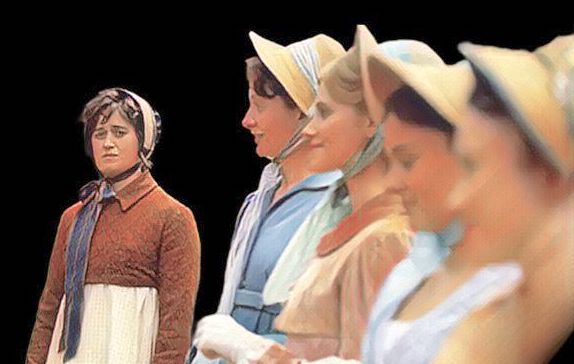
In The Other Bennet Sister, Mary does not merely confront her mother. She breaks away. And the rupture is not ambiguous, nor painful: it is presented as necessary, almost liberating.
This shift is not isolated. If, in that historical context, such a rupture would have been not only unlikely but socially unthinkable, today it is often encouraged as a way to establish boundaries and reclaim self-worth.
From nuance to diagnosis: examples in contemporary culture
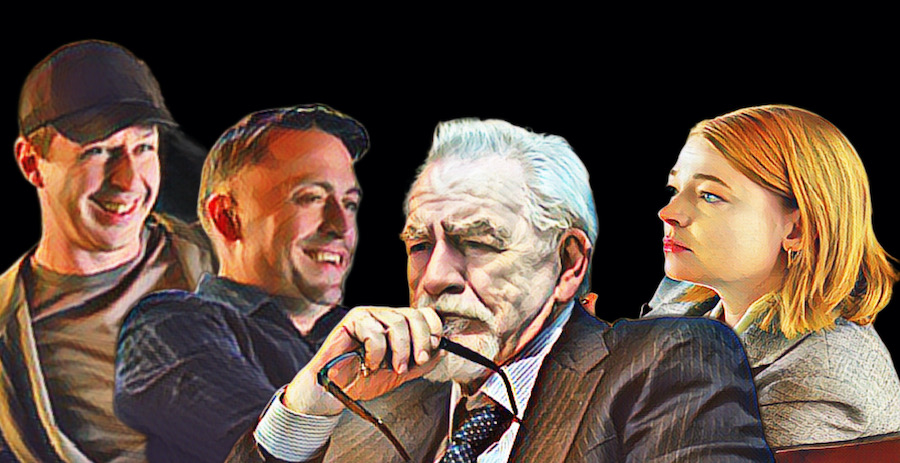
One of the most striking portrayals of narcissism — or the idea of it — in recent television is Succession. The patriarch, Logan Roy, is often read as a narcissistic father. And indeed, he displays clear traits of domination, manipulation, and lack of empathy. But the series never simplifies this dynamic. His children also reproduce, distort, and participate in this same logic.
There is no purity there.
In Euphoria, family relationships are frequently interpreted through the lens of trauma and parental failure. Yet again, the show insists on complexity: there is no single culprit, but rather a network of fragilities.
In Lady Bird, the relationship between mother and daughter could easily be labeled “toxic” today. However, Greta Gerwig refuses that simplification. There is love, resentment, and projection on both sides.
And perhaps that is precisely why it continues to resonate.
Because it does not offer a diagnosis. It offers a bond.

Something similar happens in Hacks. Deborah Vance could easily be labeled, today, as narcissistic: self-centered, controlling, unable to sustain relationships without exerting power. But the series refuses to settle for that reading. Instead, it exposes the fractures, the losses, and the defense mechanisms that sustain her persona.
And, crucially, it shows how Ava Daniels is also part of that dynamic: projecting, reacting, wounding.
No diagnosis is sufficient.
What exists is a relationship.
Narcissism in retrospect
Another important phenomenon is retrospective interpretation.
Classic characters, historical figures, and past family dynamics are increasingly re-read through contemporary categories.
Mrs Bennet becomes a “narcissistic mother.” Other figures are reframed as victims of emotional abuse. Entire narratives are reorganized through this lens.
There is something productive in this. It allows us to see dynamics that were once naturalized.
But there is also a risk: erasing complexity in favor of a totalizing explanation.
Because when everything becomes narcissism, we lose precisely what psychoanalysis insists on preserving: ambiguity.
Between rupture and bond
What is ultimately at stake is not just the use of a term, but a deeper transformation in how we think about family.
From a model based on continuity — even if conflictual — to one that legitimizes rupture as a form of protection.
This shift does not come from nowhere. It responds to real experiences of abuse, violence, and suffering.
But as it becomes a dominant language, it risks turning every difficult relationship into something disposable.
And perhaps the most uncomfortable question is this: what is lost when every pain finds a clear culprit?
Because in life — unlike in many contemporary narratives — there is not always a clear villain.
And often, what we call narcissism is simply the other being, irreducibly, other.
Descubra mais sobre
Assine para receber nossas notícias mais recentes por e-mail.
 miscelana.com