
I watch Euphoria the way you look at something deeply unsettling without turning away. It’s not exactly pleasure, nor exactly rejection. It’s a very specific kind of engagement that only major productions seem able to provoke: the kind where you recognize the technical excellence, are struck by the performances, understand the cultural impact — and yet can’t stop asking why.
Because that is the question that has never left me since the first season: what is the story?
There is something undeniable about the series. The cast may be one of the most stellar working today, bringing together actors who move between film and streaming with rare ease, sustaining performances that are intense and often extraordinary. The cinematography is sophisticated, the visual construction obsessive, and the soundtrack works as an emotional extension of each scene. Everything in Euphoria points to a very clear artistic project.
But what is that project actually saying?
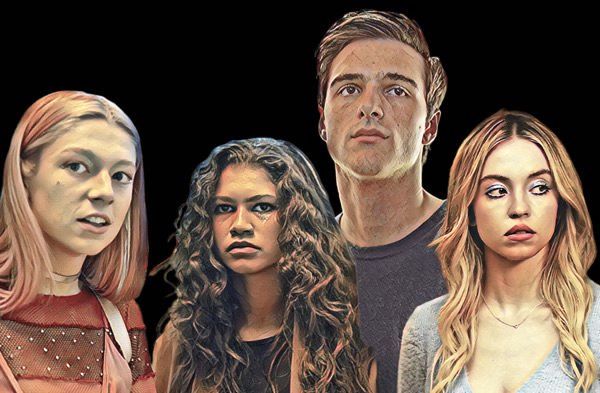
The feeling that lingers — and intensifies with each new season — is that of a spiral. There is no arc in the classical sense, no transformation that holds, no lesson that remains. There is movement, but it is circular, deepening the pain without offering an exit. Time passes, the characters age, but nothing resolves. Maturity doesn’t arrive as rupture, only as escalation.
And perhaps that is exactly where the show defines itself.
Euphoria is not a story that moves forward. It is a state that extends.
It is not interested in leading its characters somewhere new, but in keeping them trapped within a set of impulses that repeat, intensify, and harden into a pattern. There is no catharsis. When change is suggested, it is quickly destabilized. When hope appears, it comes paired with doubt.
This is not a flaw in construction. It is a choice.
And it is also what makes the experience so ambiguous.
Because if there is no trajectory, what sustains our engagement?
The most immediate answer is aesthetic. Euphoria is built to be felt before it is understood. Every scene seems designed to provoke, to impact, to linger. And it often does, but not necessarily because of what it tells, rather because of what it exposes.
And this is where the series becomes more uncomfortable.
Some moments hover on the edge between the artistic and the exploitative. The way bodies are filmed, exposed, and pushed within the narrative is not neutral. Even with the actress’s consent, even with aesthetic intent, there is a layer of discomfort that does not disappear.

The clearest example lies in how Sydney Sweeney’s character is framed. There is a visual construction that can be read as critique, exaggeration, commentary on objectification — but also as a repetition of that very logic. The series seems fully aware of what it is doing, yet not necessarily interested in distancing itself from it.
The result is an experience that oscillates between fascination and exhaustion.
Because Euphoria offers no relief. There is no pause, no counterbalance, no sense that we are moving toward understanding. What exists is a succession of tense, cruel, emotionally draining situations. A constant density that organizes itself not as narrative, but as impact.
And so the question returns, more insistently than before: why should we care about these characters?
Perhaps the answer does not lie in traditional empathy. Euphoria does not want us to like them, nor to root for clear redemption arcs. What it seems to seek is something more uncomfortable: recognition. Not identification in the direct sense, but the perception of patterns, fragilities, and excesses that exist beyond the screen.
But is that enough?
Because there is a difference between portraying emptiness and becoming trapped by it. Between exposing the absence of meaning and failing to construct meaning. And Euphoria, at times, seems more interested in remaining in that suspended space than in moving forward.
And yet, we keep watching.
Perhaps because, even without answering the most basic narrative questions, the series succeeds at something harder to define: it captures a state of mind. A world where everything is intense, immediate, excessive — and at the same time, profoundly empty.
A world where feeling more does not mean understanding more.
And maybe that is exactly what holds us there.
Descubra mais sobre
Assine para receber nossas notícias mais recentes por e-mail.
 miscelana.com