
In 1985, Miranda Richardson made her spectacular film debut, directed by Mike Newell, in the Ruth Ellis biopic Dance with a Stranger. Ruth had been the last British woman sentenced to death, thirty years earlier (in 1955), for having shot her lover, racing driver David Blakely (Ruppert Everett). Although she killed him, the court case was (and is) controversial, creating material that film or TV cannot resist. So much so that Lucy Boynton is working on a new series for ITV, still in development. That’s right, by the way, before becoming Marianne Faithfull (the project is still in pre-production), she will be another famous British woman. And why does Ruth’s story still fascinate the media?
Ruth Ellis was judged morally before answering for her crime. In a patriarchal society, she was an opportunist who lived in the night and who killed her rich and famous lover out of spite after she discovered he would not marry her. Simplistic and questionable, many argue that Ruth came from a life of psychological and physical abuse inflicted by men, including her father, her husband, and even her lover. In femicides, the traumatic past of the murderer would probably have been accepted to alleviate it. only, but with Ruth, within minutes she was unanimously condemned to hang. The debate and reaction her execution caused contributed to the eventual permanent abolition of the death penalty for murder in the country, but only in 1969.

Ruth is not a sympathetic background figure and grew up with abuse. Born in Wales in 1926, she was the fourth of five children. When she was just two years old, one of her brothers died in an accident, permanently altering her father’s personality, who started to be abusive towards his daughters, including sexually. He would have raped her older sister, Muriel, who she got pregnant at just 14 years old. The son was raised as a brother to them and as Ruth entered adolescence, she had to dodge her father too, determined to escape him. When the family moved to London, she decided she was going to “make something of her life”.
At that point, in times of war, especially for women, it was even more difficult to get work, and influenced by a friend, she would have ‘discovered’ the lively London night, where she met and fell in love with French-Canadian soldier Clare Andrea McCallum. Ruth got pregnant and he asked her to marry him, but as he was sent to France, he left the ‘bride’ taking care of everything until she returned. At 17, she had a boy, but she never saw the child’s father again. He was already married and the father of three others, he was never honest with her. Ruth would have been traumatized by the betrayal and humiliation. Muriel and her mother took care of the child and she began to look for alternatives to support everyone.
Like many women at the time, the alternative was prostitution and she went to work for Morris Conley, a con artist and pimp, who had a network of women in her service. That’s how she met her first husband, George Ellis, a dentist and former director of Crystal Palace Football Club, 17 years her senior and dealing with alcoholism. She soon began to suffer physical abuse from George, who was jealous of her past and doubted her daughter’s paternity. In a few years, they separated. Ruth returned to work with Conley, probably because she had a slightly more luxurious life, which allowed her to support her two children, her mother, and sister as well. At that stage, she platinum her hair (copying Marilyn Monroe) and believed she would have a better future. Unfortunately, she almost immediately met David Blakely, deviating from her plans.

David came from a better background than Ruth. The son of a doctor, his father often beat his mother and was tried for the death of a lover with an abortion that went wrong but was acquitted of the crime. When his mother divorced his father, David stayed with her and so when she remarried to a wealthy businessman, she maintained a luxurious existence. David was described as “arrogant and unpopular”, as well as known for “taking positive pleasure in hurting others”, as well as being passionate about motor racing. An obsession Ruth paid to maintain after they moved in together.
The relationship with David was toxic and abusive like the previous ones, but Ruth was in love with him. He got engaged to another woman and still, she forgave him. Not that he was faithful, she had another lover, Desmond Cussen, a former RAF officer who helped her financially as the debts to support David mounted. Ruth sent her first child to boarding school (paid for by Desmond) and the daughter she had with George Ellis up for adoption. As she later said, she did everything to keep David, even sacrificing her children.
Maybe by the example she had at home or because at the time domestic violence did not even exist in concept, Ruth became the target of David’s beatings, something that everyone witnessed. The love triangle between her, David, and Desmond was increasingly dangerous, with Morris Conley irritated that they were taking Ruth out of the loop, reducing the house’s profits. Fired and with nothing, Ruth went to live with Desmond, but David remained her obsession.
Discarded by him, at Easter 1955 she made a desperate decision. She said goodbye to her son and went to the party where she knew David was, but to which she would not have been invited. She waited for him outside, and when he went out with a friend to buy cigarettes in a pub, they didn’t notice that Ruth was following them. When David noticed, he tried to run, but she fired twice, insisting after him until she hit the ground. Without him being able to react, she fired three more shots. Ruth tried to kill herself on the spot, but the gun didn’t go off. Witnesses say that she never changed her behavior, remaining cool and calm. Resigned until.
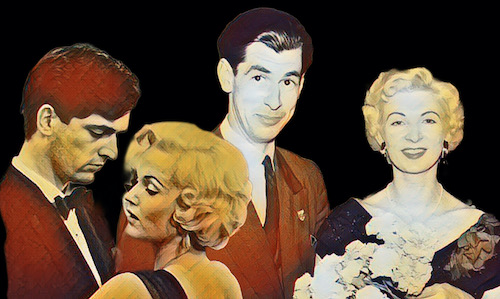
In this narrative, it is never the intention to question the guilt of Ruth Ellis, she herself wanted to die, she did not deny that she wanted and killed David Blakely, but the drawing of almost deserving of the gallows because of her past. The trial took no more than 20 minutes. The prosecutor only asked a single question: “What did you intend to do?” to which he replied without batting an eye. “It is obvious that when I shot him I intended to kill him.” There was nothing to question.
The execution took place a few months later and she refused to ask for Pardon instead of Death. She only agreed to tell her version of the story if it wasn’t used to change the sentence. She revealed that it was Desmond who bought the gun and taught her how to shoot. He was also the one who drove her to the crime scene. The judge claimed that nothing changed, on the contrary, it only proved the premeditation of the crime. Ruth’s last letter was to David’s parents: “I have always loved your son and will die still loving him.”
The tragedy marked the survivors. Ruth’s son and mother killed themselves years later. It is a story marked by violence, abandonment, and sadness and one that haunts Britons even almost 70 years later. It will be curious to see what else they might change. Surely Lucy will shine, as Miranda Richardson did nearly 40 years ago.
Descubra mais sobre
Assine para receber nossas notícias mais recentes por e-mail.
 miscelana.com