
When it hit theaters in 1944, Double Indemnity was almost a scandal. Adultery and murder were not usually portrayed so openly and as the story was also surprising and well tied together, they guaranteed critical and public success.
80 years later, the plot of Double Indemnity remains current (just watch Discovery ID to see how similar stories multiply), but some things not so much (the abusive way in which the main female character was treated, for example). Considering that the story is inspired by a real case (that of Ruth Snyder, one of the last women sentenced to the electric chair), the behind-the-scenes filming yields many legends in Hollywood, one that is always worth revisiting.

The crime and the book: where the Double Indemnity came from
Before hitting the screen, Double Indemnity was a success in novel format, written by James M. Cain, and published in 1936. Cain covered the case of Ruth Snyder and her lover, Judd Gray. In 1927, Ruth and Judd plotted to kill her husband, a man much older than her for whom she had secretly taken out a large insurance policy, which included a double indemnity clause (the payout would be double if his death was accidental).
The murder, however, was poorly executed and quickly aroused suspicion, with the couple being arrested and sentenced to death. The United States was fascinated by the story, as was the author, who used their plan as the basis for the book. They aimed to use the “double compensation” clause in the case of a violent death. In the novel, the characters are quite different and the plot is more complex, but the basic premise of a woman and her lover plotting to kill her husband for insurance money remains the same.
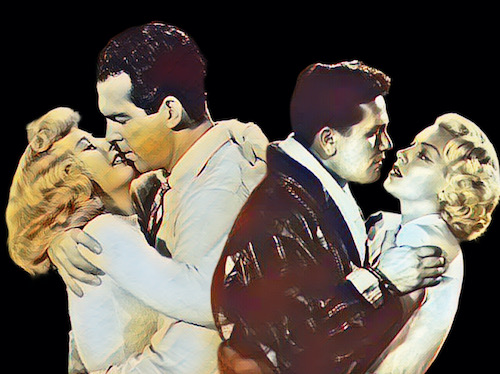
Before Double Indemnity, Cain used the same story in the book The Postman Always Frings Twice, but it was the second book that was adapted first, by the decision of the great director, Billy Wilder, which included Raymond Chandler as screenwriter for the version that now classic and considered one of the best noir films ever made, with dark and cynical tones, as well as featuring morally ambiguous characters.
One of Barbara Stanwyck’s most iconic roles
Playing the femme fatale, who is cold and manipulative, was not exactly a role that many actresses wanted, for fear that the public would not know how to differentiate fiction from reality. But Barbara Stanwyck embraced the challenge, creating one of her most famous roles. Fred MacMurray, who until now was not known for being in dramatic films, starred as the insurance salesman and lover, while Edward G. Robinson is the claims adjuster who ends up discovering the plot.
Phyllis Dietrichson was the first antagonist in Barbara’s filmography and, at the time, the highest-paid actress in Hollywood and the United States. She was convinced by Wilder to show that she was a good actress and considering the blonde wig that is one of the “problems” of the film (even in 1944 it was blatantly fake), her courage was gigantic.
When he heard complaints about how obvious the wig was, the director admitted that it was one of the biggest mistakes of his career, only realizing that it was ugly when the recording was already advanced and there was no way to go back. To disguise it, he used to say that the wig emphasizes the fact that it is not about love between the killers, but rather about lust, moreover, it highlights Phyllis’s falsehood. It’s not convincing that it was thought of, but we can live with it because Barbara Stanwyck is nothing short of sensational in every scene.
Her casting partners were also unexpected. For the role of insurance company Walter Neff, stars such as Alan Ladd, James Cagney, Spencer Tracy, Gregory Peck, and Fredric March were invited, all of whom declined to participate. Wilder took the risk of bringing Fred MacMurray, best known as a comedy actor, to play the cynical narrator of the plot. But there’s more to the lineup. At the time, Fred was negotiating the renewal of his contract with Paramount, being more demanding than usual. To “teach him a lesson”, the studios loaned him to Double Indemnity, imagining that he would fail and become softer. And then they talk about plans going wrong. For the actor, it is the best film of his career.
Fights with censorship, script with dramas too
There were many changes between the book and the film, including the ending, which was reworked and eliminated the protagonists’ double suicide. This is because suicide was prohibited at the time by the Production Code, as was sex (which is why the alternatives found are still considered brilliant today). One of the Hays Office’s demands for the script was that the criminals pay for their transgressions. The surprising shape that the script delivers this punishment is one of the surprises that most pleased critics.

The sordidness of the story did not initially concern Raymond Chandler, who considered reproducing as much of the book’s original dialogue as possible, but realized that it did not translate well on screen, something that Billy Wilder disagreed with. The fights between the two became legendary.
Double Indemnity was nominated for seven Oscars but did not win any. For 80 years it has always been on the list of the 100 best American films of all time. Ultra fair!
Descubra mais sobre
Assine para receber nossas notícias mais recentes por e-mail.
 miscelana.com