
At the beginning of the 20th century, a murder shocked New York: a married woman convinced her lover to help her kill her husband so that they could still have his life insurance money. Sound eerily familiar?
That’s right, several successful films used this “plot”, some without remembering the original and real fact, but two classics went straight from the newspaper pages to books and then films: Double Indemnity and The Postman Always Rings Twice. Both written more than 80 years ago, they speak indirectly about the life of Ruth Snyder: the murderer sentenced to the electric chair and the “true” femme fatale.

The “real” femme fatale
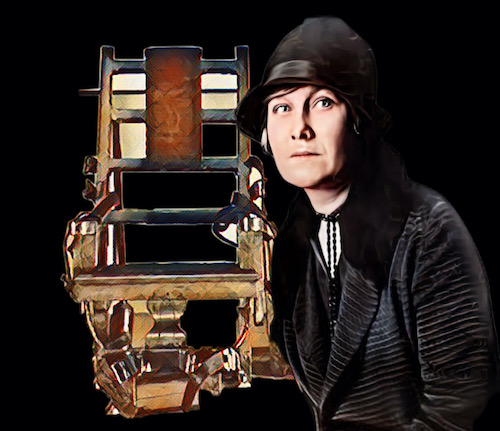
Ruth Snyder‘s name is kind of getting lost over time even though she would be a perfect story for true crime documentaries. Her short life path is best remembered for being the third woman to be executed in the electric chair by the State of New York. She was only 33 years old.
At the time of her death, Ruth was villainized by the press as a calculating, seductive, and cruel woman, who killed her husband out of greed and ambition, without really contextualizing her life trajectory in the wrong decisions she made. So much so that her story was adopted in Hollywood as that of the perfect femme fatale, the one who destroys the souls and lives of men with her beauty and evil.
Could it really be that the real Ruth reached such extremes for so little? We will have to follow that “yes”, as that was the only way it was registered.
Born May Ruth Brown in March 1895, in New York, it is not known of her childhood or upbringing, only that when she was around 20 years old, she met her future husband, Albert Edward Snyder. Apparently, no one knows what brought the two together, as it is said that she was lively, fun, and a fan of parties while Albert, who was 13 years older and an artist, enjoyed staying at home and being quiet.
Be that as it may, in 1915 they married and went to live in a modest house in Queens. The couple’s only daughter, Lorraine, was born three years later and by then the two already had material comforts with Albert working as an art editor for a magazine and earning one hundred dollars a week, a significant amount in those days. Even with their differences, they appeared to have a common life, but soon everything would change.
Abuse or jealousy?
History shows that around 1925, Ruth began an affair with Henry Judd Gray, a corset salesman, also married, who lived in the suburbs of New Jersey. The secret romance soon took on conspiracy colors when Ruth began planning Albert’s murder, enlisting the help of Judd, whom she referred to as just Judd.
Obviously, this version comes from their testimonies, but the initiative and planning with her “reluctant” lover was on the woman’s shoulders. The suggestion that there was more than greed would be in the testimonies that Albert was physically and psychologically abusive at home, factors that certainly contributed to the crime (although they do not justify it).
The fact is that Ruth was Albert’s second wife, his first, Jessie Guischard, would have died before the two met and would have been the true love of his life, something that Albert wouldn’t let Ruth forget, telling everyone that Jessie was the “ best woman he knew”, insisting on keeping a photo of herself on the wall at home and naming their boat after the deceased.

From the timeline, it is clear that the wear and tear between the two accelerated with the birth of Lorraine because just seven years later Ruth became involved with Judd. Apparently, disappointed in having a daughter, Albert blamed Ruth for not having given him a son, and, in addition to demanding a perfectly tidy house, he beat them both if his demands were not met.
In any case, according to reports, when Jessie’s photo went on the wall of the Snyders’ house, Ruth began planning Albert’s death. The fact is that divorce has been ruled out. So why kill him and not just divorce him? In addition to the divorce scandal at the time besides being a scandal, Ruth would have no right to anything. And she was financially dependent on her husband. And since she was going to be alone, better rich.
In his testimony, Judd claims that he only agreed to the plan when Ruth threatened to kill his wife, but it can be suspected that the amount of money she was going to inherit also played a role.
With the help of an insurance agent, who was aware of the scheme, she convinced her husband to purchase three life insurance policies totaling approximately $80,000 (more than $1 million today). One of the policy’s clauses said that it would pay extra if an unexpected act of violence killed the victim, known as “double indemnity”. This sealed Albert Snyder’s fate.
The poorly planned crime
Thanks to the sensationalism of the press, the interrogation was recorded role in the trial, in which Ruth responds to the prosecution about the crime. Albert slept with a revolver under his pillow and every Thursday, when he went bowling, Ruth and Henry spoke on the phone (they also exchanged letters), agreeing on every step.
Before she succeeded, Ruth had already tried to kill her husband, including twice when she disconnected the gas line from the furnace and once when she started the car with the garage door closed in hopes of filling the house with carbon monoxide. She also tried to poison his smuggled whiskey, but as it tasted horrible, he unsuspectingly threw the bottle away. Another opportunity was thought of when Albert fell ill and Ruth also added several medications to the medicine he was taking. She hoped the combination would kill him. When nothing worked, they moved on to something more violent and decisive.
Judd alleges that he was pressured by his mistress to help her with threats to tell his wife about their affair. No matter, what would be obvious, the project was not particularly well thought out.
On the night of the crime, Ruth and Albert went to a party, where she served him plenty of whiskey to get him drunk. Judd entered their house through a door that his mistress had left unlocked and hid in a bedroom. When the couple returned, they went to sleep normally. When Albert fell asleep, Ruth went to meet Judd. They differ in some details, Ruth said after she passed out and saw nothing, but what the police found put her active in the crime.
The lovers entered the room with rags soaked in chloroform and a window frame weight. Judd hit Albert in the head with his weight, but as it was only a glancing blow, he woke him up. He screamed for help and tried to grab his attacker, but Ruth grabbed the weight and hit her husband hard on the skull, killing him. For good measure, they tied a wire around his throat to strangle him and stuffed cotton wool soaked in chloroform into his nostrils.
To make it look like it was a robbery, they made a mess of the house and hid objects. To help the narrative, as a final touch, Judd tied and gagged Ruth and left her in place.
After a while, Ruth wriggled her way into the room of her daughter, Lorraine, who was just nine years old and had been in the house the whole time. It was the girl who untied her so they could call the police.
.
The letter and the failed act
Detectives immediately noticed something was wrong. They found no evidence of a home invasion and Ruth’s behavior was inconsistent with the story she told. She was too calm for the violence she would have witnessed. She claimed that she had been hit in the head and passed out, but had no signs of being hit and neither her hands nor feet appeared to have been tied tightly. Albert’s revolver, which was lying next to her as if he had been killed when reacting, had not been fired. The jewelry that would have been the objective of the robbery was hidden under the mattress. When the police commented that the robbery seemed faked, she got scared: “How can you know?”
The downfall of the lovers came through another of Ruth’s failures. Investigators found a paper with the letters J.G. on it and asked Ruth what the initials stood for. He suspected she was a lover of the late Albert, and in fact, it was a souvenir he had kept from Jessie Guischard, but Ruth replied: “Judd Gray?… Did he confess?”
Until then, they didn’t know there was a Judd Gray. Now they had a murder on their hands.
Media trial and death sentence
Ruth confessed to the romance but wanted to blame everything on Judd. She helped the police with the address of the hotel where he was staying and the lover was arrested. Trying to deny it and use a false alibi, she soon reversed and accused Ruth of forcing him to participate in the murder.
The newspapers at the time explored all the sordid details of the crime, highlighting the figure of the femme fatale, the one who destroys men like a Medusa, which created even more pressure for Justice. At this point, Ruth and Henry accused each other. The two were sentenced to death.
In less than a year, and just a few months after being arrested, Ruth was placed in the electric chair in Sing Sing, becoming the third woman to be executed by the State of New York. There were attempts to get her the pedon because it was very shocking to sentence a woman to death at that time. To make it even more complex, Governor Al Smith justified feminism as a reason for denying clemency by stating. “Equal suffrage placed women in a new position. If they are equal to men before the law, they must pay the same penalties as men for transgressing it,” he ruled.
The shock of Ruth’s death didn’t stop there. The execution was unintentionally immortalized with a photo in extremely bad taste, at the moment of the electrical discharge, taken in secret and published on the front page of the Daily News. If you Google it you will find the image easily. I refuse to post it. Judd was killed in the same chair, 10 minutes after it, without images or major scandals.
Albert and Ruth’s daughter, Lorraine, spent years at the center of family and inheritance disputes.
Inspiring books and films
The fascination with Ruth Snyder’s tragic story was the seed of a sea of profitable literature and film versions. Among them, was James M. Cain who rewrote the story not once, but twice, with both film adaptations considered classics.
Cain covered the case as a reporter, so he had access to all the details of the real crime. The first version, from 1934, is The Postman Always Rings Twice, which centered the motivation on sexual relations and physical abuse. Perhaps due to the conservatism of the time, the reception was lukewarm, very different when it was filmed in 1946, with Lana Turner playing the frustrated wife and then in 1981, more explicit, with Jessica Lange and Jack Nicholson as the lovers.
In this book, the story involves a vagabond who begins an affair with a beautiful young woman married to an older, successful businessman. Together, they plan to murder her husband, with tragic consequences for everyone.

Two years later, Double Indemnity was more successful because in this version Cain used his strengths to condemn Ruth to death: she convinced her lover to help her kill her husband to access his million-dollar life insurance policy, which had a double compensation clause without her husband’s knowledge. Instead of having an insurance agent as a third character, Cain inverted it by placing the agent as the narrator and lover of the femme fatale.
The film, written by Billy Wilder, is considered one of the greatest references in cinema noir, which turns 80 in 2024. The sordidness of the story was new for the time and therefore a success. The production hit theaters eight years after the book, but had to alleviate several important points because of censorship: sex between the lovers is only suggested, there are no images of the body and they wanted the execution scene to be the gas chamber. The ending was adapted, anyone who has seen it knows. Fred MacMurray and Barbara Stanwyck‘s performances are iconic, but current feminism would have strong criticisms of how the female role is portrayed.
Interestingly, to date, no biopic or series has been made about Ruth Snyder. There is a documentary in production, but it is not yet ready. Her story, surrounded by mysteries, would be worth revisiting. Do you agree?
Descubra mais sobre
Assine para receber nossas notícias mais recentes por e-mail.
 miscelana.com
1 comentário Adicione o seu