
Perhaps in the third season, the comparison will be reduced to House of the Dragon, a series with its own value, to its original source, Game of Thrones. Or, like the hope of preventing the spread of civil war in A Dance with Dragons, is an impossible dream. Because no one starts talking about an episode of the HBO series without citing the previous one as a reference, to criticize or praise. In the case of the third episode of season 2? Just positivity.
Yes, when they praise HOTD it is because there was explicit violence and nudity, as well as consistent dialogue, even when they come from the book Fire and Blood and invent situations not mentioned in the literature. Let’s review the episode The Burning Mill.

The Battle that names the episode
The Battle of the Burning Mill was eagerly awaited by fans of George R. R. Martin‘s universe. Given the perfection of the scene recreated with the images from the figures in the books, expectations soared through the roof. However, recording battles demand a budget that, even though it is significant like House of the Dragon, MAX did not invest. We have the teaser, we have the explanations, but it remains in the imagination because we have the before and after.
As I explained in the January post, exactly six months ago, this battle was the “first” between supporters of the Greens and Blacks, more motivated by mutual hatred between the Blackwoods and the Brackens. The confrontation became known as the “Burning Mill” because the mill was set on fire during hours of combat and was still burning when everyone died.
I’m not lying, I was hoping they would show Alysanne Blackwood, an incredible female character who was supposed to be in the plot, but, at least here, she was excluded from the series. Just as she didn’t bring Daemon Targaryen (Matt Smith) to guarantee a victory for Rhaenyra (Emma D’ Arcy), something that could still happen.
We forgive the delay in the plot because Daemon is – finally – in Harrenhall, in a sequence that was everything we wanted from him, the setting, and the characters. Faithful to the book and the narrative of the series, it was sensational especially because it marked the entry of Alys Rivers (Gayle Rankin), the witch who has already shown her ability to mess with people’s heads and who will be essential to the rivalry between Daemon and Aemond (Ewan Mitchell). So much so that her hint about the future is practically a spoiler for those who haven’t read the book, even more so, for those who have read it, she answered one of the doubts that remained open. What the current tacit agreement has been like – if you know, you know – but if not, we spare no spoilers here.
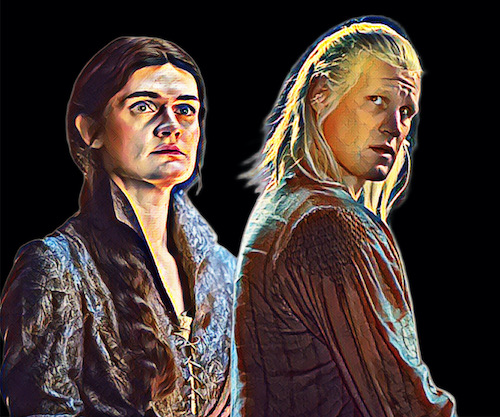
The humanity of villains and good guys
Before returning to scene by scene from the episode, it is worth highlighting a characteristic of House of the Dragon: it constantly humanizes all the characters, highlighting the vulnerability that provokes the action rather than the action itself. Although in Game of Thrones, everyone’s complexity was equally motivating their decisions, here this characteristic is exposed to the cube, kind of leaving an assessment of “weakness” more than evil or strength of everyone. This is extremely interesting.
Somehow, since the first season, the feeling of inability has been inherent to everyone and the true driver of every tragedy. Viserys I (Paddy Considine), who was not born to be king but was crowned due to various circumstances beyond his control, tried to be a good king and was seen as weak, confused, and the instigator of the Civil War. And it wasn’t his fault. As King, even though he elected Rhaenyra (Milly Alcock/Emma D’Arcy) as his heir due to the machinations of Otto Hightower (Rhys Iphans), to prevent Daemon from being the successor, after he made the decision, he never went back on his word, not even under enormous pressure. Viserys cared more about what people would say about his legacy than about the people, a common trait among all who are fighting for the Iron Throne, often feeling like a fake under the shadow of the popularity of his grandfather’s long reign.
Daemon, a kind of Prince Harry of Westeros, has the frustration of being the steppe and misunderstood. His arrogance and even petulance for being a Targaryen harm him, and we see that yes, he and Rhaenyra have a love and mutual influence that makes the two unique.
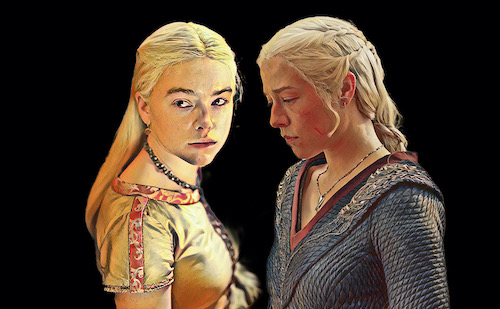
Rhaenyra feels inadequate for being a woman, not that she agrees with it, but aware that it is an obstacle to being taken seriously. As she moved away from her father when he married Alicent Hightower (Emily Carey/Olivia Cooke), she is insecure about Viserys’ decision for her, something that Daemon fueled by remembering the truth: she was only chosen as successor to remove him from the throne. We can follow!
Aegon II (Tom Glynn-Carey), spectacular, in fact, is the fool who wasn’t even trained for a blow that his grandfather would always give in time, with a mother indifferent to him, a jealous brother, and the shadow of his name. After all, Aegon the Conqueror is the greatest Targaryen legend, and he, his second name, is the opposite in everything. Having him try to wear his predecessor’s armor (too big for him, a sensational metaphor) only for Larys Strong (Matthew Needham) to prevent what everyone wanted – for the King to go into battle – was incredible.
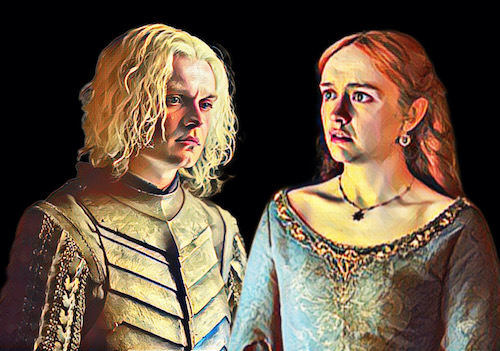
Alicent, the confused and intellectually challenged one, who always contributed to the conflict both by trying to “be good” and by supporting the Hightowers, is always the symbol of what the series highlights. Used shamelessly by her father, she has no leadership, no security, and no voice. Her envy of Rhaenyra is overwhelming because her friend/stepdaughter symbolizes and has everything she doesn’t have: entitlement, love, admiration, purpose, intelligence, and determination. If we remember that the first scene of the two shows that Alicent is literally “everything to the letter” and Rhaenyra is a page-turner, we don’t need to delve deeper between them. Alicent’s weakness has always been glaring.
Aemond is also the boy who was humiliated by his nephews and his brother, the Targaryen who didn’t yet have a dragon, who is also the one who suffers from “Harry syndrome”, and is the secondary one who no one cares about. Like her brothers, she is also vulnerable because Alicent is a terrible mother (distant, aggressive) and therefore uses aggression as a shield.

And finally, we have the hateful Ser Criston Cole (Fabien Frankel), a knight of simple and foreign origin, something that is always thrown in his face by men of noble lineage, like Daemon and now Gwayne Hightower (Freddie Fox). Cole rose on the merit of timing, political alliance, and fighting skill, but when he was treated as inferior by Rhaenyra, he became a monster.
Yes, Cole’s unrealistic proposal for the princess to run away with him came from the heart, but even more so from being where his blood wouldn’t allow it: in the position of a noblewoman’s consort. By denying him, Rhaenyra only made it even clearer to the knight that he would never be accepted by the elite and that is what he sees in her figure, social rejection. Meanwhile, it is men who reject him, not women.
Criston Cole, when he is not in public, suffers from the anxiety of having to prove himself as a strategist, as a knight, and worthy of being where he is, and we see that even he has his doubts.

In Dragonstone we see that even the twins Rhaena (Phoebe Campbell) and Baela (Bethany Antonia) have their conflicts, with Rhaena not understanding the great trust that her stepmother/aunt placed on her shoulders by leaving her with the responsibility of taking care of the Targaryen heirs. She only sees Baela gaining space and prestige by flying with Moondance while she has to stay behind. In this case, even Jacaerys Velaryon (Harry Collett) is jealous. He (aware of being a bastard) also has his insecurities and is hurt by his increasingly protective mother. Let’s go back to the episode.
Rhaenyra’s leadership questions and an encounter outside the pages of the original
Neither Rhaenyra nor Aegon yet have the trust of their Councils, ignored, questioned and almost ridiculed in attempts to resolve the conflict. Even with two children murdered on both sides, Rhaenyra still wants diplomacy and because she is a woman, not because she wants Peace, she is practically ignored by everyone. Not even Baela obeys her.

Aegon, who wants war, has a Council wanting to avoid a conflict and is listened to because he is a man, but manipulated and ignored because he is a boy and the second option. However, he has everyone’s obedience.
Rhaenys (Eve Best) admires her cousin/daughter-in-law more every day because she understands her frustrations and witnesses her genuine commitment to being “Queen”, not just wearing the crown. She and Corlys (Steve Touissant) will be the next indirect victims of this conflict and it is exciting to see that if there was time, the two would be great partners.
The Crown has an immediate isolating effect and Rhaenyra can only be vulnerable without judgment when she is with Rhaenys. The proposal that the “mothers” try to take control of the situation sounded ridiculous and foolish, especially after the tragic deaths on both sides. What made up for it was that the writers had to invent the impossible to unite Alicent and Rhaenyra in a scene well before what would happen and the actresses did the job.

History marked a Rhaenyra wracked by grief and sorrow at having lost her children, but the series shows that this sadness did not paralyze her at all. On the contrary, it motivated her to find an alternative to prevent more deaths.
With that, Rhaenyra disguises herself and takes the greatest risk of her life by going to find Alicent in King’s Landing, disguised as Septa. The dramatic proposal, as I mentioned, is saved by the actresses, but in terms of narrative, it consolidates their inability to govern.
Rhaenyra who misses the opportunity to kill her rival and strike an assertive blow to her position and Alicent who doesn’t capture her right away, ends the war. It’s a lot of incomprehension potency! But it gives us the chance to see how stupid Alicent really is because if she hadn’t already caught her father’s laugh when she wanted to sell that Viserys changed his mind, by insisting with Rhaenyra, he finally understood that she didn’t understand anything and that she messed up. It is irreversible and irreparable, as she says, because she will never be able to enter the council and apologize for the mistake or she would do so by proving her stupidity. She lets Rhaenyra escape, doubling down on her stupidity. On the other hand, Rhaenyra, who had all the signs that she was the chosen one (the white deer, Viserys’ determination), will now have more security (in theory) in her attitude. Too late, ladies. Too late.
The evil of whispers
The episode also changes the reaction of Helaena (Phia Saban) as devastated by her son’s death, giving Alicent forgiveness for being involved with Cole and accepting that the world is oppressive for little princes. An irrelevant scene, as we realize.
In King’s Landing, the dangerous Ulf (Tom Bennett) declares himself a Targaryen bastard, as the brother of Daemon and Viserys, but we see that he is a loudmouth, so… could he be lying?

And the two most poisonous strategists in Westeros, Mysaria (Sonoya Mizuno) and Larys use mental poison and logic to position themselves as Masters of Whispers, on opposite sides. Mysaria is more transparent with Rhaenyra: she wants the position to get revenge on the Hightowers because she is indebted to the queen who saved her life. Larys, the eternal provocateur of chaos, has left Alicent behind and is surrounding Aegon. It was Larys who took Otto out of the way and now planted the seed of discord between Aegon and Aemond, one that History had not fished out. the two dangerous men are already on the move and the result? Blood, a lot of blood visible…
Descubra mais sobre
Assine para receber nossas notícias mais recentes por e-mail.
 miscelana.com