
In 1947, actress Olivia de Havilland was amazed by the play The Heiress and became determined to make it into a movie. She fought for Paramount to buy the rights and hire William Wyler to direct it. It worked. Two years later, she won her second Oscar for Best Actress in the film of the same name.
The Heiress the film in Brazil changed the title) is an adaptation of Henry James‘ Washington Square. The book, which is one of the writer’s most popular, is one that he didn’t like. Inspired by a true story, it was released to close the trilogy of heiresses: Daisy Miller, The Portrait of a Lady, and Washington Square portray the complex reality of women in the 19th century, where they needed husbands to survive and, if they were lucky enough to have a fortune, they had to be aware of con artists looking for money. A difficult and toxic male world.

Like the other heroines, Catherine Slope is an heiress, but unlike the others, she is neither beautiful nor intelligent, living an Oedipine-like and pathological relationship with her father. If on the pages she struggles to have paternal love, in the author’s mind, she was the best thing in the whole story. In fact, the only one.
The adaptation of the book for the stage has simplified a plot that apparently has no twists and turns and was a huge success with Wendy Hiller as Catherine and Basil Rathbone as Dr. Sloper.
The story revolves around the ‘dull’ Catherine (De Havilland), the only daughter of the millionaire doctor (Ralph Richardson, who played the role in London) who rejects her because his wife died in childbirth. Always trying to please him, but without success, she is 17 years old and begins to be courted by a very handsome young man, Morris Townsend (in the film, Montgomery Clitf), but who Dr. Slope considers only a gold digger.
To test him, Catherine’s father imposes several restrictions and even distances himself, but she seems to be completely in love (and he, although somewhat uncertain, remains firm). When he finally puts the final test on the table that demands proof of love above matter (to marry Morris, she will be disinherited), Morris backs off, turning Catherine into a spiteful and cynical woman.
Years later, with her father no longer alive, Morris courts her again, but, as the Brazilian spoiler title explains: it is too late.

The film is spectacular even today, even 75 years later. The details of the camera and acting are so significant that they directly influenced one of the greatest scholars of cinema, none other than Martin Scorsese.
The director drew inspiration from The Heiress when he made The Age of Innocence (of course!) and, more recently, Killers of the Flower Moon. “I was about eight years old, and it was a very, very powerful experience. My father took me to the movies and [we] watched it,” Scorcese shared in an interview. He modeled the main couple in his film on Morris Townsend (Montgomery Clift) and Catherine Sloper (Olivia de Havilland). “What’s interesting is, ultimately, how Catherine makes her decision at the end of the film… The question is: does he [Morris] really want her, or does he want her money? That’s the key,” he argues.
Scorcese also appreciates the subtlety of how Wyler showed that the Slopers’ entire fortune was actually a prison for them. And he draws another parallel with his film, comparing the decisions of the female characters. “[Catherine] does what she does. Now, at the end of the day, whether she’s right or wrong — in other words, whether she reads him correctly or incorrectly — is not important. She makes that change. She becomes strong. As she says to her father, ‘I have good teachers because you told me how not to love.’ It was very powerful. I always felt that Morris, the character played by Clift, when he came back, I don’t think he loved her. And Leo (DiCaprio) said, ‘Well, what if he did?’” he explained. “Even Lily Gladstone looks like Olivia de Havilland. There’s no doubt about it. She really does. Catherine is very strong and she doesn’t give up at that moment. I think Mollie is the strongest person in this film, played by Lily. Ultimately, she makes a decision. It’s [about] how far love goes, you know? And she holds on and holds on and holds on until she decides,” he concludes.

The parallels continue. Montgomery Clift, always a perfectionist, was chosen by William Wyler to replace Erroll Flynn precisely because the director knew that Clift would bring the necessary ambivalence to the role. The actor didn’t like his performance, but we can disagree with him, right?
And Leonardo Dicaprio is another fan. He’s been watching Clift’s work in The Heiress and also A Place in the Sun, which is also a tale of an ambitious man who marries for money. To create Ernest, Dicaprio mixed the two performances.
Returning to the 1949 classic, for William Wyler the suffocating tension of the house was “so exciting as a shootout, and possibly more exciting” and compared the plot to “gentle but forceful domestic warfare attacks”. Known precisely for knowing how to explore humanity in stagnant but toxic environments, critics consider that he captured the drama of domestic tyrannies perfectly. After all, Wyler is the master of psychological “armed battles” between characters.
On the personal side, biographers of the actress and the director also draw parallels. Olivia, who already had an Oscar and was a star, broke with Warner to have greater artistic freedom. In the 1940s, this required great daring. Wyler had also left MGM and created his own production company. Telling the story of a repressed and nullified person finding inner strength to form herself as an independent person was perfect for both of them. And Olivia really wanted to work with him, who was already considered one of the best directors of all time.
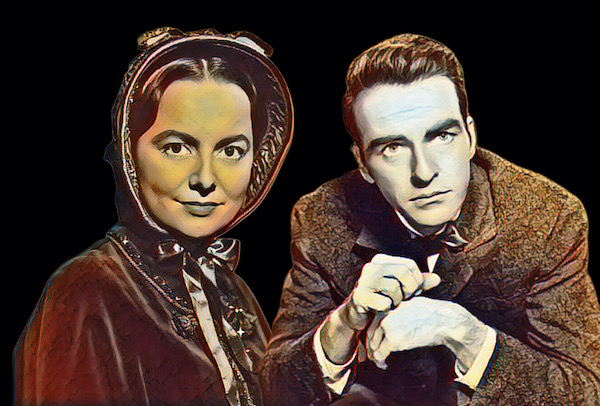
There are long studies of how Wyler communicates Catherine’s changes throughout the story. From not being able to admire herself in the mirror at the beginning until she addresses her father looking at him through his reflection, as well as her signature, the dramatic climb up the stairs at the end, when with each step she feels more empowered.
The stairs, by the way, give rise to several behind-the-scenes legends. Olivia, who was beautiful, struggled to play the unattractive Catherine Slope, abused and manipulated by everyone for much of the story. Wyler made her record the scene in which she is devastated after being abandoned more than 30 times, ordering her to fill her suitcase with books so that it would be heavier with each take. (Of course, the star and director fought), among other details.
One of the most praised decisions of the film was to bring Ralph Richardson to reprise the role he had in the London production. His ironic inflections, pauses, and small gestures are gigantic in manipulating and destroying Catherine’s confidence. He is not evil or cruel because he wants to see her suffer; he gets angry and suffers because he perceives a dangerous vulnerability in her. Until she hits back, like the good student she was.
The character I haven’t mentioned yet, the nosy and foolish aunt Lavinia, played by Miriam Hopkins, who projects herself onto her niece and encourages her to behave like the heroine of a love story, which couldn’t be further from reality, as Sloper sees it.
A behind-the-scenes “truth” that worked on screen was the fact that Montgomery Clift didn’t admire Olivia de Havilland, had problems with everyone, but achieved two things: one, being handsome and adored, he wasn’t an obvious antagonist. And the second, he wasn’t exactly sweet with his romantic interest.
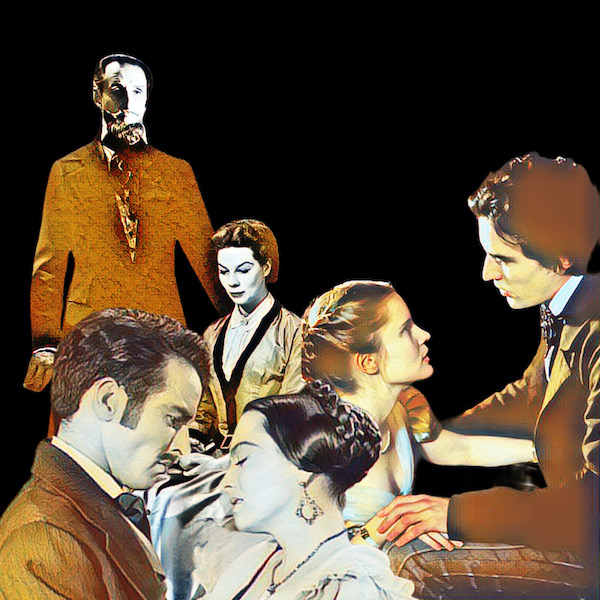
In the end, The Heiress manages to stay modern even when feminism has changed so many conventions. Today Catherine is seen as an example of a woman who breaks free from sexist expectations and makes decisions for herself, standing up to those who underestimated her. Without romantic illusions, but in control of herself. In the 1940s, she was seen as a vengeful and cold woman who destroyed the men who made her so unhappy. Clearly far from what Henry James had in mind when he created her in the late 1800s.
The Heiress was nominated for four Oscars and won four. It remains one of the best dramas of Hollywood’s golden years and, without a doubt, one of my favorites.
There was a remake in 1997, directed by Agnieszka Holland and starring Jennifer Jason Leigh, Albert Finney, Maggie Smith, and Ben Chaplin, but it didn’t have the same impact as William Wyler‘s work. Likewise, in 2012, Jessica Chastain starred in a revival on Broadway, but what everyone really remembers is The Heiress. One of the unforgettable classics.
Descubra mais sobre
Assine para receber nossas notícias mais recentes por e-mail.
 miscelana.com