
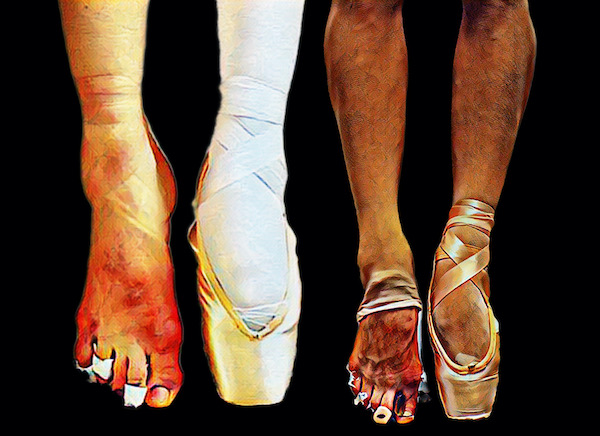
There are iconic images of ballet in Art: Edgar Degas’ paintings of ballerinas, his sculpture of Marie Van Goethem, La Petite Danseuse, and now, in the 21st century, the photograph “Megan LeCrone’s feet, soloist at NYCBallet.” You think you don’t know what it is, but I doubt it.
It is the photo that shows a ballerina’s injured foot next to another one wearing a pointe shoe, making clear the duality between the beauty of ballet and the physical effort involved, becoming a powerful symbol of this art.
The image shows Megan LeCrone‘s feet, captured by Henry Leutwyler backstage at the New York City Ballet, and was first published in 2012 in the book Ballet. Its influence is so significant that it inspired other works, and the Étoile series parodied it on its first season poster. Remember now?

Since it appeared on social media in 2012, the image has been widely shared over the last decade; it is the visual icon of contemporary ballet.
The story behind this image is as interesting as it is, and has inspired several artists and photographers to explore similar themes. And, as expected, it has also generated controversy.
One photo, two worlds
Leutwyler had already built a solid career as a portrait and still life photographer when he decided to delve into the daily life of the New York City Ballet. For months, he wandered backstage at the company, seeking to capture what the public does not see. “I wanted to document the backstage of the ballet with the same precision that I would have in a scientific laboratory,” he said in an interview.
The image of LeCrone’s feet was neither posed nor planned—it came during a moment of rest, when the ballerina was taking off one of her shoes. One of her feet, wearing a perfect pointe shoe, and the other bare, injured, covered in marks, calluses, and bruises, is the best image of what remains hidden from the public.
Who is Megan LeCrone?
Megan LeCrone is one of the most expressive soloists of the New York City Ballet (NYCB), recognized both for her crystal-clear technique and the dramatic intensity she brings to the stage. Born in Winston-Salem, North Carolina, she began dancing as a child and quickly stood out for her discipline and passion for classical ballet. She joined the company in 2002.

Megan’s career was not without its difficulties. She suffered a series of injuries early in her career, which kept her off the stage for years. However, her resilience brought her back with a vengeance—and in 2013, she was promoted to soloist. Since then, her repertoire has grown and includes leading roles in choreographies by George Balanchine, Jerome Robbins and contemporary choreographers.
Discreet and technical, she never sought stardom outside the stage. The photo, however, catapulted her image beyond the world of dance, even if unintentionally. For years, the ballerina preferred not to comment on the repercussions, but when she does speak, she acknowledges the sacrifices of dance, but does not consider them to be so relevant.
The impact and viralization
The image circulated intensely after the publication of Ballet, but gained viral traction between 2015 and 2017, with the strengthening of social networks such as Instagram and Pinterest. Several international media outlets published articles highlighting the contrast between the glamour of the ballet shoe and the wounds of reality. Users shared the photo with phrases such as “art is sacrifice” or “what you don’t see on stage”.

The raw simplicity of the image turned it into a lasting symbol — not only of ballet, but of the idea that every form of aesthetic excellence requires hidden effort. It was used in contexts as diverse as performance psychology classes, fashion campaigns and editorials about femininity.
Reinterpretations and controversies
The success of the photograph also generated copies. In 2015, the American photographer Tyler Shields published a virtually identical image: a ballerina on pointe with one foot shod and the other bare, equally injured. Leutwyler accused Shields of plagiarism, which sparked a debate about appropriation and authorship in the artistic world.
In an Instagram post, the Swiss photographer criticized the narrative presented by Shields, who claimed to have conceived the idea for the photograph years before. To Leutwyler, the original image was a spontaneous documentary record, while Shields’ version appeared to be staged.
Although Shields’ photograph was widely criticized for its similarity to the original, it revealed how visually recognizable the concept had become. There is no record that any Leutwyler has initiated formal legal action against Shields, and the dispute has remained in the public and artistic sphere, with no known judicial resolution. In any case, the aesthetic “one foot in beauty, the other in pain” has become part of an iconographic repertoire that is easily associated with the world of dance and its backstage.
The return of the image — now in the form of fiction
More than a decade after its creation, LeCrone’s image resurfaces — or rather, inspires — the poster for the Étoile series. Aimed at portraying the competitive and emotional universe of professional ballet, Étoile uses a clear visual reinterpretation of Leutwyler’s work to announce its narrative proposal: to reveal what happens beyond perfection.
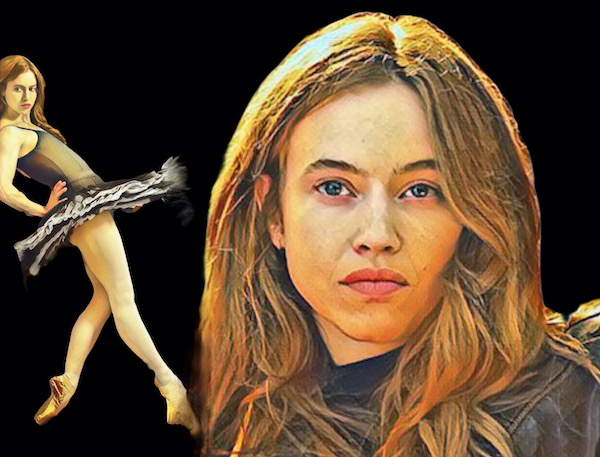
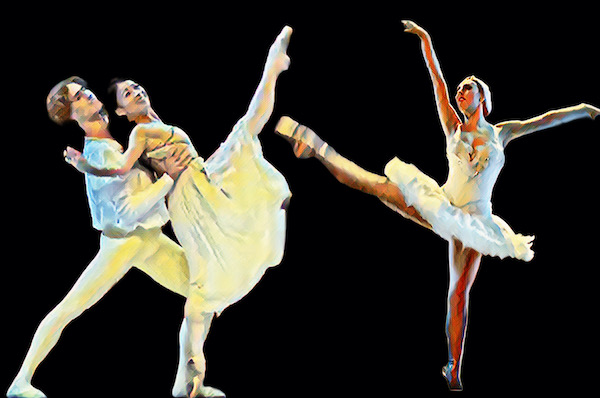
Although the poster for the series does not literally use the same photograph, the concept is almost identical. A close-up of a ballerina’s feet repeats the visual gesture of dichotomy: rehearsed beauty on one side, real rawness on the other. The aesthetic choice indicates that the series intends to move away from the idealized romanticism of dance and delve into its most human and painful layers.
The body as the stage for truth
The permanence of Leutwyler’s image and its resurgence in a new context demonstrate the power of documentary photography to capture lasting symbols. Ballet — for centuries associated with lightness, invisible discipline and controlled aesthetics — found a new emblem in this record. A reminder that each sublime gesture carries with it deep marks.

More than a photo about dance, this is a portrait of what the body endures to keep an illusion alive. Megan LeCrone, without knowing it, turned the face—or rather, the feet—of a truth that many avoided facing.
And perhaps, for this reason, her image still circulates, inspires, moves, and now returns, in the form of fiction. Because there is something in that silent composition that no show can hide forever.
Descubra mais sobre
Assine para receber nossas notícias mais recentes por e-mail.
 miscelana.com