
Before Tom Cruise was sprinting across rooftops, jumping out of planes, or scaling skyscrapers, Mission: Impossible was already a cultural phenomenon—and much of its impact came from its music. The theme composed by Lalo Schifrin in 1966 is not just one of the most iconic pieces in TV and film history. It’s a score that redefined the sound of pop espionage, challenged rhythmic norms, and became an instant anthem of tension, intelligence, and action. The Mission: Impossible theme doesn’t just sound suspenseful and like a machine in motion, like mental gears turning with precision.
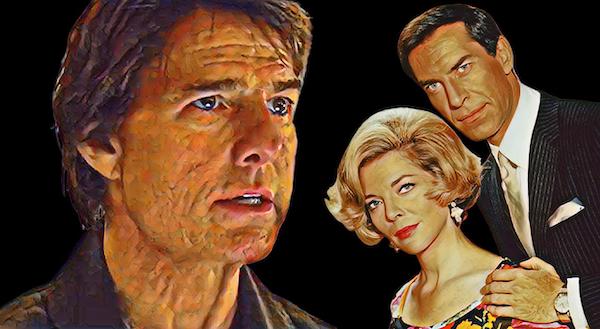
Lalo Schifrin and the Mission to Create the Impossible
Born in Buenos Aires, maestro and pianist Lalo Schifrin was already well-known in jazz and film music circles when he was approached by Mission: Impossible creator Bruce Geller to compose the series’ soundtrack. The brief was clear: they wanted something modern, striking, and unlike any spy music before it. The show’s universe was high-tech for its time, with agents skilled in disguise, precision operations, and almost mathematical plots. The music had to reflect that spirit.
Schifrin responded with a piece in 5/4 time—a bold structural choice, especially for television. The irregular meter creates a subtle sense of imbalance, as if something is always one step ahead of the listener. “I used 5/4 because I wanted a rhythm that suggested something out of the ordinary, something that wouldn’t resolve predictably,” Schifrin later explained. The main theme shifts between 5/4 and 6/8 passages, combining explosive brass, bongos, syncopated bass lines, and dramatic pauses. In short, this was thinking-man’s spy music.
Schifrin also composed numerous incidental cues for the show, many derived from or fragmented versions of the main theme, creating a consistent musical language that was groundbreaking for 1960s television. It wasn’t just a catchy opening—it was a sonic signature for the IMF universe.
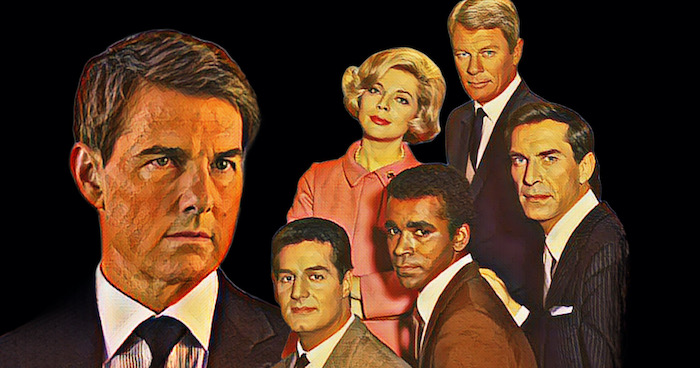
Recognition and Legacy
The theme earned Grammy and Emmy nominations and instantly entered the pantheon of the most recognizable themes in pop culture, alongside The Twilight Zone, James Bond, and Batman. The series’ intro—with agent headshots cut between clips of action, all to the pounding beat of Schifrin’s music—set a visual and auditory template that would be emulated for decades.
Schifrin’s sound was so distinctive that it survived the passage of time and the franchise’s cinematic rebirth. Even with new scores composed for each film, the original theme was never discarded—only reimagined. That makes it not just a hit, but a rare case of musical longevity in Hollywood.
Reinvention on the Big Screen: Cruise, Action, and Remix
When Tom Cruise and director Brian De Palma launched the Mission: Impossible movie franchise in 1996, they had a double mission: modernize the brand and honor its legacy. The film’s score was composed by Danny Elfman, known for his collaborations with Tim Burton, but the studio knew fans expected to hear those famous notes. The solution was to commission a contemporary version by two members of the world’s biggest band: Larry Mullen Jr. and Adam Clayton of U2.
Their 1996 version modernized the theme with electronic beats, loops, synthesizers, and a driving bassline, turning it into a danceable remix that became a hit in its own right. Released as a single, the track topped charts worldwide and came with a sleek music video intercutting film clips with a minimalist studio performance. For a new generation unfamiliar with the 1960s series, the theme now sounded fresh, modern, and cool—yet unmistakably faithful to Schifrin’s melody.

The Evolving Scores: From Zimmer to Balfe
Each installment of the film series brought in a new composer, and with them, a new take on the theme. Generally, the main melody remained intact, but the arrangements, textures, and instrumentation varied widely.
- Mission: Impossible II (2000) featured a score by Hans Zimmer, who gave the theme a rock edge with distorted guitars, heavy percussion, and even tribal elements. Zimmer also composed dramatic choral cues that matched the operatic style of director John Woo.
- Mission: Impossible III (2006) brought in Michael Giacchino, who paid tribute to Schifrin with modernized yet faithful orchestral arrangements. Giacchino also composed emotional motifs for Ethan Hunt’s personal life, which was becoming more central to the narrative.
- In Ghost Protocol (2011), Giacchino returned and gave the score more rhythmic intensity, especially in scenes set in Dubai and the Kremlin, with fragmented versions of the theme punctuating high-energy sequences.
- Rogue Nation (2015) and Fallout (2018) brought in Joe Kraemer and later Lorne Balfe, respectively. Balfe, a Hans Zimmer protégé, elevated the theme with full symphonic power, choral elements, and deep rhythmic force that mirrored the franchise’s epic growth.
- In Dead Reckoning – Part One (2023), Balfe further expanded the theme with piano variations, escalating tension, and subtle electronic layers, setting the stage for an emotional and grand finale (which, ironically, remains delayed due to production issues).

Why It Still Works
The theme’s longevity lies in its melodic and rhythmic elasticity. The main melody is simple yet sophisticated; the structure is memorable; the 5/4 meter still feels unpredictable and exciting. It can be orchestrated, remixed, deconstructed, or merely hinted at—and still be instantly recognizable.
Moreover, the Mission: Impossible theme represents something rare: an instant sonic identity. While other franchises regularly change musical styles, tones, and composers, Mission: Impossible has anchored itself in a sound that serves as its calling card. With each new installment, audiences expect to hear those familiar beats—it’s part of the ritual, like the lit fuse in the opening or the tape that self-destructs.

Mission Accomplished
Across more than five decades, Lalo Schifrin’s theme has transcended generations, genres, and formats without ever losing its impact. It’s studied in music schools, remixed in clubs, referenced in comedies, and still thrills audiences in theaters. It is, simultaneously, a Cold War artifact and a symbol of modern cinematic spectacle.
If the franchise continues beyond Tom Cruise, we don’t yet know who will lead the IMF. But one thing is certain: the musical mission is safe. Because all it takes is a single note, and everyone knows the action is about to begin.
Descubra mais sobre
Assine para receber nossas notícias mais recentes por e-mail.
 miscelana.com