
On May 31, 2025, Clint Eastwood turned 95 — an impressive milestone not only for his physical longevity but also for the enduring creativity of one of the most iconic names in film history. Actor, director, producer, composer, former mayor, and cultural icon, Eastwood is a figure who has spanned decades, reinvented himself, defied conventions, and accumulated an impressive list of awards, controversies, and accomplishments. Far from announcing retirement, he continues to plan new films — as if time itself followed his rhythm.
The Beginning: From Western Heartthrob to Masculine Archetype
Clinton Eastwood Jr. was born in 1930 in San Francisco, California, and grew up during the Great Depression. After serving in the Army, he tried his luck in Hollywood, landing minor roles until he rose to fame as the laconic cowboy in the TV series Rawhide. But it was in Italy, under the direction of Sergio Leone, that he became an icon: A Fistful of Dollars (1964), For a Few Dollars More (1965), and the simply perfect The Good, the Bad and the Ugly (1966) launched the so-called “spaghetti western” and redefined the genre with their gritty aesthetics, stylized violence, and moral ambiguity.
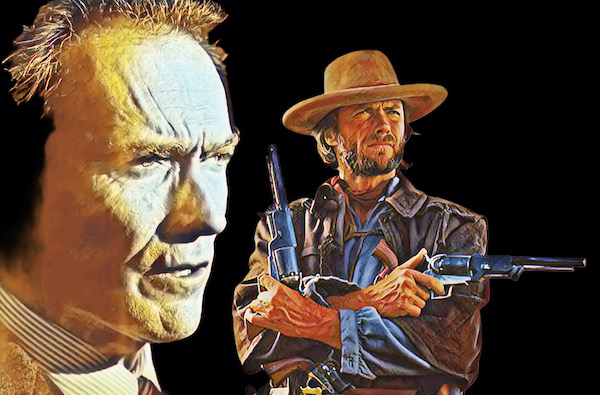
Eastwood embodied “the man with no name” — impassive, cynical, relentless — creating a new masculine archetype. This persona was solidified in the 1970s with the Dirty Harry franchise, in which he played police inspector Harry Callahan, a symbol of brutal justice in times of urban crisis and political paranoia. The line “Do you feel lucky, punk?” became part of American pop mythology, and Eastwood, a controversial emblem of virility and authority.

The Turning Point: From Actor to Acclaimed Auteur
Many expected Clint Eastwood to be just another aging action star, but he defied expectations. Starting in the 1980s, he solidified his career as a director — and not just any director. His films began to show a rare maturity in Hollywood, with a dark, economical, reflective lens on violence, honor, redemption, and aging.
He directed works like Bird (1988), about jazz musician Charlie Parker, and Unforgiven (1992), his twilight western that deconstructs the myths of the genre and won four Oscars, including Best Picture, Best Supporting Actor (Gene Hackman), and Best Director. It marked Eastwood’s consecration as a serious and sophisticated filmmaker.
In the 2000s, he saw a second wave of acclaim with Mystic River (2003), Million Dollar Baby (2004), Letters from Iwo Jima (2006), and Gran Torino (2008). Always drawn to themes like guilt, heroism, and national memory, Eastwood managed to adapt his austere style to the melancholy of the 21st century. He has received over 40 Oscar nominations throughout his career and won 5 statues, including two for Best Director.
Controversies: Conservatism, Guns, and Trump
Despite his artistic stature, Clint Eastwood has never been a consensus figure. His political views have placed him at the center of many controversies. In 2012, speaking at the Republican National Convention, he addressed an empty chair as if it were Barack Obama — a gesture widely mocked and interpreted as either a senile delusion or a symbol of outdated conservatism.
Eastwood’s positions, however, are complex: he has identified as a libertarian and has supported both Republican and Democratic candidates. In 2016, he sparked outrage by downplaying racism in interviews and showing sympathy for Donald Trump. Later, while criticizing Trump’s behavior, he said he preferred Trump’s economic policies over Biden’s.
He has been accused of glorifying violence and vigilantism, especially during the Dirty Harry era, and of promoting outdated views on masculinity. Yet his more recent works — such as American Sniper (2014), Sully (2016), and Richard Jewell (2019) — are more ambiguous, offering human portraits of controversial and marginalized figures.
Late Reinvention and the Body as Language
Even past the age of 80, Eastwood has not only continued directing but also acting. In Gran Torino, he played a racist war veteran who develops an unexpected relationship with his immigrant neighbors — a role that seemed like a reckoning with his own cinematic persona. In Cry Macho (2021), at age 91, he starred in an unusual western, more contemplative and disillusioned.
His body, once a symbol of physical strength, has become a vessel for fragility, exhaustion, and the passage of time. Few artists have embodied aging so authentically, without hiding its marks. Eastwood’s directorial style has also aged with grace: long takes, clean editing, measured pacing, understated soundtracks — a cinema of restraint, of listening, of moral chronicles.
Awards and Recognition
Eastwood is one of the few artists to have won both Best Picture and Best Director twice at the Oscars. He has also received the honorary Palme d’Or at Cannes, the Golden Lion in Venice, the César Award in France, the National Medal of Arts in the U.S., and tributes from the European Film Academy.
Additionally, he remains involved in the soundtracks of many of his films — he is a jazz pianist and has composed original music for works such as Million Dollar Baby and Gran Torino. A true artist in the classical sense.

At 95, No Signs of Retirement
Even approaching a century of life, Clint Eastwood shows no signs of stopping. In 2024, he released Juror #2, a courtroom thriller starring Nicholas Hoult and Toni Collette. Rumors suggested it might be his final film, but Eastwood himself avoids such declarations. In recent interviews, he stated: “As long as I feel useful and have something to say, I’ll keep going.” Apparently, he’s already working on a new film. Considering his swift production process — rarely taking more than a few months to shoot and edit — we may very well see another Eastwood film by 2026.
His determination perhaps sums up his trajectory: a man who has always sought something to say about America, violence, time, silence, justice, and solitude. At times controversial, nearly always relevant, Clint Eastwood is one of the last living legends of a Hollywood that no longer exists, but that he helped reinvent — as a leading man, as a filmmaker, and as a haunting presence.
At 95, he still challenges the myth of retirement. And perhaps that’s the most fascinating thing: Eastwood, until the end, refuses to be a relic. He wants to be present. He wants to be in action. He wants to keep filming. And, as long as the world allows, he will.
Descubra mais sobre
Assine para receber nossas notícias mais recentes por e-mail.
 miscelana.com