
More than once, the turbulent relationship between brothers Noel and Liam Gallagher has been compared to that of Princes William and Harry—bizarre as it may sound. The two went 15 years without speaking face to face (though they traded barbs in interviews and on social media), in a rift that broke the hearts of fans around the world. And 2025 marks the return of their band, Oasis, in a billion-dollar world tour that proves money, at some point, spoke louder than resentment. And we’re the ones who win.

After all, few bands have managed to capture the spirit of their time with as much intensity as Oasis. Born in Manchester in the early 1990s, the group led by the explosive brothers Liam and Noel Gallagher became synonymous with a golden age of British rock — marked by arrogance, irreverence, massive choruses, and a confidence that bordered on messianic delusion. While American grunge dove into angst, Oasis looked upward — to the Beatles, to the sky — and asked: “Don’t you know you might find / a better place to play?”
Their debut album, Definitely Maybe (1994), already showcased the band’s power, but it was the second album, (What’s the Story) Morning Glory? (1995), which turned them into a global phenomenon. With hits like “Wonderwall”, “Don’t Look Back in Anger”, “Some Might Say”, and “Champagne Supernova“, Oasis became the soundtrack of post-Thatcher British youth — and soon, of young people worldwide. Britpop had found its king, and the Gallagher’s swagger was a cultural manifesto: to be loud, to be big, to be invincible.
But behind the sunny guitars and defiant confidence, a time bomb ticked. The Gallagher brothers were combustible opposites — Noel, the melodic and sarcastic brain; Liam, the instinctive, charismatic, chaotic voice. Their fights became almost as legendary as their songs. For years, interviews were verbal battlegrounds, tours played out like cold wars, and backstage areas were sites of explosive drama.

The end came in 2009, when a fight between the brothers before a Paris show culminated in what Noel called “a point of no return.” He announced his departure from the band, abruptly ending Oasis without farewell or closure. Just silence — and public resentment. Liam carried on with Beady Eye, then a solo career, while Noel launched High Flying Birds. Both released good records, but they carried the weight of what had been lost. Because, despite their individual talents, it was together that they created a seismic impact.
And then, over the next decade, time worked its strange magic. Distance, age (relatively speaking), constant media pressure, and fan insistence. Every cryptic tweet from Liam was read as a possible sign of reconciliation. Rumors of a reunion became an annual tradition. And now, with the official confirmation of the Oasis Live ’25 world tour, the question is no longer if — but what it means.

More than a nostalgic celebration, the return of Oasis is symbolic. It marks not only the reunion of two estranged brothers but also a generation’s reconnection with its youth. Seeing Liam and Noel on the same stage is, for many, like reopening a long-guarded letter — a plunge into raw emotions, lyrics that still hurt or heal, choruses that never lost their breath.
It’s also a reminder that rock music still holds cultural and emotional weight. In an age of algorithms and disposable tracks, Oasis stands for a time when music was a collective ritual, a public catharsis, and a shared identity. A band that united crowds around simple yet immense anthems — built on three chords and a wide-open heart.
And finally, there’s beauty in the imperfection of their journey. Oasis was never a “perfect” band. It was messy, impulsive, flawed — and perhaps because of that, deeply human. If they return now, with wrinkles and scars and all, they return more real than ever. And that, in the end, might be the greatest gift to their fans: not just the sound that shaped their lives, but proof that even the most broken bonds can be mended. To the sound of a dirty guitar and a chorus shouted at full volume.
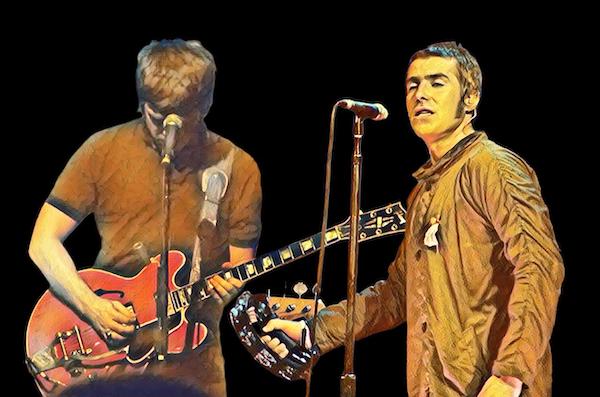
Oasis in Brazil: Tour Dates, Expectations, and History
The long-awaited Oasis Live ’25 world tour will bring the band back to Brazil after a 16-year absence. Concerts are scheduled for November 22 and 23, 2025, at Estádio MorumBIS in São Paulo.
This will mark the band’s fifth visit to Brazil. Their previous appearances were:
- 1998 – Be Here Now tour, with shows in São Paulo and Rio de Janeiro.
- 2001 – Rock in Rio performance.
- 2006 – Don’t Believe the Truth tour.
- 2009 – Dig Out Your Soul tour, with performances in São Paulo, Rio de Janeiro, Brasília, and Curitiba. I attended one of those shows in Rio and witnessed the negative energy between the two, who didn’t interact on stage—a prelude to their breakup just a few months later.
The band’s return to Brazil is a historic moment, closing out the world tour on Brazilian soil and reigniting the passion of fans who waited over a decade for this.

But What If They Fight Again? Could the Tour Be Canceled?
This is the question every Oasis fan is asking — and not without reason. The infamous feuds between Liam and Noel Gallagher are almost as legendary as the band itself. Throughout Oasis’ history, backstage arguments, public insults, trashed dressing rooms, and last-minute cancellations were almost routine. In 2009, as we know, the band effectively ended behind the scenes, after a brutal fight before a gig.
So yes: there is a real risk of tension during the tour — and even cancellations — if things sour between the brothers again. However, there are several reasons to believe this time might be different:
- Bulletproof contracts – Reunions of this scale usually come with heavily detailed contracts that include stiff penalties for walkouts, delays, or cancellations. Money and legal obligations are strong incentives to stay professional — even if the love isn’t back.
- Separate logistics – Sources close to production say Liam and Noel will maintain separate dressing rooms, routines, and even flights, precisely to avoid constant contact and reigniting old sparks. The idea is to meet only on stage — where they’ve always worked best.
- Different motivations – This time, both seem to have more conscious motivations. Noel, always the holdout, appears to have accepted the symbolic and commercial value of reuniting. Liam, who has publicly pushed for it for years, knows this is his chance to cement a legacy. They may not love each other — but they understand what Oasis represents.
- Age and time – Both are now in their early 50s. No longer boys driven by ego and booze. And while their tempers may still be unpredictable, there are signs they know this might be their last real chance at a musical — and historical — reconciliation.
Should any public argument erupt, the tour may continue with some adjustments. The nightmare scenario — a full cancellation — would likely only occur in an extreme falling out. In such a case, contracts mandate refunds and major financial penalties.
For now, Noel remains silent, Liam jokes on social media, and the general mood is cautious anticipation. Fans are torn between hoping it all goes smoothly… and secretly wanting an epic onstage argument to go viral. And who knows, maybe a new album will follow the tour?
Descubra mais sobre
Assine para receber nossas notícias mais recentes por e-mail.
 miscelana.com