
In The Gilded Age, Marian Brook is often presented as the story’s moral center — a young woman who arrives in New York with little money, no social power, and an almost radical belief that marriage should not be her only destiny. But across the seasons, Marian’s journey becomes far more complex, shaped by heartbreak, social pressure, and the difficult realization that independence comes at a cost.
Supposedly, Marian is the series’s leading lady, positioned as a counterweight to more ambiguous figures such as Bertha Russell. She embodies the conviction of a woman trying to remain strong in a society where a “good” marriage — not necessarily a happy one — was considered a woman’s ultimate goal.
In the original synopsis of Season 1, Marian was introduced as the main heroine: a charming, principled young woman determined to do something meaningful with her life. As the story progresses, however, we encounter a Marian who still holds those ideals but has clearly been transformed by experience.

Created by Julian Fellowes, Marian is not a titled heiress like Lady Mary Crawley from Downton Abbey. She is a small-town girl whose life collapses when her father dies, leaving her with only thirty dollars and no prospects. With nowhere else to go, she moves in with two aunts she has never met, beginning her uneasy initiation into New York high society.
Literary parallels place Marian closer to Henry James than to Edith Wharton, particularly echoing Isabel Archer from The Portrait of a Lady. Like Isabel, Marian is intelligent, curious, and idealistic, seeking independence while resisting conventional marriage. Yet, as with James’s heroine, her choices lead not to freedom alone but to painful lessons about society’s limits.
Another James novel, Washington Square, also mirrors her trajectory. Its heroine, Catherine Sloper, falls for Morris Townsend, a man strikingly similar to Tom Raikes. Raikes’s eventual betrayal and marriage to another woman shatter Marian emotionally but also force her to mature.
Marian’s evolution throughout the series has been a joy to witness. Her confrontations with her aunt Agnes, conservative and opinionated, are inevitable, but what’s interesting is that, over time, Marian listens. She begins to understand society’s logic and even tries, reluctantly, to follow her aunt’s advice.

Throughout the series, Marian’s evolution has been subtle but significant. Her clashes with her conservative aunt Agnes are inevitable, yet over time she begins to listen, gradually learning the rules of the society she once resisted. The timid, almost provincial young woman of Season 1 becomes more self-possessed, though never entirely comfortable within elite circles.
Her past hardships are easy to overlook. Marian lost her mother early and endured life with an alcoholic father whose financial irresponsibility left her vulnerable. In New York, she finally experiences stability and affection from her aunts and cousin Oscar, but that security comes with expectations.
Marian’s modern outlook is reinforced by her friendship with Peggy Scott, whose resilience broadens Marian’s understanding of privilege, race, and ambition. She still longs to marry for love — a radical notion for the era —, yet she now recognizes the dangers of impulsive attachment after her near-elopement with Raikes and her broken engagement to the widower Dashiell Montgomery.
Her growing feelings for Larry Russell have become one of the show’s central romantic tensions. Their relationship, however, faces formidable obstacles: Marian’s lack of fortune, the expectations of strategic marriages, and above all, Bertha Russell’s fierce ambition for her son. Love alone may not be enough to overcome these forces.
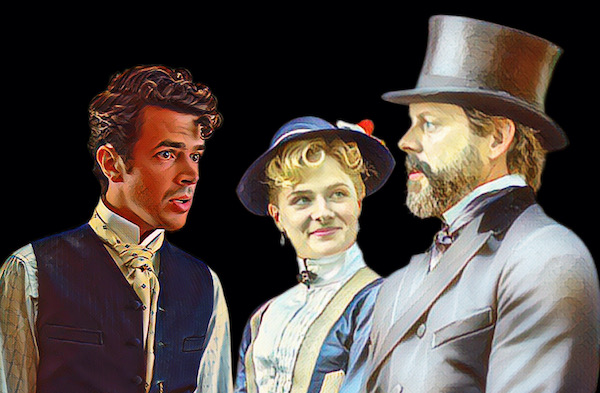
Aware that she cannot afford another scandal, Marian becomes increasingly cautious and insecure about Larry’s intentions. He supports her ambitions, including her desire to teach, but remains financially dependent on his parents and, therefore, subject to their control.
Fans remain divided over Marian’s financial future. Some speculate that her father secretly left valuable railroad stocks, potentially making her an heiress; others believe she truly has nothing. If the former proves true, it could dramatically alter her position in society, though Bertha Russell may still consider her unworthy.
Several narrative possibilities could resolve the tension: Marian discovering hidden wealth, Larry gaining independence through business success, or both. Yet even such changes would not guarantee acceptance within the rigid hierarchy of Gilded Age society.
Episode synopses suggest that Marian will continue to struggle with anxiety about her future, particularly as major social events unfold around her. Whether she ultimately confronts Bertha directly remains uncertain.

Analysis: How Has Marian Brook Changed in The Gilded Age?
Marian’s arc is ultimately a quiet but profound process of maturation. She begins as a romantic idealist and gradually becomes a woman shaped by loss, caution, and hard-won self-knowledge. Her mistakes do not destroy her belief in love, but they teach her that autonomy and dignity must come first.
Through Peggy, she encounters a broader America beyond her sheltered upbringing, gaining insight into realities Agnes cannot teach her. If Marian once symbolized promise, she now represents the difficult path toward self-determination in a world resistant to female independence.
Perhaps her greatest transformation lies in her persistence: she continues to seek purpose even when society offers her few options. Unlike Bertha’s overt ambition or Agnes’s rigid conservatism, Marian’s strength is quiet, internal, and deeply human.

In this way, she emerges as one of The Gilded Age’s most intriguing figures, not because she dominates the narrative, but because she embodies the tension between personal freedom and social constraint. Her story is less about triumph than about endurance, making her paradoxically one of the show’s most modern characters.
Descubra mais sobre
Assine para receber nossas notícias mais recentes por e-mail.
 miscelana.com